"We cannot pay for the deficiencies": Adif workers stand up to Puente
Work pressure, lack of staff, of maintenance and the LZB failure, the main causes of the accident according to the employees
-
CAT -
CAST
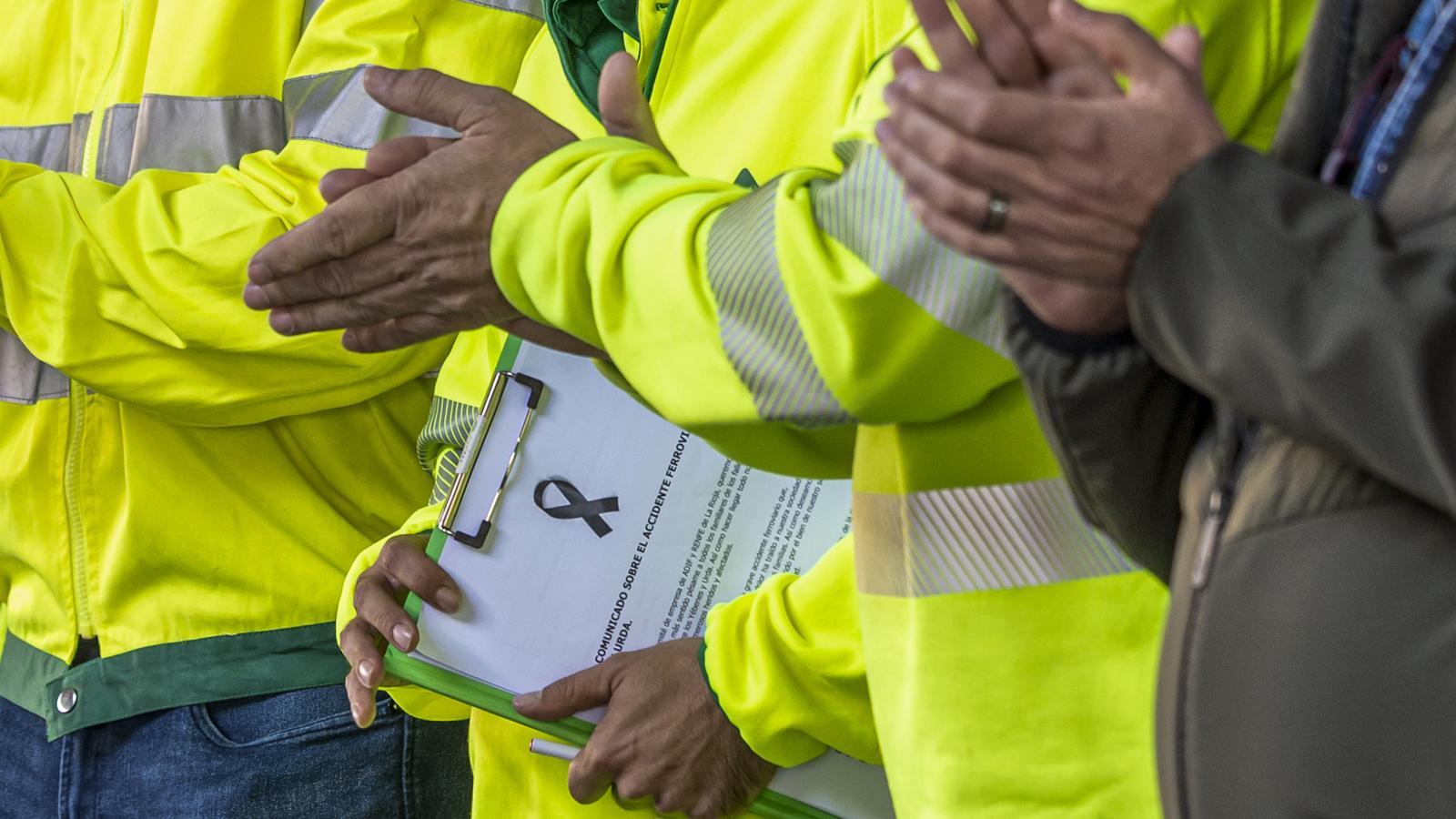
Barcelona / MadridThe tragic railway accident in Urda, in the province of Toledo, which has already left about seventy fatalities, has sparked unrest among railway workers, controllers, and train drivers, especially after this Wednesday the Minister of Transport, Óscar Puente, pointed directly to the "human error" of an operator in the Adif control center room.
"The responsibility does not lie with any worker," CCOO said in a statement, and has also called for the "immediate" dismissal of Puente and to subject the accident to a "rigorous investigation" that clarifies the facts and establishes responsibilities. In the same vein, the UGT has spoken out, considering it "inadmissible" that the ministry has focused on the workers' actions before "all the circumstances" surrounding this event. "Adif's deficiencies cannot be paid for by those who support the railway with their daily work," they state from the UGT. For his part, the minister has himself requested to appear before the Permanent Delegation of Congress.
Meanwhile, the leaking of the train drivers' audio recordings with the control center has left employees and unions deeply affected and upset: "Railway company workers are professionals and their privacy must be ensured, not thrown to public mockery, and even less so in such a complex, delicate, and serious event as a train accident in which people have died," conclude representatives from CCOO. "The individual is just one part of it, and furthermore, one can be led into error," defends Antonio Tobal, head of traffic safety for the UGT at Adif, who continues: "One would need to look at the organizational factors that led to the human factors: workload, shifts, stress... everything adds up."
The leak has also been criticized by the train drivers' union SEMAF. "The information was theoretically supposed to be guarded," said General Secretary Diego Martín in statements from Atocha, where he described the audio recordings as "biased." He also criticized it as "irresponsible" to assign blame for the accident already without waiting for the investigation to unfold.
The other causes pointed out by the workers
Returning to work, this Thursday, was hard, according to the Adif and Renfe workers consulted by ARA. They feel unfairly singled out and point out that, although the signs point to human error, what should be done is to investigate what failed until that mistake was reached. "For starters, what failed is the security system; and, furthermore, one never works alone, and neither the pressure nor the resources available are being taken into account," points out a worker who prefers to remain anonymous.
The unions bring many other aspects to the table: lack of staff, outsourcing, excessive workloads at regulation and control centers (CRC) such as the one in Atocha, and they denounce a management, available resources, and professional conditions for Adif employees that are insufficient. "Isn't all this the ministry's responsibility?", they ask from the UGT.
Oswaldo Hernández, an Adif maintenance worker who recently retired, is clear: "They wanted to shake off the blame, and quickly. In the middle of 2026, the human factor should not even be on the table. We need to put in place the means so that safety systems do not fail, but that is an economic issue and one must have the will to do so. What cannot be done is to switch from LZB [the safety system that ensures that, if there is a problem, trains stop automatically] to an older system in which the human factor comes into play much more, and leave these people helpless," laments Hernández, who is still a union representative for Adif railway workers.
Other employees who have passed through the control center describe the “pressure” experienced in this workplace, especially in the morning. "These are rotating shifts, we cannot leave until our relief arrives and we self-regulate our screen break time –explains a former employee–. At Atocha, there are 13 people per shift and a backup who can help if someone has any indisposition or problem; that is when there is one, which is not always." Hernández adds: "There is a lack of staff. A lot. We have practically everything outsourced. And I will tell you more: furthermore, in Catalonia there is a lot of staff instability, and a lot of turnover, and this means that in some points there are the usual four veterans while the rest are all novices." And he/she ensures that this further aggravates the feeling of insecurity. "It is not the same for someone who has been regulating traffic for decades to do it as someone who has just started," he/she points out.
Not even a year of Adamuz
The unions have recalled that less than a year ago, after the fatal accident in Adamuz (Cordoba), complaints and demands were put on the table regarding the situation of trains in Spain and, in particular, high-speed rail, not only regarding working conditions and the safety of workers, but also regarding the infrastructure, which in recent years, with rail liberalization, has experienced an increase in its use and, therefore, wear and tear.
"Now there is more traffic, and for this reason it is necessary to check if more resources are needed and if there is room for improvement, but all this has not been taken into account, despite the liberalization," adds Tobal. In fact, just after the Adamuz accident, the train drivers took a stand and reached the point of unilaterally deciding to lower the speed to 230 km/h as a precaution in some sections of the high-speed lines. Finally, Adif, following the accident and the complaints from train drivers regarding irregularities and bumps on the tracks, imposed temporary speed restrictions on almost 150 kilometers of the railway network for safety reasons. One of the affected lines is the Madrid-Barcelona one, which has not yet returned to normal.
