Ceuta: the staging of chaos
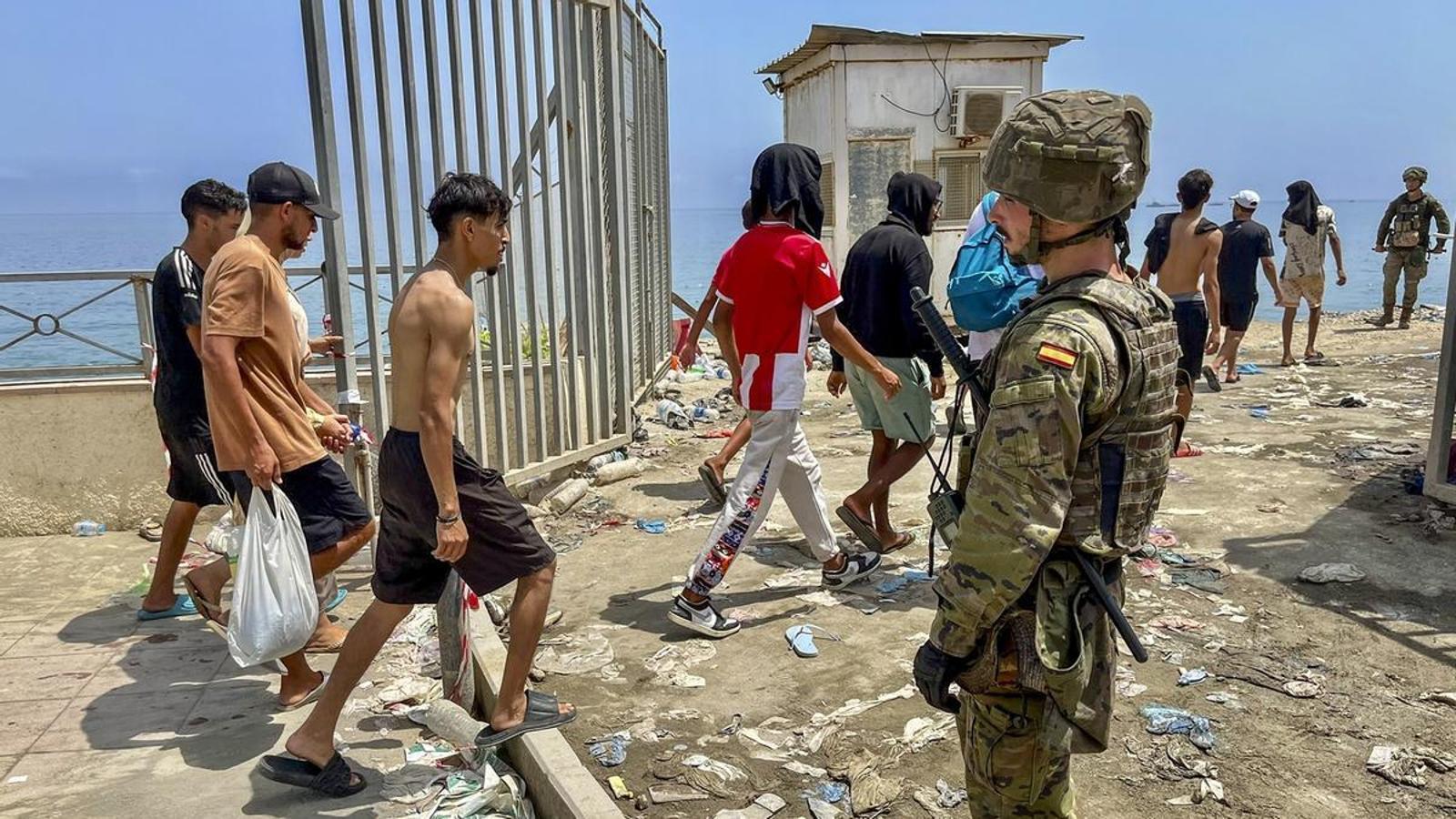

The images about Ceuta are repeated once again. They show thousands of young people arriving by sea, exhausted, but also families and even babies. We see how the Civil Guard is unable to do anything, paralyzed by what most media outlets do not hesitate to call an "avalanche". Beyond the beach, we know of overwhelmed reception centers and hundreds of people sleeping in the open. Images of closed shops also arrive, of a completely paralyzed city.In this context, Ceuta is requesting the declaration of a national emergency while the Spanish government continues to praise the "exemplary collaboration" of Morocco and the Moroccan government remains silent. All of this is a déjà-vu. It seems incredible how the staging of chaos can follow such a precise pattern.But where the focus should be placed is on the causes and consequences of this theatricalization. Among the causes, what makes it possible is the willingness of thousands of young people to jump to the other side at any moment. Many of them do not notify their families until they have already arrived. Some come from afar. They are willing to leave everything behind because deep down they feel they are leaving nothing. Some do not work or study. Others are young people with studies but with few future prospects.Their demands became clear with the mobilizations of the so-called "Gen Z" during the fall of 2025, which denounced the deterioration of public services (especially healthcare and education), youth unemployment, and corruption. As Bulgarian political scientist Ivan Krastev recalls, "when you can't change the government, you change geography".
But what has made possible the sudden increase in arrivals in Ceuta is that Morocco has stopped controlling the border. It is not the first time. It did so also in May 2021, when more than 8,000 people arrived irregularly in Ceuta in less than 48 hours. At the time, it was interpreted as a response to what Morocco considered a lack of loyalty due to the hospitalization in Spain of the leader of the Polisario Front, Brahim Ghali, but in essence it was also a way of demanding complicity with the issue of Moroccan sovereignty over Western Sahara.This time two hypotheses are considered, not mutually exclusive. On the one hand, it is interpreted as a protest against Pedro Sánchez's visit to Algiers, with which the reconciliation between Spain and Algeria has been sought to be staged. On the other hand, it is also thought that it may be a consequence of the Congress's decision to grant Spanish nationality to those born in Western Sahara and their descendants, which is a form of recognition.But the most revealing aspect of this recurring staging of chaos is not the causes but the consequences. And these consequences have to do with the two great traumas that condition migratory debates and policies in Europe today. The first is related to the fear of a new migratory crisis. Since 2015, the European Union has been obsessed with irregular arrivals at its borders, even when numbers have been consistently declining for years. A few thousand entries in a few hours do not substantially change the scenario. And it is worth remembering: no matter what Meloni says, the figures irregular arrivals in Italy are much higher. In 2025 there were 66,328 compared to Spain's 36,775.
The other trauma is the fear that the migratory issue will further fuel the rise of the far-right. Because it does. Analyses of public opinion show that the majority of European citizens do not see immigration as a problem, but rather the perception of a lack of control. This is what the images coming from Ceuta feed, and this is what the far-right exploits when it talks about invasion and an overwhelmed border. The Trump administration could not help but attribute it to "far-left globalist policies" and the Italian Minister of Foreign Affairs to regularization, which he claims would incentivize mafias. He ignores that in these contexts there are no mafias because they are not needed.These fears lead Europe, and here is the main consequence of this new episode of staging chaos, to overreact. On the one hand, it is scandalized and embarrassed by the "indecent" and "cynical" use that the Moroccan government makes of its own citizens, whom it uses as "weapons" to pressure the neighboring country. It forgets, however, that it was it itself that began to make transactional use of migrations. Money in exchange for control. In this sense, it is we who have placed ourselves in their hands. On the other hand, the fears are such that Europe is willing to do whatever it takes to avoid it. The 2021 crisis led the Spanish government to recognize Moroccan sovereignty over Western Sahara. This time it remains to be seen what it will eventually accept to re-establish a control that, by definition, will always be as desired as it is precarious.
