They find two rhinoceroses from 200,000 years ago in the Cova de les Teixoneres of Moià
The skeletons, in very good state of conservation, are the only ones documented in the Iberian Peninsula and among the few in Europe
-
CAT -
CAST
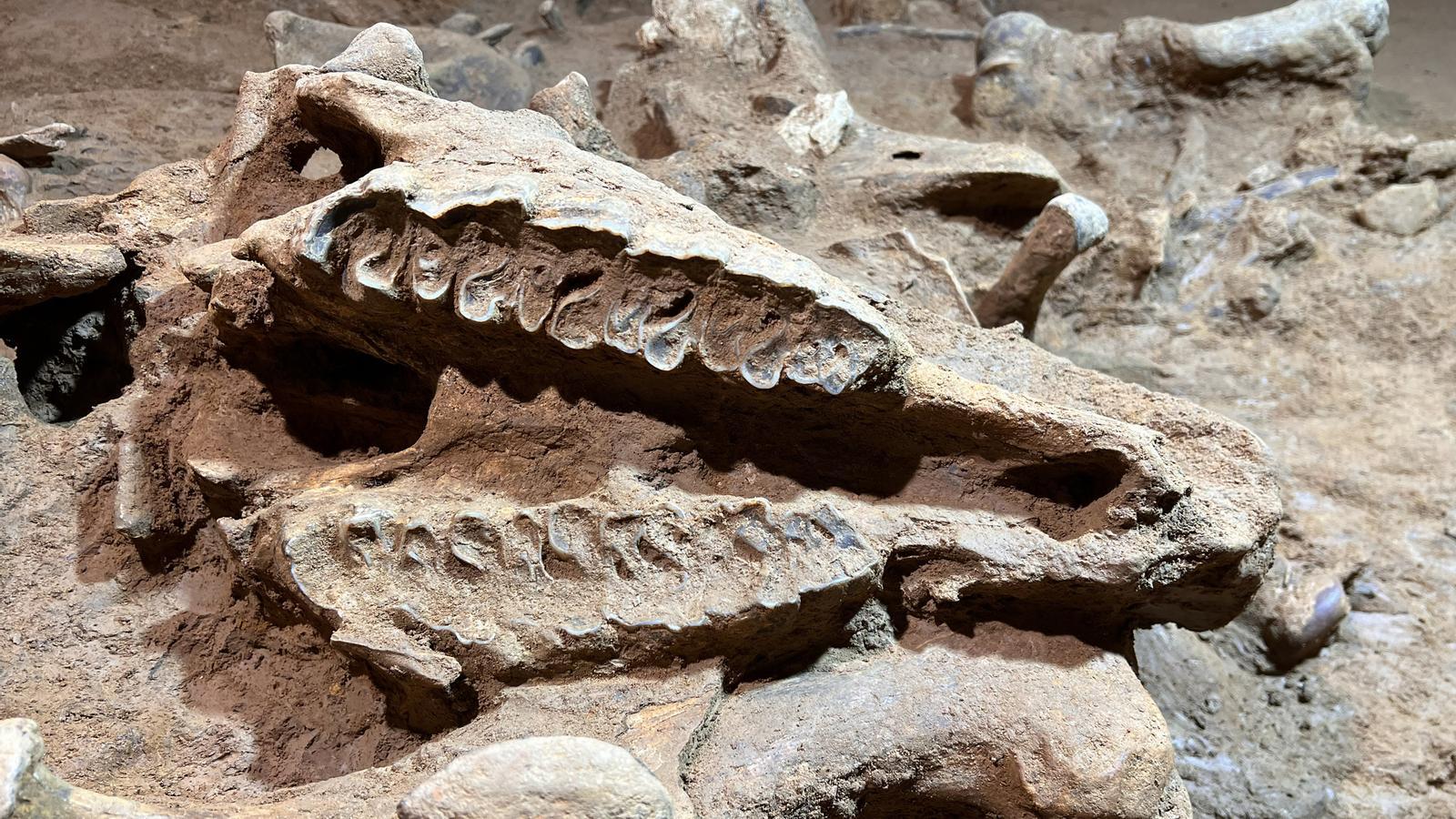
BarcelonaNew findings at the archaeological site of Cova de les Teixoneres in Moià. Researchers from the Rovira i Virgili University (URV) and IPHES-CERCA have recovered two complete skeletons of steppe rhinoceros (Stephanorhinus hemitoechus) approximately 200,000 years old. The remains are the only ones of this animal currently documented in the Iberian Peninsula and among the few located in Europe, with only two known cases in Germany and Italy.
The principal investigator of the project, Jordi Rosell, explained that the discovered rhinoceroses could weigh over one and a half tons and admitted that they have not been able to determine how they reached the interior of the cave. "It is possible that they entered attracted by some type of natural trap, such as a pool of water or an involuntary fall, but the investigations carried out so far do not yet allow us to identify it," he stated within the framework of the presentation of the findings.

One of the most surprising elements is the extraordinary state of preservation of the bones. “We are convinced that once we have cleaned them, we will be able to know if the carcasses were used by Neanderthals or by carnivores in the area, such as hyenas, cave bears, or wolves,” declared Ruth Blasco, a Ramón y Cajal researcher at IPHES-CERCA. She pointed out, in this regard, that around the skeletons "lithic tools" – made of stone – have been found, as well as "flakes and the fragment of a broken bone point, which represents a type of tool unprecedented in this period”.

The so-called steppe rhinoceroses disappeared about 20,000 years ago, with the arrival of the intense cold of the Last Glacial Maximum. “In more modern strata we already had remains of rhinoceroses associated with Neanderthal camps [...] But these are woolly rhinoceroses (Coelodonta antiquitatis)”, explains Florent Rivals, ICREA research professor at IPHES, in a press release. “The presence of the steppe rhinoceros in the lower strata indicates that there was a succession of climatic changes between 200,000 and 75,000 years ago significant enough to cause a replacement of relatively temperate animals by other forms more adapted to the cold”, he adds.
Taking advantage of carcasses
The excavation team, which also includes researchers from the UB, UAB, and other universities in Madrid, China, Argentina, and Portugal, has also recently been excavating the remains of a hearth dated at 40,000 years old. “The hearth is associated with remains of eaten animals and some tools,” explained Anna Rufà, from IPHES-CERCA, who highlights that the lithic industry found is very similar to that of the lower strata: “This means that this species was capable of adapting to the different climatic events of prehistory without substantially changing its technology”.

In parallel, the same team has been excavating in the nearby Cova del Toll, known for having been a hibernation site for cave bears. “Here too we have found lithic industry,” pointed out Ivan Ramírez, a researcher at the University of Barcelona. “We have been looking for some time for evidence that clearly shows that Neanderthal groups in the area took advantage of the carcasses of animals that died during hibernation. The pieces recovered this year will serve to increase them and we will be in a position to debate the hunting of cave bears during the Middle Paleolithic,” he described.
Both Cova de les Teixoneres and Cova del Toll are known for having been a refuge for many species. “The upper strata, that is, those dated between 100,000 and 35,000 years ago, present a curious association of animals in which very cold-climate species, such as the mammoth or the woolly rhinoceros, coexist with temperate-climate animals, such as the roe deer,” explained Rivals. In the excavation campaign by URV and IPHES-CERCA, remains of other animals have been found, presumably also whole, such as a horse, an aurochs, and at least three bears.

