Miquel Travé: "Besides my father, who else will pay 40 euros to see me compete?"
World champion of canoeing
-
CAT -
CAST
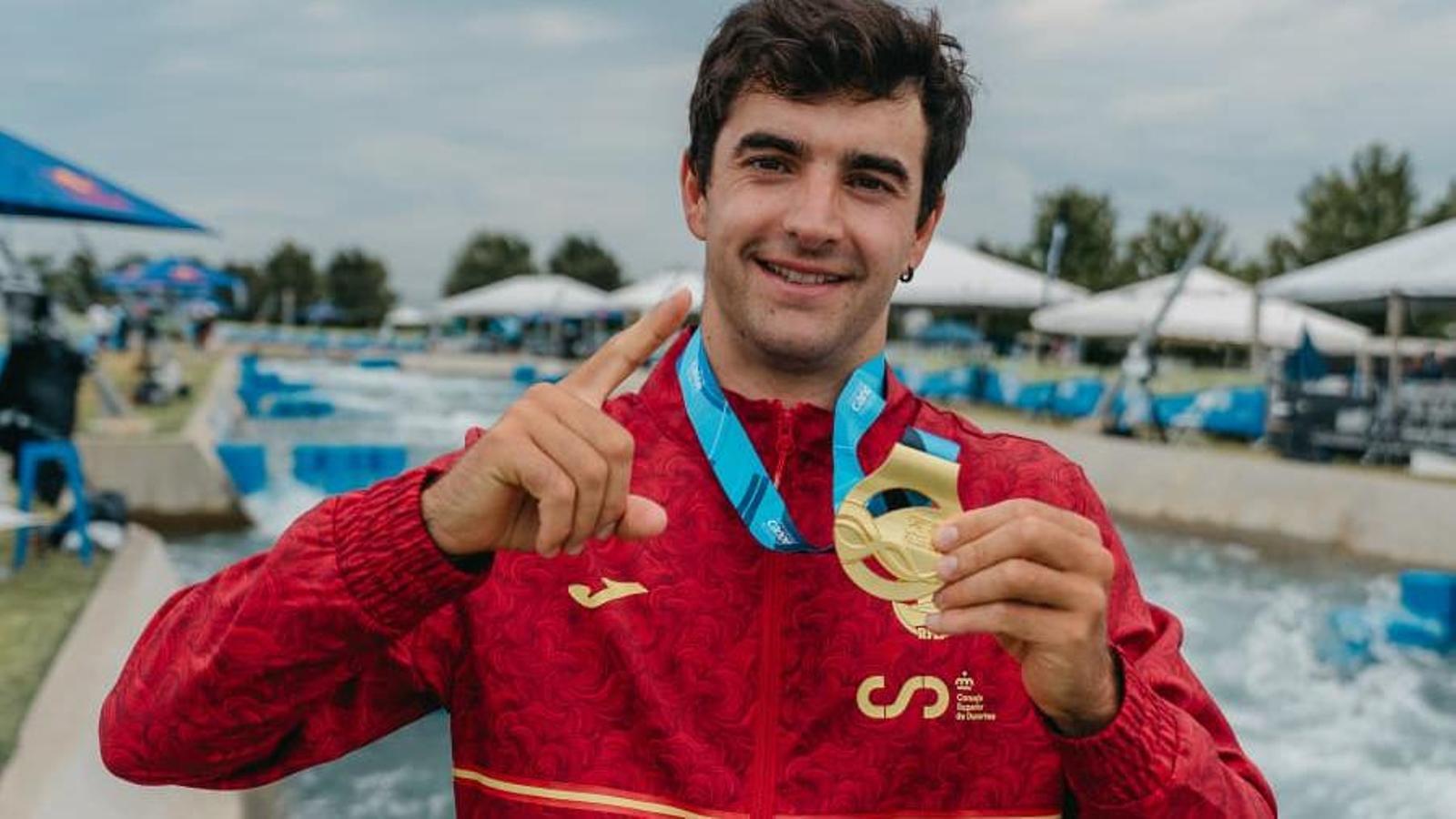
BarcelonaThe life of Miquel Travé (La Seu d'Urgell, 2000) has not changed one bit since he was proclaimed world champion of canoeing in July, becoming the first Catalan and Spaniard to win Olympic slalom gold. Calm and disciplined, he maintains a routine of training six hours a day. In fact, he postpones the video conference with ARA by a few minutes precisely because one of the sessions has run long.
After a historic achievement like this, didn't your body ask for a big celebration?
— Frankly, I didn't even know it was a historic victory. I didn't know it was the first gold in an Olympic modality... I was very happy and celebrated it, but without making a show of it. I try to do the same thing I've been doing until now, which has worked well for me. So I don't want to change much.
You are a resident of La Seu d’Urgell. I understand that in such a small city you must be a celebrity.
— Don't think so. It's true that in recent years I've been getting results and everything has been progressive. Perhaps at some point I'll meet people who know me. Neighbors or families with children. The adults greet me, but the children wonder who I am.
Really?
— I think it's a cultural issue of ours. Of society. We are in a country that knows football very well. Basketball is one notch below, and then, tennis. And from here, I could mention 40,000 minority sports. Which have little visibility and, therefore, it's hard to make a living from them.
What could be done to improve this visibility?
— For two years now, the International Federation has decided to charge a subscription to the Planet Canoe channel to watch all competitions. I think it's a blatant mistake. If there are only a few of us practicing this sport, because it is a minority sport, what interests us is to open up, to have visibility. My father might spend 30 or 40 euros to watch all the competitions in a summer. But who else? I think of the children, who if they don't have access to this sport will go to watch another one.
Have you sent this complaint to the International Federation?
— Yes, and not just the Spanish, all the internationals. Their philosophy is that with this money they create much more content for social networks. But we are interested in people seeing the entire competitions. Seeing what the sport is about. Not just the four videos and the four clips they might upload.
I understand, therefore, that it must be difficult to live off this.
— I, in recent years, I have been fortunate enough to achieve enough results to become financially independent. But it is very difficult to get sponsorship. And, I couldn't tell you the reason, but much more so in Catalonia, when compared to people who come from Galicia, Castile and León, or the Basque Country. Now the Generalitat is trying to create a program called Arc 365 to try to guarantee that a person dedicated to sports, if they have a bad year, can continue to live off it. In my case, we do seven major competitions a year, but we bet our salary on one: the World Championship.
And you won it. In addition, in Oklahoma, on the same channel where the tests for the 2028 Games will be held.
— Yes, but that has nothing to do with it and is no guarantee of anything. I have won, and therefore, things are not going badly for me on the channel. But in the end, each test is different, the route we will have to take will also be different...
In Paris 2024 you had silver within reach but you touched the last gate and that penalty dropped you to fifth place. Does this gold make up for it?
— Partly, yes. But not entirely. Initially, I was very happy to reach the Games, but that final touch left me shaken and it was hard for me to recover mentally. Fortunately, thanks to the work, the results returned later. And now this gold. Anyway, the goal remains to win a medal in Los Angeles. Gold, silver, bronze...
You are 26 years old. Is the life of a canoeist very long?
— There is the case of Maialen Chourraut, who is 42 years old and continues to win medals in World Cups. It is an exceptional case. The average age to retire is between 35 and 40. It also depends on economic viability and how you take care of your body.

How is canoeing/kayaking, regarding infrastructure?
— Right now, La Seu is the only operational and well-functioning channel in the entire State. I have also been lucky enough to be born here and live here since I was little, and to save myself the commutes. Really, it is an incredible facility. Afterwards there is a channel in Zaragoza, but it has had many problems since it was inaugurated.
What happened?
— Initially, the Seu channel collects water from the river. And if there isn't enough, it can be pumped. In Saragossa they built it in 2008, but all the water has to be pumped. And with the crisis afterwards, everything stopped. Furthermore, it has had filtration problems. In recent months they have been trying to restart it. That would be good news. Perhaps it wouldn't have the level of the Seu, but it would serve us for training. For now, we only have one place in good condition.
Do you also have to go away to train?
— Yes. Because besides canals, there are some rivers in Spain, but they are not top-tier. You can find them in Europe, the thing is that practically none are less than 10 hours away by car to get there. And I need it to work on things I can't do at La Seu. It is what needs to be done. In the end, between training and competing, I spend six months a year away from home.

