The WHO warns that there will be more hantavirus cases among passengers, but rules out a major outbreak
The Ministry of Health confirms the positive contagion of the isolated Spaniard

MadridThe World Health Organization (WHO) has wanted to send a message of calm regarding the spread of hantavirus, while also anticipating that it is foreseeable that more cases will appear among the ship's passengers in the coming days. The reason: the long incubation period of the disease. In fact, this Tuesday the positive case of one of the fourteen Spanish passengers has been confirmed, who has symptoms but is stable.
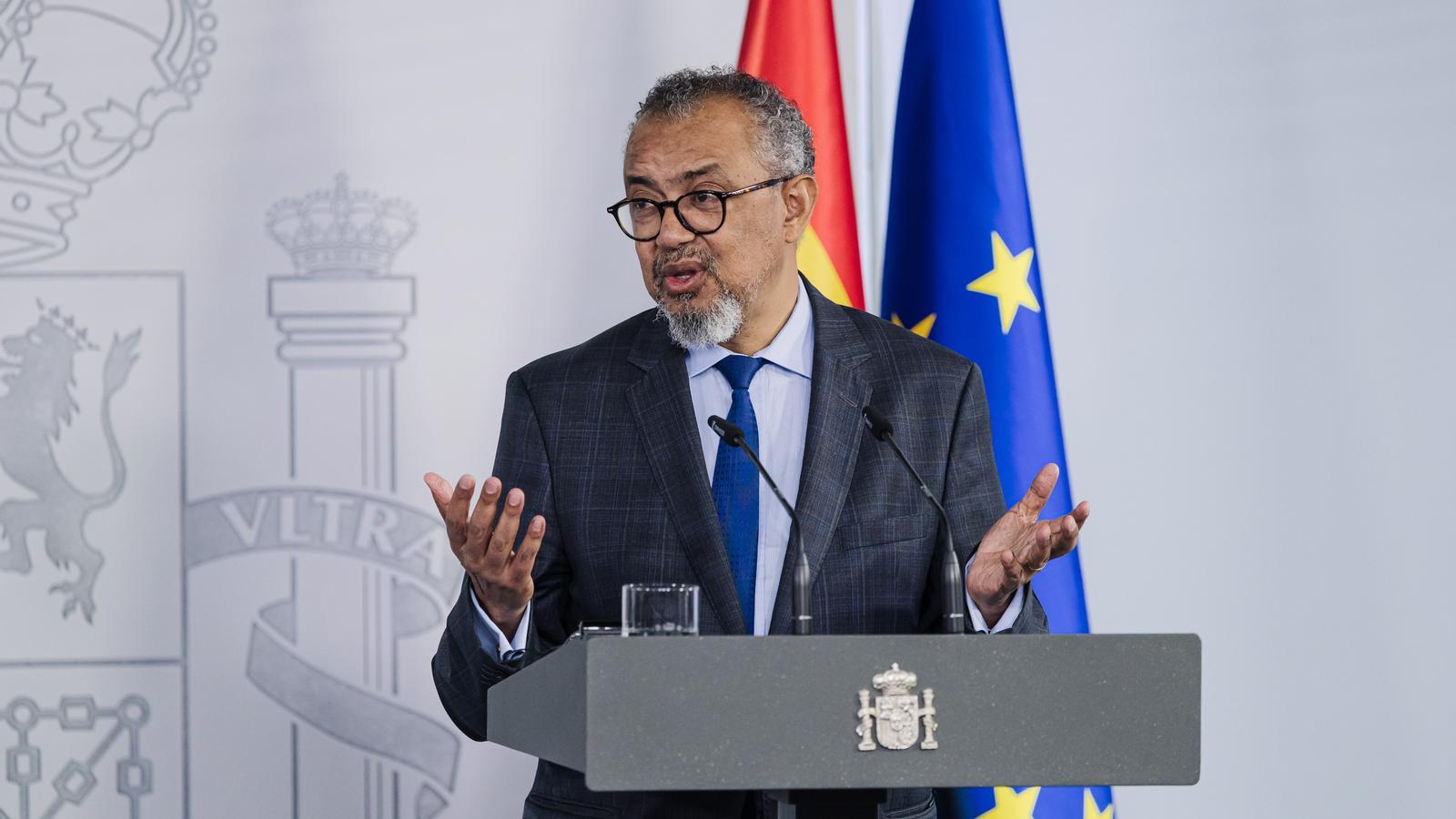
The Director-General of the WHO, Tedros Adhanom, insisted this Friday that "there will surely be more cases," but ruled out that this would translate into a "major outbreak" of the virus. "The first case was reported on April 6, but from when we received [at the WHO] the report until the contagion was confirmed, there were many interactions between the passengers. [...] The incubation period is between six and eight weeks, and since these interactions occurred [before measures were taken], we must expect more contagions," Adhanom detailed in a joint appearance with the Spanish President, Pedro Sánchez, from Moncloa.
Tedros Adhanom and Pedro Sánchez met this Tuesday morning after the operation to evacuate passengers and crew on the island of Tenerife from the cruise shipOperation "successful"
Tedros Adhanom and Pedro Sánchez met this Tuesday morning after the evacuation operation of passengers and crew on the island of Tenerife of the cruise ship MV Hondius, affected by hantavirus. A operation that both have defined as "successful". "We received a distress call. Why would we have refused to help? [...] Why should we not protect our compatriots?", Sánchez asked at a press conference, while he reproached those who "have remained silent" and "have looked the other way".
The head of the Spanish executive defended the reception of the ship by the State and thanked "the work of the more than 400 professionals who have participated". "We will continue to closely monitor the evolution of the passengers. [...] So far there have been zero incidents", he remarked. Sánchez also took the opportunity to defend "transparency" regarding information, especially with the Canary Islands government after it showed its reluctance to receive the ship.
Adhanom also once again thanked the "solidarity" of the State and the citizens of the Canary Islands in particular. "I would like to thank Mr. [Pedro] Sánchez and his government for Spain's admirable leadership and collaboration over the past week", he said, and stated that it would have been "inhumane" for the passengers to undergo quarantine on the ship. The Director-General of the WHO explained that they asked the State to get involved in the reception of the ship after verifying that Cape Verde "did not have the capacity" to do so.
One Spaniard infected
The Ministry of Health has confirmed the contagion of the Spanish citizen who provisionally tested positive for hantavirus this Monday. As for the rest of the passengers, a total of thirteen, all have tested negative in a second test.
The infected citizen is isolated at the Gómez Ulla Hospital in Madrid and this evening presented "a slight fever and mild desaturation, although at the moment he is stable and without evident clinical worsening," according to ministry sources. The protocol established by the health authorities indicates that he must now be transferred to a High-Level Isolation and Treatment Unit (Uatan), specialized in the care of infectious diseases.
The other thirteen passengers have tested negative in microbiological tests. The group as a whole has been admitted since Sunday afternoon at the military hospital, in isolated rooms with negative pressure, where they must undergo a mandatory 42-day quarantine; this means that, at a minimum, they will be there until June 17.
