Violence in Catalonia: are there more crimes or more social alarm?
Police confiscate more knives among young people and detect more disobedience in the streets

-
CAT -
CAST
BarcelonaIn the realm of security, there are often perceptions in society that do not quite align with police data. There is a reality: two highly publicized homicides have recently occurred, both in the street and with witnesses who saw them up close. But, with the data in hand, for the police, the increase in crime in Catalonia –or the idea that there is now more than before– is a perception: last year fifty-four homicides were committed, the same as a decade ago. This year nineteen have been committed and, if the pace of cases is maintained like this, the year could end with a similar balance to 2025.
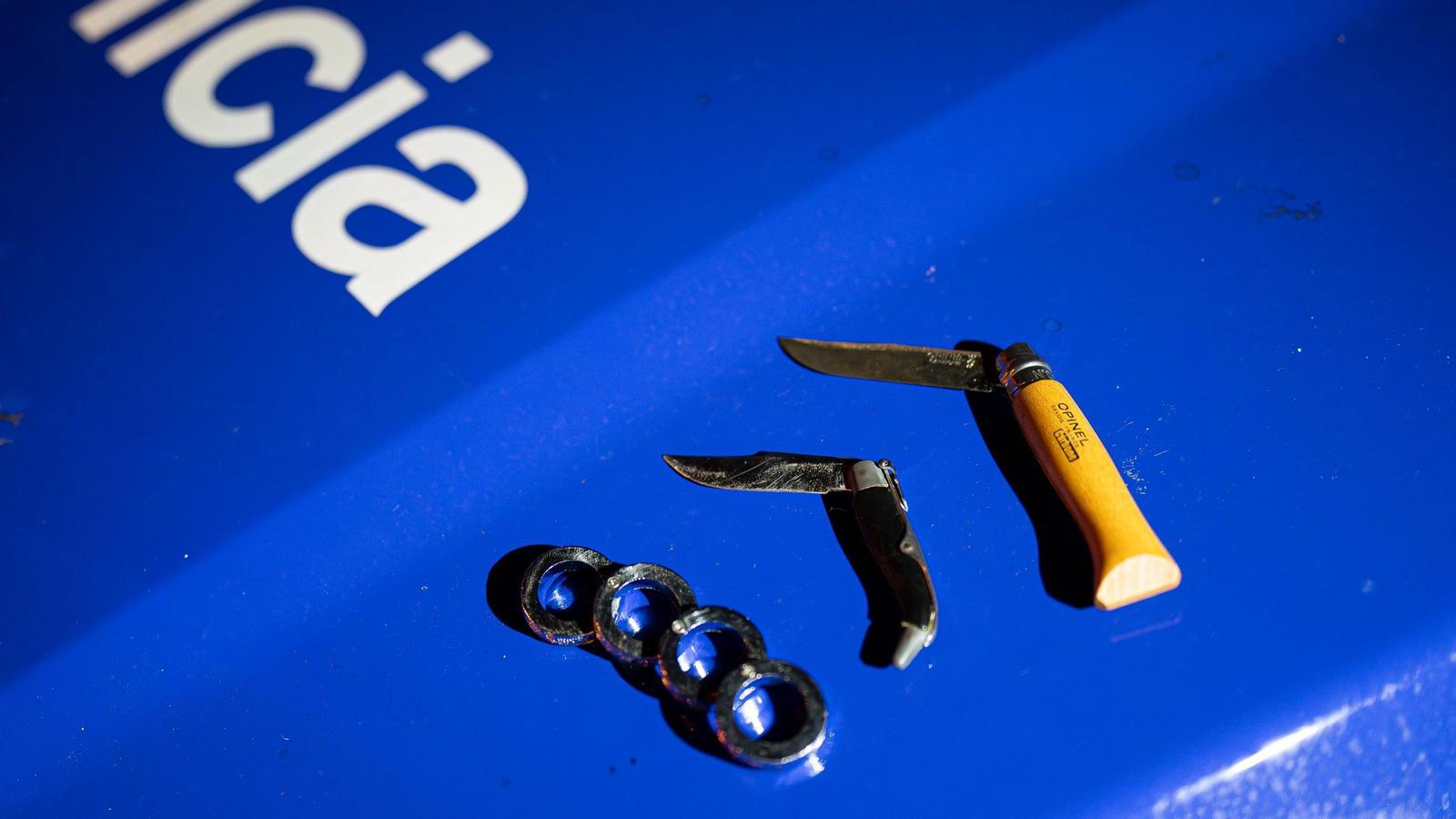
The Esplugues de Llobregat crime, in which a 41-year-old woman was stabbed to death by a stranger who is now in preventive detention, and a new fatal stabbing in the Raval of Barcelona a few hours later, in which a minor ended up arrested, have once again placed the debate on violence in Catalonia at the center. Specifically, there is more talk than ever about bladed weapons. The Mossos d'Esquadra admit that in recent years there has been an increase in incidents with sharp and cutting objects. Last weekend alone there were two fatal stabbings and seven more injured by knives. However, they maintain that the belief that we are in the worst moment is a perception.
After the implementation of the Daga plan to combat bladed weapons, incidents with knives have decreased by 31% in the first quarter of 2026. Recidivism –people who have been detected carrying a bladed weapon on more than one occasion– has also fallen: if in 2025 this percentage was 34%, it is now 27%. However, in Catalonia there are eight incidents with bladed weapons every day, and the police are concerned that those who wield them are predominantly very young people. In 2025, 9,000 bladed weapons were seized, and 500 were carried by minors. Furthermore, 40% of those identified for carrying knives were between 18 and 30 years old. Half of these individuals are of Spanish nationality and 96% are men.
Trivialization of violence
This is not exclusively a Catalan problem. At the state level, the Basque Country also had to launch an action plan against bladed weapons in February 2023, as did Navarra, and other territories such as Andalusia have asked the Ministry of the Interior to activate one to curb knife assaults. But if we take a tour of Europe, the trend is similar. Germany approved a security package in 2024 that prohibits knives at popular festivals, sporting events, and markets. In the same year, Austria created an operational group against juvenile crime, which explicitly focused on bladed weapons. In France, random checks are carried out in schools to prevent the use of bladed weapons, and Italy is considering installing metal detectors at the entrances of educational centers.
In fact, one of the big questions is whether there is an increase in violence, but above all whether it occurs at younger ages. Superintendent Toni Rodríguez, a member of the Mossos d'Esquadra Headquarters, is piloting the plans against bladed weapons and recidivism that are already underway throughout the country. For some years now, they have perceived an "insubordination" in the streets; a dynamic of "lack of values", of "trivialization of violence". He points to song lyrics, videos of fights that go viral, or other elements, but indicates that, often, these factors are linked to failures of the formal system, which fails to redirect the situation of these people. The emergence of new youth gangs could also be linked to this effect, as this newspaper explained.
For this reason, Rodríguez advocates for not opting so much for relentless punishment –with fines or, in the most serious case, with prison sentences– and advocates for moving towards rules of conduct. The superintendent also believes that the presence of mossos in schools, with the pilot plan that is already being implemented in one center, as well as with mediation with families, can help to improve this conflict, also linked to other problems such as absenteeism and substance abuse.
Alternative measures
Currently, the police are encountering cases of young people carrying a bladed weapon in the street who are fined, but then do not pay the penalty. Thus, they do not feel that they are receiving any punishment. To alter their behavior, Rodríguez proposes obliging them to take, for example, discipline courses or prohibiting them from approaching public transport or nightlife under a court order.
These are measures similar to those used in traffic offenses (the points license and the need to take a course to recover them). In fact, Rodríguez explains that these measures can also be useful in combating repeat offending, a phenomenon that affects thieves who accumulate many priors. Among the five types of incidents in which a knife is most used, robberies with violence and intimidation are the first.

These proposals are added to various initiatives that the Mossos have been implementing for months, such as the Daga plan (2023). The Catalan police are confiscating more bladed weapons than ever and Superintendent Rodríguez explains that in summer they will increase resources and reinforce areas such as public transport. Furthermore, the police have identified 236 high-risk points for bladed weapons where more officers have already been deployed.
Concrete increases
This "insubordination" thatintendent Rodríguez speaks of can be seen in the increase of some specific crimes. The Mossos are noticing an increase in attacks on authority and disobedience, and this is not an especially hot period in terms of street demonstrations. In the last decade, attempted homicide offenses have also doubled, closely linked to the use of bladed weapons, and threats (+80%) and assault (+78%) offenses have increased, according to open data from the Mossos d'Esquadra.
and Tamarit also points out, there are some that can be a risk factor for having certain violent behaviors.

Data in Catalonia also shows that in the 80s and 90s there was a higher homicide rate. The highest rate per 100,000 inhabitants, according to figures from the National Institute of Statistics, was in 1987. Speaking of decades, a fairly even average rate has been maintained over the years. Furthermore, it must be taken into account that a good part of the crimes must be framed within the scope of delinquency. For example, in 2025, 53 homicides were recorded, of which 12 could be linked to organized crime. Since the summer, there have already been three shooting murders that are part of a Montenegrin drug clan war. in a Montenegrin drug clan war. These types of homicides are indeed increasing, as Catalonia, in the words of Rodríguez, has been becoming a "transit zone" for criminal groups.
Memory loss
"Violence has been decreasing. In the 80s and 90s it was worse. And if we go further back, violence was very normalized," points out Tamarit, who adds that right now there is "an excess of dramatization" and "a loss of memory." "Society has always been violent," concludes the professor, who has studied the evolution of homicides on several occasions. Now there are other elements that favor this "excess of dramatization," such as social networks, which show, even with images, the crimes that occur in Catalonia.
This is what happened in early May in Esplugues, a cruel and extremely violent crime that the Mossos investigators have not linked to jihadism, but to a mental health problem. Precisely, Tamarit is conducting a study on the link between certain mental health problems and homicides, and it all starts from the point that the vast majority of people with mental disorders are not violent. Only 0.37% of incidents attended by the Mossos are due to mental health problems. But, as this newspaper has explained in previous reports and Tamarit also points out, there are some that can be a risk factor for having certain violent behaviors.
