Lewandowski's Estelada and Lamine's Palestinian flag mark Barça's party
Barcelona again goes out in force to the street to celebrate a title won in the face of Real Madrid
-
CAT -
CAST
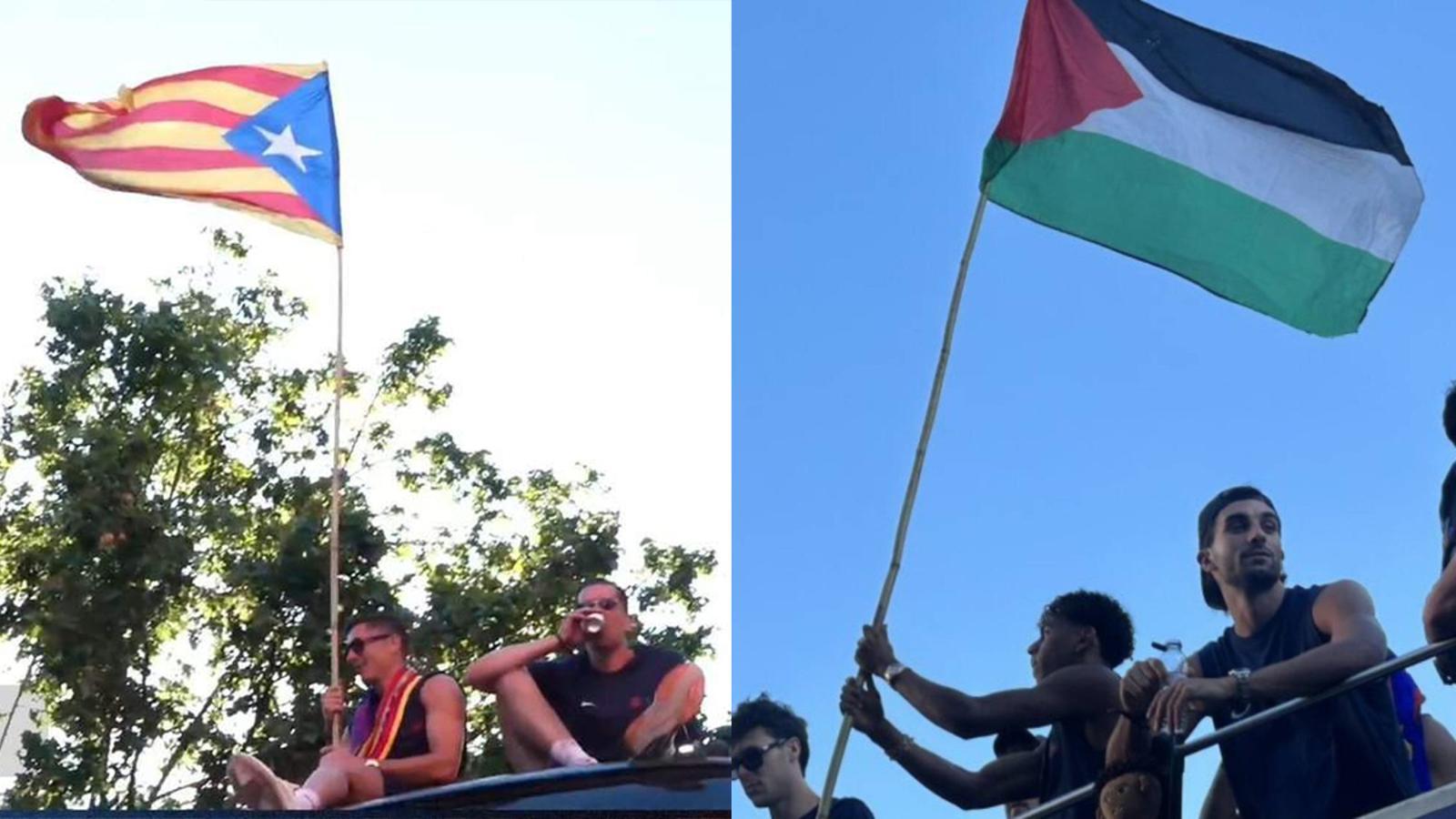
BarcelonaBarely 24 hours had passed since winning the League title when Barcelona took to the streets again to celebrate the championship. The first team players of Barça treated themselves to a massive crowd shower in a multitudinous parade, with 750,000 attendees according to City Council figures, which started and ended at Camp Nou and passed through some of the most central points of the Catalan capital. Celebration, chants, humor, pyrotechnics, and demands, such as Lewandowski waving an estelada or Lamine Yamal with the flag of Palestine. Two iconic images, especially the second, which quickly began to go around the world.
The communion between team and fans is immediately palpable. Parades are not new. But no one gets tired. After all, it's once a year. And if it comes after winning the title right under the nose of the eternal rival, all the better. The squad is homegrown, feels the colors, and knows what it means to win a title with the blaugrana crest. They are young, winners. They connect with the fans, whom they understand and whom they are eager to cheer on. It's no coincidence that an estelada goes up on the bus, that Lewandowski takes it and passes it among the footballers. Or that Lamine takes advantage of all the media impact of a blaugrana parade to position himself in favor of Palestine. He, who is destined to be the best player in the world, and not just any footballer.
The party lasted all afternoon but could have lasted all day. For the footballers it is not a mere formality, it comes from within. They feed off each other. They don't wave at thin air and raise their fists out of habit; they do it looking into the eyes of a girl waving a scarf, of a grandfather applauding with his cane, or of a wide-eyed child vigorously shaking a flag bigger than him.
The most impatient were already waiting for the procession at five in the afternoon, a magnificent time to start the champions' parade. A day tinged with blaugrana. Transversal, where everyone has a place. From small to large. There is a terrifying crowd and congestion in the center. Moving with a private vehicle is impossible, and some – perhaps lovers of other colors – let out curses of protest. They are a minority.
The parade is long and everyone wants to be well-positioned. The entrances to the metro and trains don't tire of spitting out fans. Suddenly beach balls appear, and people pass them around while they wait for their idols to arrive, shouting ""Vinícius, beach ball"". Others disguise themselves with a cone on their heads. A couple of percussionists set the rhythm for the songs that play at Camp Nou and are now part of popular culture.
The little ones don't settle for just one pass and sprint along the sides to get positions and watch the bus go by two, three, four times or however many it takes. Those who don't wear the shirt wear the cap. Or a scarf, or a flag, or have painted their faces. They jump, shout, and sing, and drive the Guardia Urbana and the Mossos crazy, who are making efforts to prevent accidents. But it's a day of celebration and nothing happens. The older ones are there too, and they're content with getting a good spot to see the team up close. Perhaps on the street, perhaps on a balcony. The most important thing is to be there. To feel it.
Perhaps it was a more serene parade compared to other years, but equally emotional. With the mascot Cat leading the way and the footballers in the background, on top of a bus where two trophies are secured, the League and the Super Cup. It's a special day for Lewandowski, aware that it will very likely be his last celebration in Barcelona as a player. The Pole climbs to the front of the bus, drinking beer, because today everything is permitted. Afterwards, his compatriot Tek joins him, who vapes without hiding it while the fans chant his name with shouts of "Szczesny the smoker". Who knows if he understands it. But surely he doesn't care. He, who went from being retired in the sun of Marbella to experiencing firsthand the blaugrana ecstasy and lifting five titles in two years. In his entire career, he had lifted eleven. Casadó takes off his shirt, Raphinha dances samba, and Araújo excites the crowd when he starts singing at the top of his lungs ""Perico, tell me how it feels". And his teammates and the people, delighted, follow him instantly. Halfway through the parade, Lewandowski picks up a Catalan flag, waves it, and hands it to his teammates, and Lamine joins the demonstrations with a flag of Palestine.
Flick's gaze, contemplating the spectacle with rapture, seated in the front row, is not that of an ordinary coach hired to do a job. It is that of a sexagenarian who has become the most Mediterranean German on the planet. Someone who is living a second youth and enjoys being a coach, a father, and a pillar of the locker room. On Sunday morning, he was informed that his father had died. Despite this, he stayed to sit on the bench in the decisive classic. On Monday, he also did not leave, but remained in the city to proudly contemplate the work he had helped to build. He has received a tremendous return from the street, with shouts of encouragement and words of gratitude.
Past Camp Nou, Travessera de les Corts, Balmes, Gran Vía, and Passeig de Gracia, the procession reaches La Pedrera, a symbolic spot for the centenary of the death of architect Antoni Gaudí. The players begin to retrace their steps and the party is already winding down, although the most persistent want to make the most of the parade until the end. The fans return home with a smile on their lips and a wish. What if next year, the Champions League is also celebrated?
