Half of Valencian teachers stop on the first day of indefinite strike: "We will resist the maximum"
Some 40,000 people demonstrate for public school and unions raise follow-through to 90%
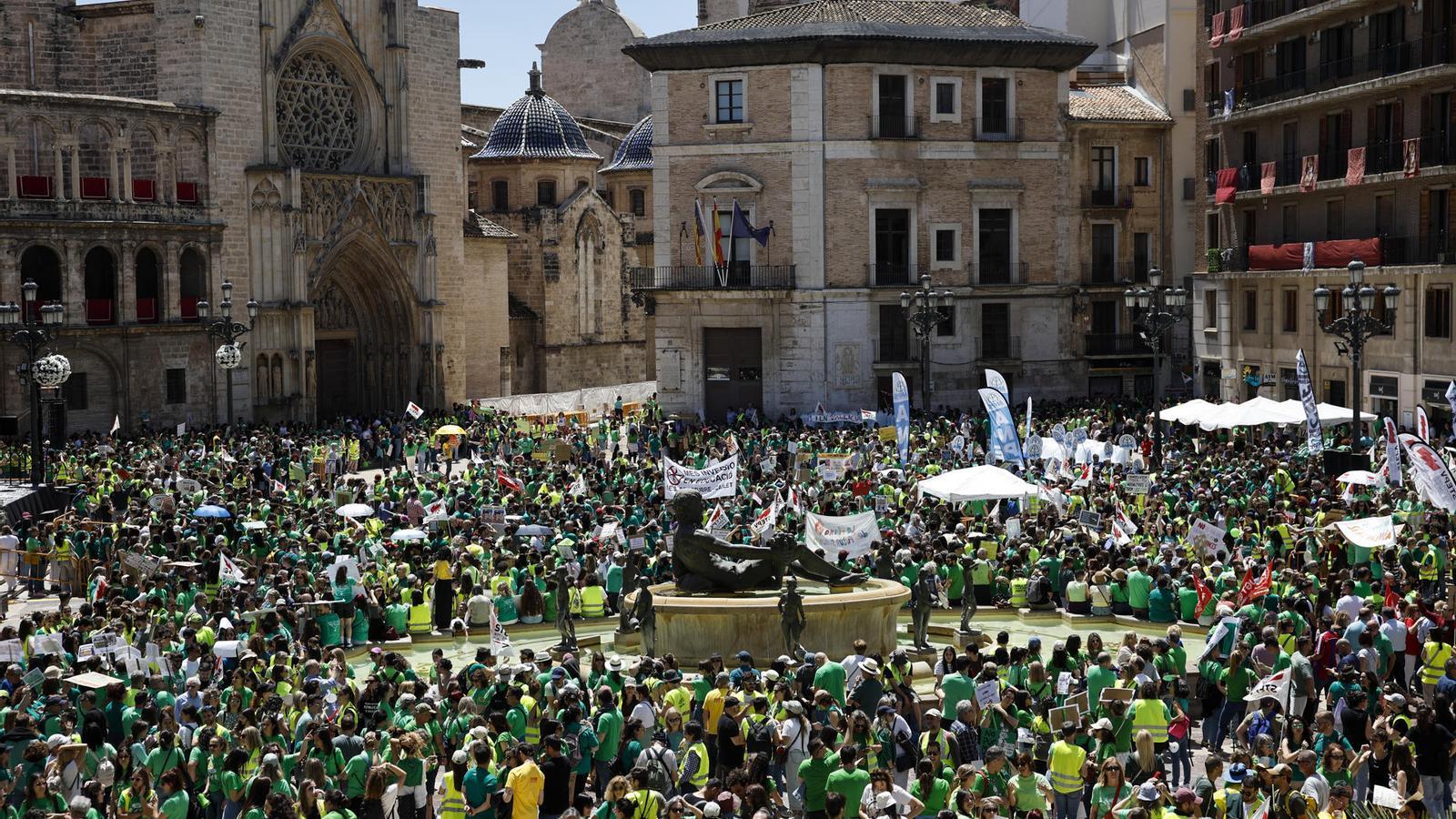
Valencia"We will resist to the maximum." The slogan among Valencian teachers seems clear after the success of the first day of the indefinite strike that began this Monday. According to the Generalitat, 50.12% of teachers have supported the strike, a figure that unions raise to 90%. All this in a context with high minimum services imposed by the education department, which in the case of second-year baccalaureate teachers has been 100%. According to the Valencian government, which has obtained the approval of the Superior Court of Justice, it is necessary to ensure that students are evaluated with a view to the selectivity exam that will take place in June.
Be that as it may, for the convener unions, the participation has been a success. The most forceful was the Union of Workers of the Valencian Country (STEPV), which has described the day as "historic and unprecedented". "In most educational centers, only the minimum services attended," they highlighted. The joy of the teaching representatives seems justified given that they have surpassed by 10 points the already successful protest of last March 31. At that time, according to the ministry, 40% of teachers supported it, a figure that unions raised to 80%. Beyond the data, a fact that demonstrates the exceptionality of the moment is that in the Valencian Country, an indefinite strike in the education sector had not been called since 1988.
The strike has emptied classrooms, but has filled the streets. This time with marches in the four major Valencian cities. The largest was in Valencia, where, according to data from the Spanish government delegation, more than 20,000 people demonstrated. In the case of Alicante, participation rose to 12,000. In Castellón de la Plana, there were 5,100, and 2,800 in Elche. In Valencia, green t-shirts in defense of public education and Catalan have colored the streets, accompanied by banners with messages such as "We don't want to survive, we want to educate," "Vocational calling cannot sustain everything," "More resources, fewer ratios," or "Burned-out teachers, extinguished future."

How many strike days?
One of the doubts that will be resolved in the coming days will be the capacity of the teaching staff to maintain mobilization despite the economic impact it has on each worker's pocket, which is equivalent to approximately 1.4 days of salary for each day of strike. This is demonstrated by three teachers who have explained it to el ARA, who highlight the complexity of the debate. While Susana Moscardó, an agricultural production teacher at a high school in Calp, explains that she does not feel up to striking "all week, but a couple of days due to the salary reduction this entails", Rosa Amorós and Lidia Moragón, two mathematics teachers at a high school in Valencia, assure that they will support it until the unions and the Coordinator of Teaching Assemblies of the Valencian Country say so. "We will resist to the maximum," they state.
What the three do agree on is that they are not very hopeful about the ministry's response. According to Moragón, the Generalitat "has already shown that it wants public education to degrade". "They will not yield, if they wanted to negotiate they would have already done so," agrees Amorós. "What the Generalitat wants is to cut," summarizes Moscardó. Despite this pessimism, Moragón is clear that the only possible response is mobilization. "We have to take advantage of the unity among teachers that exists now," she emphasizes. Of the list of demands: reduction of ratios, recovery of purchasing power, improvements in schools, more teachers, more Valencian and less bureaucracy; Amorós highlights the need to focus on improving infrastructure and tools to cater to diversity. Moragón also does so, complaining that many citizens only focus on the demand for salary increases. "If the teachers' demands are not met, public education will continue to deteriorate and the shift to subsidized schools pursued by the current Valencian government will increase," she warns.
While teachers protest, the Generalitat seems to be waiting. The Minister of Education, Carmen Ortí, assured this Monday that if the unions want to negotiate again, she will convene them "as soon as possible". The regional secretary of Education, Daniel McEvoy, also said so. "Whoever wants to sit down and talk about what Valencian students and teachers need, will find us on the other side of this table," he assured. Before sitting down again, the unions demand a proposal that represents a substantial improvement. In this regard, they describe the offer made last week by the Generalitat to increase salaries by 75 euros gross per month over three years as "ridiculous". "As long as a real and effective negotiation does not begin, the indefinite strike will be maintained," they conclude.
