"The tourism of leaving on the weekend to have a pizza in Florence is nonsense"
The ARA and the IEC organize the event 'From paid holidays to tourismphobia' to seek solutions in the face of mass tourism

-
CAT -
CAST
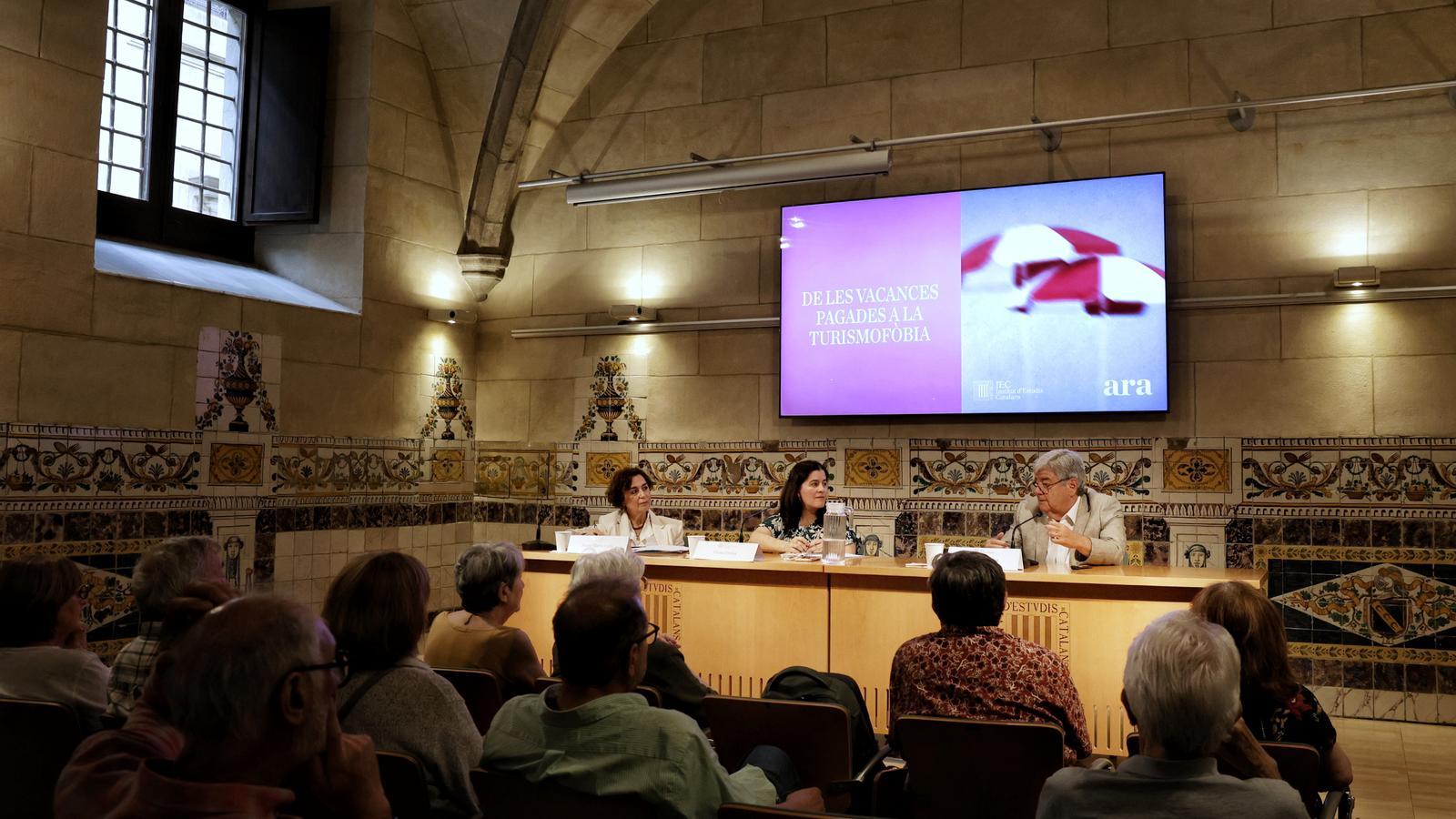
BarcelonaHousing problems, saturation of public services, road collapse, closure of local businesses, and a rampant increase in low-skilled and poorly paid jobs. This is the result of the "anything goes" and "only growth and making money matters" mentality behind the exorbitant explosion of tourism in the Balearic Islands, but also in cities like Barcelona or Florence. How to regulate tourism – without giving it up, but also without dying from success – and how to minimize the damage of one of the global industries are the topics addressed by Guillem López Casasnovas, Professor of Economics at Pompeu Fabra University (UPF), and Joana Maria Seguí, geographer at the University of the Balearic Islands, at the event From Paid Holidays to Tourismphobia, organized by the newspaper ARA and the Institute of Catalan Studies (IEC) and moderated by the deputy director of ARA, Elena Freixa.
"It's better to have tourism than not. But beware, because having too much is dangerous; tourism must be managed with care," began López Casasnovas, who is also a member of the IEC and participated in the creation of the now-famous Fenix Report that questions the Catalan economic model. In this regard, the economist stated that the current situation with tourism – which ultimately generates tourismphobia – is due, among other things, to two phenomena. On the one hand, it is an economic activity that grows based on labor, as services do not incorporate much technology. On the other hand, it is a sector that has grown so much that it "has to compete on price because productivity is very difficult to increase." The way to compete by offering cheaper prices is to lower wages, and in Spain, this has been achieved through immigrants who are "willing" to earn less due to their situation.
Here, according to López Casasnovas, one more factor must be added: "For the state, the volume of tourists is very important." "Only growth and making money matters. We grow in volume, but not in quality of life," warned Joana Maria Seguí. The geographer, also a member of the IEC, exemplified the tourist overflow suffered by the Balearic Islands with various data showing "the pressure [of tourism] on the territory." "Tourism and air transport have tripled from 1990 to 2025; since 1985, the resident population has practically doubled to cope with tourism and the service sector; in Ibiza and Formentera, vehicles have increased by more than 100% since 1998...", Seguí enumerated, before finally summarizing: "The figures are staggering".
Furthermore, the geographer insists that all of this impacts housing, in the form of fierce competition between holiday rental housing and residential needs. "It causes brutal effects such as people living in caravans and illegal settlements. Also in the health system, which is overwhelmed, and in the educational system, which needs new classrooms every year [in the Balearic Islands]".
The antidote: stop subsidizing low-cost?
Faced with this scenario, the question for the two experts was obvious: how do we address it? What solutions are there? Seguí warns that "many" localities have already taken measures, such as creating low-emission zones for residents or reducing vehicle entry, given that "tourists do not travel by public transport, but by rental cars." However, he calls for taking a step further with the promotion of ordinances, for example, to guarantee priority access for residents to public transport.
For his part, López Casasnovas directly asks to address the problem of "low-cost. "The tourism of going away for the weekend to have a pizza in Florence is a nonsense," he warns. He assures that we are at a time when the State subsidizes these trips "so that companies do not go bankrupt" and that this is the first point that needs to be changed. In this regard, he points to the reality that today "our young people who do not have the savings capacity to access a mortgage, the only luxury good they have is to travel. Furthermore, he also assures that the "pressure" to travel as a form of luxury and as one of the "only pleasures" they can afford thanks to "low-cost offers has increased, and this does not bring "quality" growth to a country's economy.
"Tourism can change. Instead of picking here and there... if the cost of going to a place is very high because transport is expensive and hotels have a fixed price, people will look for destinations where they can stay longer to offset the cost of the trip," insists the economist, who concludes that this could alleviate tourist pressure because there would not be so many people going "everywhere".
