The Spanish government plans to transfer 500 immigrant children from Ceuta to the Peninsula
The PP insists on the expulsion of all immigrants, including minors
-
CAT -
CAST
Madrid / BarcelonaThe Ministry of Youth and Childhood is working to transfer up to 500 unaccompanied immigrant girls and adolescents from Ceuta to the Peninsula, according to ministry sources. The proposal is for the autonomous city's government to maintain guardianship of the minors and for custody to be transferred to social entities that manage reception centers. This is the solution they have found to speed up the usual process by which guardianship is transferred to the receiving community, which has the competencies.
However, the PP rejects this approach. To begin with, the president of Ceuta, the popular Juan Jesús Vivas, stated this Wednesday afternoon that the ministry had not yet "asked for any transfer mechanism to be activated." In any case, he made it clear that his priority is to return all children to their country of origin, thus disregarding current legislation. The leader of the PP, Alberto Núñez Feijóo, also defended this: "In no case can the perverse precedent be created of granting rights to those who have participated in an illegal invasion [...] Neither adults nor minors. They must all be returned," Feijóo stated from Ceuta. The popular leader took advantage of the visit to the Spanish enclave, where the humanitarian emergency is still palpable on the streets, to position himself as an alternative to Pedro Sánchez's government and make a series of promises to tighten border control should he reach La Moncloa, starting with the construction of a new breakwater on the border with Morocco.
In response, sources from the Spanish government emphasized that "it is illegal to repatriate minors without individually verifying" the conditions stipulated by law. "Both Feijóo and Vivas know that it is illegal to return migrant boys and girls to Morocco if their best interests are not guaranteed. And this means, first and foremost, attending to them correctly, listening to them, and knowing if they have a family to return to," they defended. And they concluded: "The avenues offered by the Ministry of Youth and Childhood aim to adequately and urgently attend to 500 girls in a situation of absolute vulnerability, and the autonomous city has the obligation to protect them and assume their guardianship. Any refusal of these formulas is a refusal."
Ball of figures
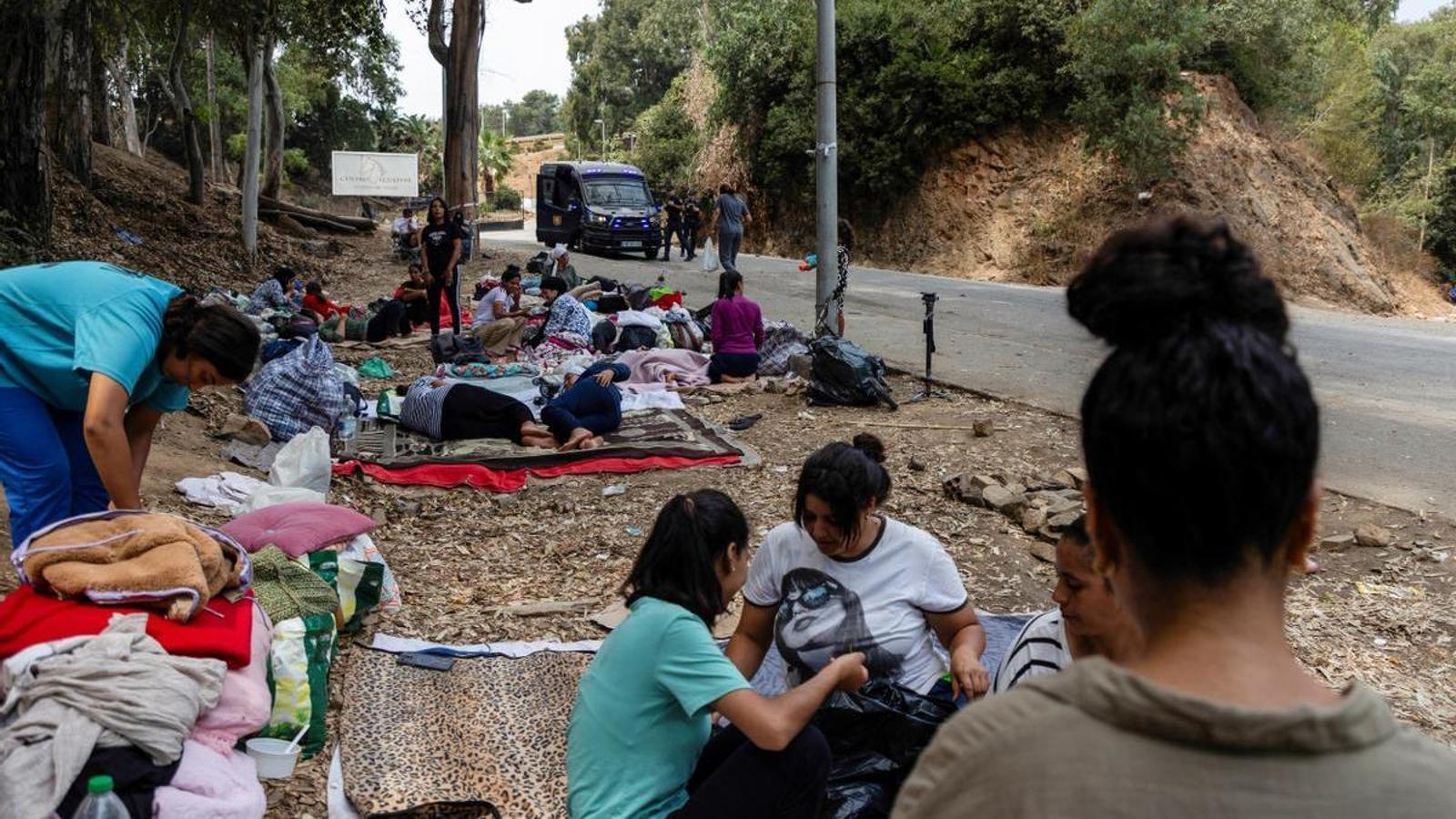
Almost three weeks after the mass entry, there is no official figure on how many adult immigrants and minors remain in the city, but there are now 2,168 children registered in the protection system. Some of these children ("about 500, approximately) continue to sleep on the street, in makeshift spaces set up by the residents of Ceuta due to the collapse of institutional reception centers, such as the sports center in the La Reina neighborhood, on the outskirts of the city. Other minors are housed in spaces provided by the autonomous city, such as the two public schools – in this case, there are only girls, about 350, according to local government estimates, who need to find them an alternative before the start of the school year. For this reason, the Ceuta government has been looking for alternative locations for these minors for days.
Lara Contreras, director of influence, programs, and alliances at Unicef Spain, has just returned from Ceuta and says that there are "very young children, seven years old," who sleep on the street, "with no alternative" beyond "neighborly solidarity." Therefore, she calls for speed and resources to "identify minors and detect vulnerabilities," always keeping "the best interests" of the children above all else. Although it is admitted that girls and adolescents are the ones who face risks of being recruited by mafias and suffering sexual assault, Contreras argues that boys also need "protection" against the risks of being "recruited by drug trafficking and suffering abuse and mistreatment." The organization has insisted to the Spanish government that "no one can be left out of protection" and has recalled that both Spanish legislation and international conventions ratified by the State oblige them to guarantee it.

The Spanish government is working on a plan that includes the binding and solidarity reception of all these minors by the autonomous communities. That is, the mandatory distribution of minors who cannot be reunited with their families. This, however, will not happen until later. A meeting of the ministry has been convened for next week with regional child welfare officials to advance the plan. Sira Rego's ministry also foresees family foster care and other formulas to speed up reception, and in fact, the intention is to approve a foster family law after the summer to improve both reception and adoption procedures in the State.
The priority is to reunite
However, as is usual, the priority is the family reunification of unaccompanied minors in their country of origin with their parents. The Spanish government, in fact, is in permanent contact with Morocco to make this possible, as revealed by the executive's spokesperson, Elma Saiz, this Wednesday in statements to RNE. Unicef warns, however, that these hypothetical returns must be carried out in accordance with legislation, that is, "examining case by case, identifying vulnerabilities and guaranteeing their protection".
This process is complex and often slow in order to guarantee the best interests of the minor, whose opinion must be heard and taken into account. "The minors tell us they don't want to return," assures Contreras, who states that in this crisis there are two novelties that had not been seen in other migratory movements: very young children, "five or six years old, alone or with older siblings" and "many girls". Why? "They have lost their fear of water and have prepared themselves to arrive by swimming," she replies.

A specialized team from the Ministry of Youth and Childhood – including psychologists, pedagogues, and social educators – has permanently relocated to Ceuta to help speed up procedures, which must be carried out before representatives of the Public Prosecutor's Office for Minors. At this point, Unicef and Save the Children have proposed to the executive the creation of an "emergency unit" for the care of minors to support the identification of the most vulnerable children. When the Canary Islands requested the activation of the emergency mechanism, the reception of minors on the Peninsula sparked a war between the PP communities and those governed by socialists, which delayed the arrival of the 400 children. Furthermore, Catalonia committed to voluntarily host 30, although not all of them arrived and they were waited for for more than half a year.
From the Federation of Entities with Emancipation Projects (FEPA), they had already pointed out to ARA that this assessment "could be done from other communities. The entities [in Ceuta] are overwhelmed," warned Ferran Rodríguez, president of the entity. Since the first day, neighborhood and local associations have been attending to the immigrants who have remained in the city, offering them food, drink, and shelter. However, Unicef denounces that many children "cannot have three meals a day nor do they have guaranteed hygiene".
