
The Moroccan Organization for Human Rights (OMDH) demanded this Tuesday that independent investigations be opened into the deaths, injuries, and alleged human rights violations recorded at the border of Ceuta and Melilla beyond the entry of tens of thousands of people from Morocco at the end of July. The NGO has demanded that this investigation be "independent", that it be carried out in both Spain and Morocco, and that the results be public in order to guarantee families the right to truth, justice, and reparation.
Brussels defends the return of all migrants from Ceuta, including minors
Local and state authorities are still looking for a place for half a thousand children and adolescents
18/08/2026 - 19:59 h

-
CAT -
CAST
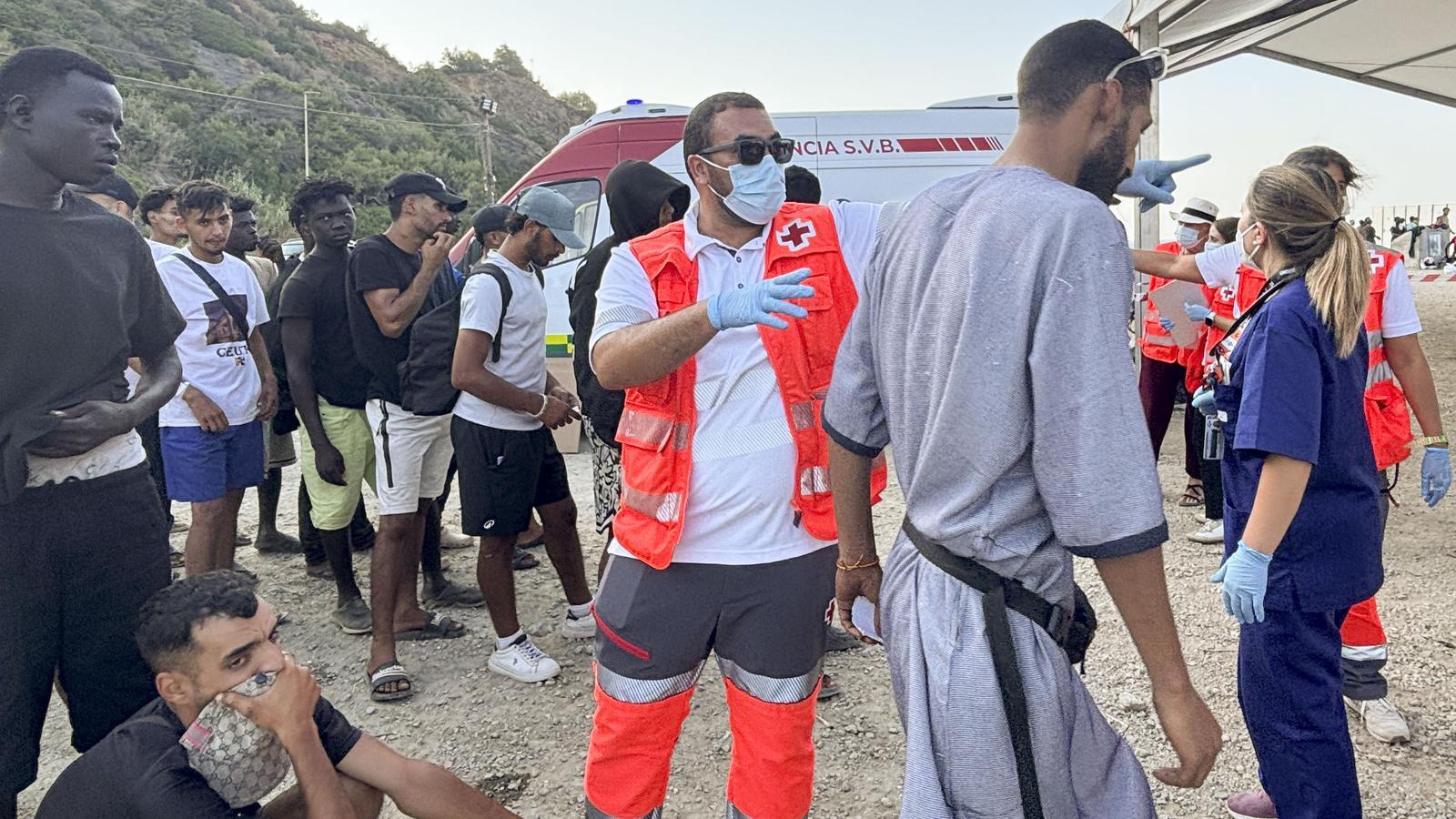
MadridEighteen days after the entry of tens of thousands of people from Morocco to Ceuta, the European Commission maintains its position on the future of migrants who remain in the autonomous city. The community executive has argued that all of them should be returned, including the more than two thousand minors who have entered without adult relatives and to whom community law and Spanish immigration law itself grant special protection. Brussels argues that European Union law also provides for them to be returned. "We continue to insist that the expectation is that all those who are irregularly in Ceuta will be returned," said the spokesman for the Internal Affairs commission, Markus Lammert, this Tuesday at a press conference.
To affirm this, Lammert has held onto the return directive approved last June. Specifically, to the provisions on the return of migrants in irregular situations, "including unaccompanied minors," said the spokesperson. However, the regulation that provides for this will not come into force until it is ratified by the Council of Europe, where the 27 member states of the Union are represented.
Morocco has already offered to collaborate on the return of all minors – the Spanish Ministry of the Interior has identified 2,168 so far – and Lammert has reiterated Brussels' offer to "facilitate and support" this process. A technical team from the EU's Directorate-General for Migration and Home Affairs visited the autonomous city last week to get a firsthand look at the situation on the ground and gather information on the needs of migrants – particularly unaccompanied minors.
What does Spanish law say?
However, beyond EU regulations, Spanish legislation establishes that before deciding on the repatriation of a migrant minor, family circumstances in the country of origin must be studied and the possibility of family reunification assessed. If it is not possible, the minor will be placed under the guardianship of the autonomous administration, which must provide basic care until they reach the age of majority.
During the process, it is essential to have the testimony and opinion of the young person, as the law stipulates that, above all, "the best interests of the minor" – that is, their well-being at all levels – must be taken into account to avoid putting them at risk. Finally, it is the Delegation of the Spanish Government in the autonomous community that is responsible for deciding whether repatriation can be carried out. A technical team from the Ministry of Childhood and Youth has been permanently stationed in Ceuta to expedite these procedures. In this context, the General Council of the Judiciary (CGPJ) has asked the High Court of Justice of Andalusia to reinforce human resources for the duration of this exceptional situation. Sources from the Ministry of Justice assure that they have already made progress in this reinforcement and that they have everything "ready" for when it is requested to continue doing so.
Children still without space
Meanwhile, Ceuta continues to look for places to accommodate at least 500 migrant minors unaccompanied, explain local government sources to ARA. "We continue to look for locations for the minors", they indicate. These are the minors who would not be in any reception center of the Ceuta government – they are far above its capacity–, which is the one that has competence over them, in the same way that autonomous communities do. They are children who still sleep outdoors, in spaces that some residents of the periphery have improvised, or are welcomed by the residents themselves.
At the time, two public schools were also opened where the girls who arrived alone were welcomed. Sources from the Ceuta government indicate that there are about 350. But the intention is that these schools be freed up for the start of the school year.
More places for adults
On the other hand, the Spanish government has begun to set up four spaces for adult migrants who continue in the autonomous city surviving in improvised settlements, many of whom are asylum seekers. One is part of the Loma Colmenar car park, a plot ceded by the government of Ceuta. The other three spaces are owned by the Spanish government. These are the facilities of the equestrian center, within the Military Sociocultural Sports Center; the old football field of the cavalry barracks, and the Guano space, also linked to the army. The ministry does not specify how many people there will be in each space, although the Loma Colmenar car park plot will be the largest.

The bulk of people who will be accommodated will be those found on Trampolín beach. Here, a thousand migrants from different countries in Africa, from Sudan to Yemen, Niger, and Egypt, have been demanding for days to be able to process their international protection application. For now, the Spanish government has already registered about 500 applications, according to Interior.
The army is the one setting up these four provisional and temporary spaces – they are basically tents with bunk beds – and it is expected to do so "quickly", according to sources from the Spanish Government Delegation in Ceuta, although they do not specify within what timeframe.
The Ministry of Inclusion, Social Security, and Migrations estimates that 1,500 people will be able to find shelter there, but the number of adult migrants on the street is higher – it is taken for granted that some will be returned to Morocco. In any case, the head of this department, Elma Saiz, has not ruled out the possibility of increasing the places later on.
These large reception spaces come after weeks in which efforts have been focused mainly on border reinforcement and control, the identification and registration of people – especially minors – and their return to Morocco. In fact, until just before August 15, when both sides of the border were completely sealed to prevent a new entry, returns were maintained swiftly – police sources indicated to ARA that about 600 migrants were returned "voluntarily"–. Now the trickle of people leaving Ceuta continues, explain sources from the Ministry of the Interior, but to a lesser extent.
A center to resolve returns
In parallel, sources from the Ministry of the Interior explain to ARA that the opening of a Temporary Centre for Foreigner Attention (CATE) next to the port of Ceuta is being finalized for adult foreigners who have entered irregularly, and for whom the police must resolve the deportation file within the 72 hours set by the immigration law.
During this period, the police must register and confirm the person's identity, and from there initiate the individual process for their return. The migrant, however, has the right to appeal the decision and must have access to legal assistance and a translator. Sources from the Ministry of the Interior explain that the space aims to make the process take place in more "dignified" conditions.
On the other hand, the cases of soldiers deployed in Ceuta who have contracted scabies now amount to 24, of which two predate the massive influx of migrants, according to a note from the Ministry of Defense in response to complaints from military associations. Thus, Margarita Robles' department assures that the cause of the infection is not related to contact that military personnel may have had with the arrived migrants, and points out that scabies is common in areas of high humidity. All those affected are undergoing treatment and the facilities have been sanitized. Professional entities, however, argue that they contracted the infection after being housed in unsanitary, disused premises.
A Moroccan NGO requests an investigation into deaths at the border
