Barcelona will buy the block threatened by a macro-eviction in Sant Andreu
The eviction affects a block in this Barcelona district with 18 occupied flats, where vulnerable people and at least seven minors live

-
CAT -
CAST
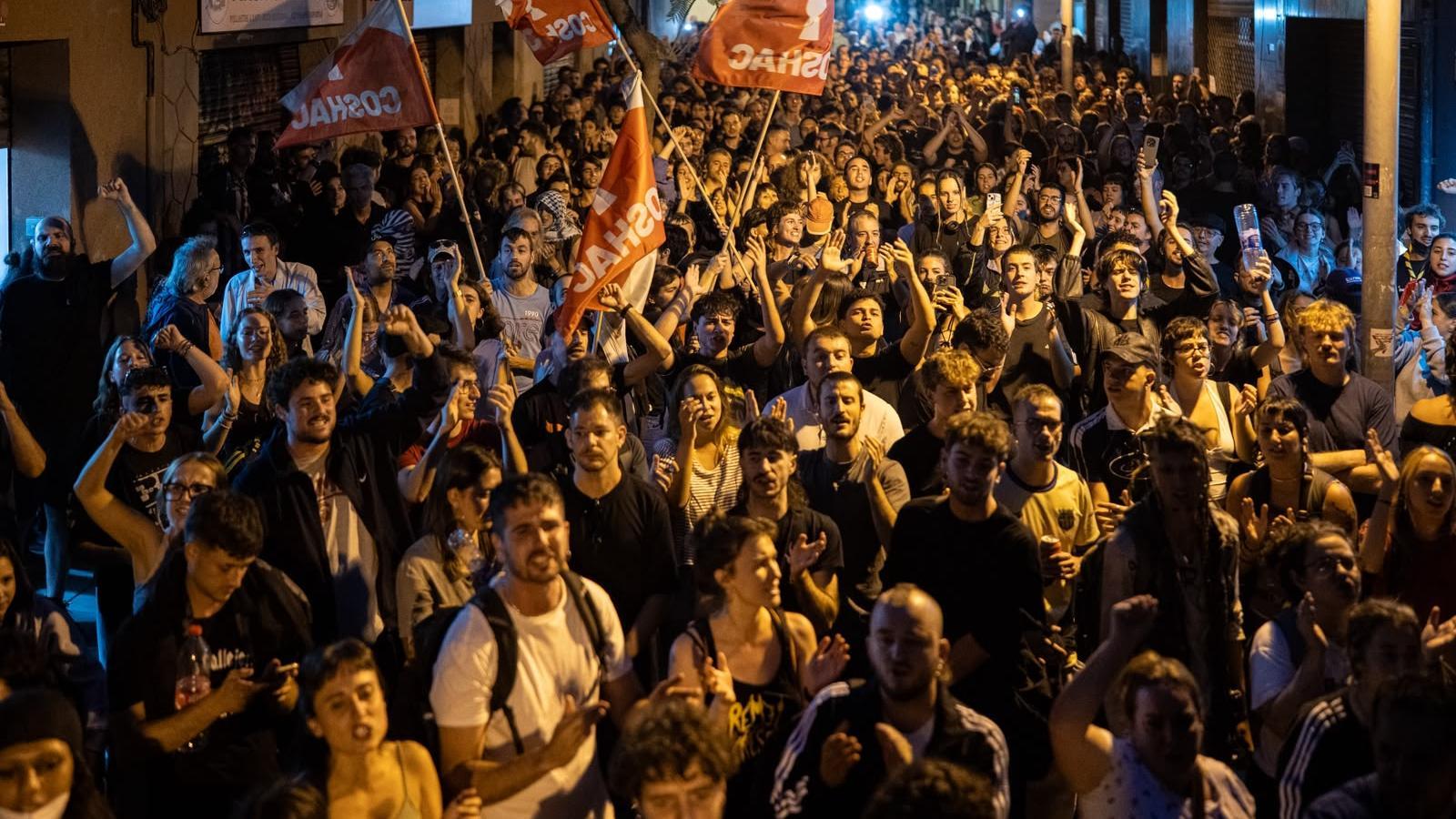
BarcelonaAfter some three hundred people spent ten hours trying to stop a mass eviction this Wednesday in the Sant Andreu district, Barcelona City Council announced that it had reached an agreement with the building's owner to purchase it. The eviction was scheduled to take place at 8 a.m., but it was not until 2:30 p.m. that the Mossos d'Esquadra arrived at the apartment building to proceed with the eviction. When it seemed the eviction would be carried out, at 4:30 p.m., the situation returned to its initial point. Barcelona City Council and the Government of Catalonia had assured that they were working to stop the police operation, while the group of people gathered continued to grow to apply pressure.
All of this took place in the Sant Andreu district the same week that the housing crisis has caused snap elections and a general strike, and the same day that the new housing decree is published in the Official State Gazette (BOE). About fifty people are facing eviction from the building at number 74, Llenguadoc Street. It involves eighteen apartments that have been occupied for nine years, where several vulnerable people and at least seven minors live. "We are very worried," explains Mel, a resident of the building, to ARA.
Like her, who this Wednesday marks 32 years since arriving in Spain from Brazil, many are migrants and report that in recent years they have suffered all kinds of harassment to force them out. They explain that empty apartments have been boarded up, interiors have been destroyed to make them uninhabitable, and they have even received threats to make them leave. "We are talking about families, children, the elderly, and vulnerable people who have had no alternative," says Maria Serra, spokesperson for the Housing Union Confederation of Catalonia (Coshac).
In an emergency press conference, the Deputy Mayor for Economy of Barcelona, Jordi Valls, stated that a principle of agreement has been reached with the owners to acquire the property through the housing emergency fund created a few weeks ago by the Generalitat, as well as with municipal resources. "This fund must serve for situations like this one, and today we have attempted to use it," he defended. After stressing that it is a "complex operation," he assured that it will be put into practice and that the main objective this Wednesday was to stop the eviction.
"Both Mayor Collboni and President Illa have been on top of it," he said, and defended the action of the Housing Loss and Occupancy Intervention and Mediation Service (SIPHO) and the Barcelona Social Urgencies and Emergencies Center (CUESB), regarding the minors. However, Valls also admitted that the driving force behind this intervention has been social movements, "which have the capacity to apply pressure and make the reality visible" behind the evictions.
For her part, the Generalitat's Secretary of Housing, Lídia Guillén, celebrated that the eviction has been stopped "especially for the people affected." "We need a great alliance with administrations, organizations, and neighborhoods to turn the right to housing into a reality," she stated, and added that the fund must make this possible.
Ten hours stuck
The housing commissioner of the Catalan capital's city council, Joan Ramon Riera, and the director of the Housing Agency of Catalonia, Miquel Bagudanch, had traveled to the block to learn about the situation firsthand and stop the eviction. "Minister Paneque has asked me to stop this eviction," Bagudanch stated. "It is neither appropriate nor necessary to carry out this eviction," added Riera.
For its part, the City Council has insisted that the most important thing is that the eviction be stopped, and from then on, concrete solutions can be studied. "From the City Council, we can talk about many things, but we need time to be able to reach and build agreements," he highlighted. In this sense, municipal sources insist that the council has requested the suspension from the TSJC due to the vulnerability of the people living there. They assure that the four families with children in the block are being monitored by social services. "In the event of an eviction, if they have no alternative, emergency accommodation will be sought," the City Council remarks.

Union sources explain that the property belonged to Reale Seguros, but that after several legal proceedings and seeing that the evicted apartments were being re-occupied, it was sold last year to the company Thunder Optical Minur SL, which has been trying to evict the people occupying the apartments since then.
The neighbors are clinging to the hope that the two decrees approved again by the Spanish government on Tuesday will suspend the eviction. This morning they were published in the BOE, but the one referring to evictions will not come into force until Thursday. One of the decrees temporarily suspends evictions for vulnerable families and incorporates measures such as an extraordinary extension of leases for two years, in addition to numerous tax incentives for both the purchase of apartments and for tenants and small landlords.
The other decree establishes indefinite lease contracts and compensation for the tenant if the landlord wants to end the contract early. The forecast, however, is that finally only the first one will go ahead, since the Permanent Deputation of Parliament –the parliamentary body that replaces Congress when elections are called or during holiday periods– will overturn the other.
