Kenso Soai is the second consecutive Japanese person to receive the Nobel Prize in Chemistry after the Academy awarded Susumu Kitagawa last year, together with the British scientist Richard Robson and the Jordanian Omar M. Yaghi, for their work in the field of metal-organic frameworks.
Nobel in chemistry for the detectives of nature's asymmetry
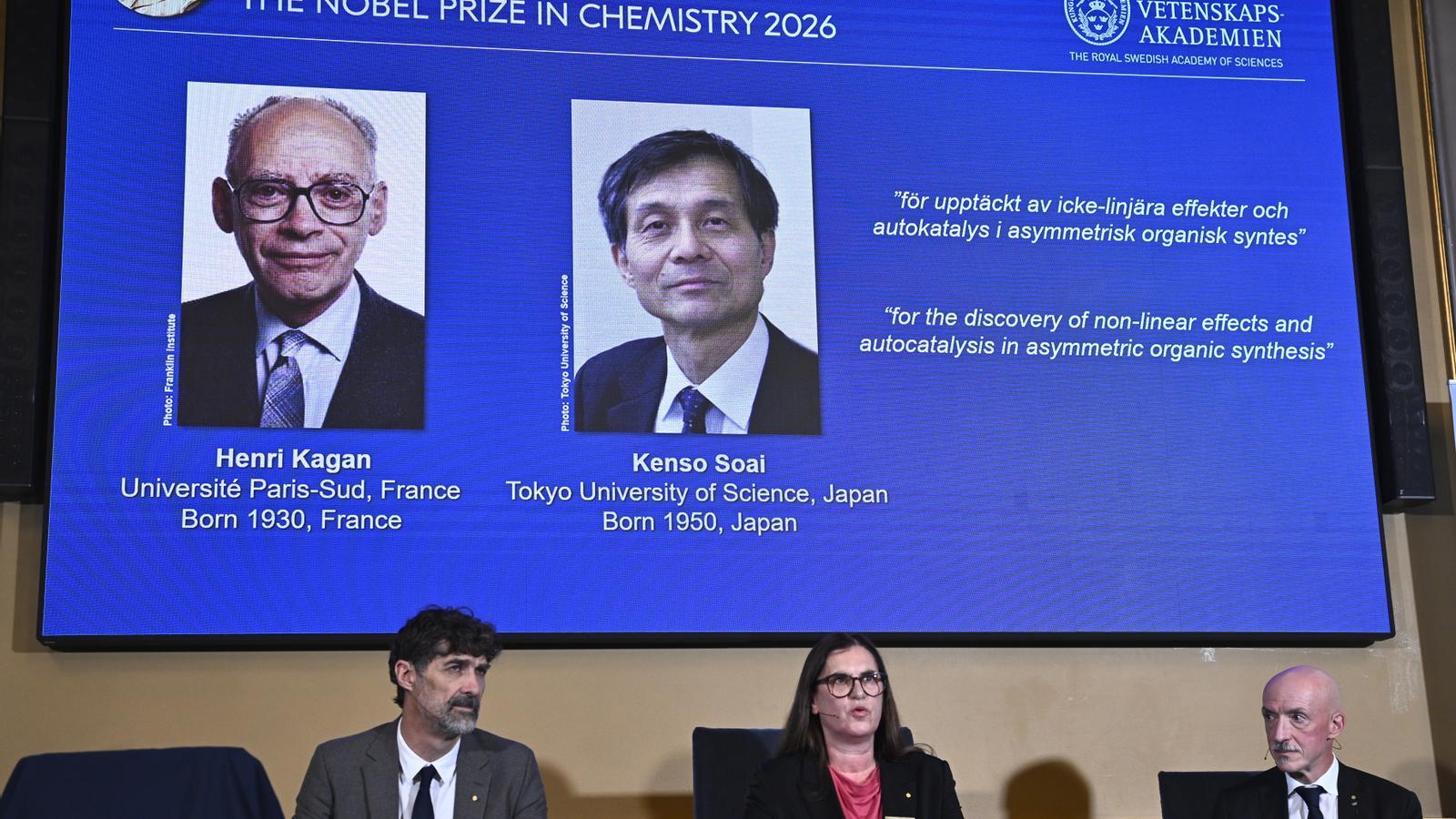
Kenso Soai and Henri Kagan take the recognition for explaining how one mirror form can come to predominate
07/10/2026 - 20:05 h
-
CAT -
CAST
BarcelonaIf two molecules are practically identical, why does nature end up favoring one? To understand this phenomenon, which is known as homochirality, we can perform an exercise of imagination with a pair of shoes: the right and the left are mirror images of each other – as if one were the reflection of the other in a mirror – but they cannot be swapped because each fits a different foot. With some molecules, like amino acids, the same thing happens: they exist in two almost identical forms, but they cannot be superimposed. They are the so-called chiral molecules.
The origin of this chemical asymmetry was a mystery for a long time. Now it is known that a small initial difference between these two forms can eventually be amplified until one of them ends up predominating. It is this breakthrough that the Royal Swedish Academy of Sciences has recognized with the 2026 Nobel Prize in Chemistry. The award distinguishes Kenso Soai, a Japanese professor at the Tokyo University of Science, for conducting "one of the most spectacular chemical experiments ever performed," as well as Henri Kagan, a French professor at the University of Paris-Sud.
The institution recognizes the trajectory of the two scientists for "their contribution to the understanding of chemical asymmetry." While Kagan demonstrated how a small imbalance can be amplified, Soai went further with a chemical feedback mechanism, the so-called asymmetric autocatalysis. "That is to say, that the product of a chemical reaction contributes to favoring the formation of more product of the same chirality," summarizes Josep Puigmartí-Luis, ICREA professor at the University of Barcelona and head of the ChemInFlow group, to ARA.
For years, getting a chemical reaction to produce only one of the two mirror forms seemed almost impossible. When scientists tried to create them, they often obtained a mixture of both in similar proportions. But only one of them is mostly found in our cells.
The problem was not just a question of laboratory precision: if the molecules were intended to interact with living beings, as is the case with medicines, the two forms can behave differently. One can be good for health and the other, harmful. In a symmetric medium, the two enantiomers have the same physical and chemical properties, but they deflect polarized light in opposite directions. On the other hand, in chiral environments, such as cells, they can behave differently.
The genius of two scientists
Kagan took the first big step in 1986: he discovered a way to amplify one of the two forms and obtain an excess much greater than what had been considered possible until then. Combinations of molecules with the same chirality can be more active than those that combine opposite signs. This causes a small initial excess of one of the two forms to amplify during the reaction and end up generating a much greater excess in the product.
A few years later, Soai took this idea even further and in 1995 described a reaction with the potential to favor a single form. Almost a decade later, in 2003, he demonstrated that it was possible to end up forming practically only one of the two molecules. A milestone that, until then, seemed reserved for the chemistry of life.
These discoveries have had applications in drugs, aromas and fragrances, agricultural chemical products, and new materials. The professor of organic chemistry at the Complutense University of Madrid and full academician of the Royal Academy of Sciences Nazario Martín considers it a "magnificent" Nobel, which stands out for the "genius" of the laureates: "The answer was there and only they saw it," he states in statements to SMC.
For Puigmartí, the Nobel is also a recognition of a scientific community that has been working for decades. "I was surprised because the chirality community is not that big and, sometimes, it does not have much visibility," he says. At the same time, he considers that the prize values a line of research that has been developing over many years.
A second consecutive Japanese laureate
