The sweetness of Saint Dionysius
The 'mocadorà', a Valencian tradition made of marzipan, history and love
-
CAT -
CAST
With the arrival of October, the streets begin to lose the colors of summer. The trees have already shed their first leaves, ocher and earthy tones gain space, and routines return to occupy the days. Autumn has something of a premiere and a pause at the same time: while we resume our course, perhaps we also look back a little.
Let's think about the months that have passed, the places where we have been and, above all, the people who have been there with us. Those who have shared the extraordinary days and also the simplest ones. Those who remain close and those who, for one reason or another, we would like to have by our side again.
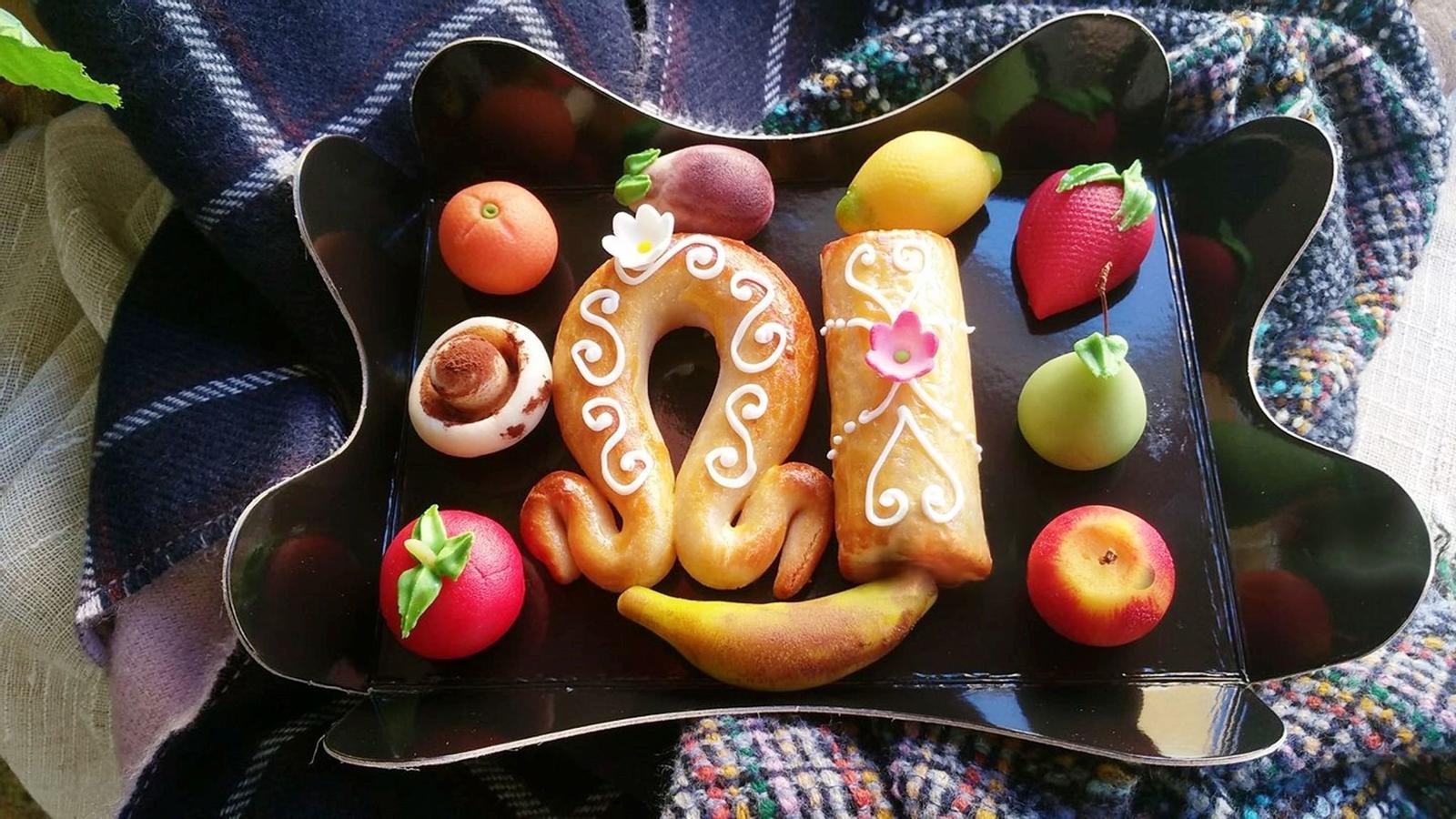
It is precisely amidst this feeling of longing that there are corners of the Valencian Country where, at the beginning of October, the season resists losing its color. Pastry shop windows fill with marzipan fruits: oranges, lemons, cherries, strawberries, and pumpkins appear arranged on the counters, modeled with such precision that they look freshly picked. Beside them, the figures of the piuleta and the tronador recall an ancient festival, when gunpowder perfumed the streets and firecrackers broke the sky.
This landscape of colors, shapes and flavors is the result of a custom that every October 9th puts love back at the center of the celebration. The story of the mocadorà, however, cannot be explained as a tradition born whole in a single moment. It is the result of several customs that met around the same celebration. Between the memory of a territory, gunpowder, marzipan and the custom of giving gifts, the mocadorà of Saint Donis would end up taking shape.
The trace of a silenced celebration
To understand how it was born, one must go back to the date itself. October 9th is a day linked to the history of the city of Valencia: in the year 1238, James I entered the city after the conquest and, over the years, that day became a public celebration. The first centenary, in 1338, gave rise to commemorative acts and, finally, the festival began to acquire an annual dimension also linked to Saint Dionysius. Gunpowder and fireworks soon occupied a prominent place there, to the point that on the eve of the festival, the streets and buildings of the city could be filled with firecrackers and pyrotechnic shows.
For centuries, that celebration lived on the street. But after the War of the Spanish Succession, the Nueva Planta decrees of Philip V prohibited the public commemoration of October 9th and, with it, the acts that accompanied it. The festival lost its official expression, but some of its symbols found other ways to survive. The memory passed into homes and workshops, and what had been part of a public celebration began to take on smaller and more domestic forms.

According to one of the most widespread explanations regarding the origin of these figures, Valencian confectioners supposedly reproduced in marzipan some of the firecrackers that had disappeared from the streets. The piuleta and the tronador were thus converted into sweets: two forms that recalled gunpowder without the need to light any fuse. The fire had disappeared from the sky, but its symbols could still rest upon a pastry shop counter. Over time, these same pieces have also received another reading: that of seeing in them an allusion to the male and female bodies. An interpretation that has taken root in the popular imagery of the mocadorà and that endows the set with an even more intimate meaning.
Alongside these figures appeared marzipan fruits, inspired by the products of the Valencian orchard. Oranges, lemons, cherries, strawberries, or pumpkins turned the almond paste into a small edible landscape. According to tradition, these pieces evoked the fertility of the Valencian orchard and recalled the offering of fruits and vegetables that the people made to Queen Violant of Hungary, wife of James I. A gift reserved for a long time for special occasions and progressively linked to the celebration of Saint Dionysius.
The way these gifts are presented has also been evolving. The cloth handkerchief became the traditional wrapping for marzipan sweets and ended up giving its name to the custom. Today, however, it is also common to find them arranged on pieces of Manises ceramics, linked to the Valencian artisanal tradition. The mocadorà has thus been incorporating new ways of being presented without losing the essence: gathering the sweets and offering them to a loved one.
A new saint for lovers
Saint Denis already had a history of its own long before becoming the patron saint of Valencian lovers. Dionysius is venerated by Christian tradition as one of the first evangelizers of Gaul and as the first bishop of Paris. Tradition explains that, in the 3rd century, he was beheaded together with his companions, Rusticus and Eleutherius. Then he picked up his own head and continued walking while preaching until he fell where the basilica dedicated to the saint would later be built. From this figure of faith and perseverance, devotion remained; from the coincidence of dates with the Valencian festival, a much more earthly patronage would be born centuries later.
The sweets that were prepared for the day of October 9th ended up becoming gifts for loved ones, until the custom acquired a dimension of its own: gifting marzipan figures to someone special. What had begun as a product associated with marked occasions thus found a new way to express affection.
The handkerchief, however, would still take time to arrive. The name mocadorà, used to refer to the set of sweets wrapped in this piece of cloth, is later and became established in the 19th century, when this piece of fabric became one of the usual supports for the gift. The custom added a second part to the present: after eating the marzipan, the cloth remained as a souvenir.
Over the years, the custom of gifting these marzipan pieces became established and took root especially in the pastry shops of Valencia and nearby towns. The tradition has been adapting its forms and presentations, but the underlying gesture has not changed: gifting sweets as a sign of affection.
When love wraps itself
There is a certain intimacy in the moment of entering a pastry shop to look for a mocadorà. Because its true value is not so much in the sweetness of the marzipan as in the thought that accompanies it: knowing who it will be brought to, imagining their face upon receiving it. Nothing simpler, and nothing more difficult to explain.
It is no coincidence that this custom has ended up being associated with Saint Dionysius, the patron saint of Valencian lovers. Just as the saint continued walking with his head in his hands, without stopping doing what he had set out to do, love is also, many times, a matter of perseverance: that of someone who, year after year, repeats a gesture that they already know will make the other person happy.
The sweets run out, the colors blur and the days go by, but often the handkerchief remains folded in a drawer, kept without really knowing why. A sole witness to that moment when someone, on an October 9th, thought of us.
Perhaps the mocadorà has survived for so many centuries and so many things for a very simple reason: at the end of the day, to love is to find someone before whom you do not need to hide anything and with whom we can feel vulnerable. Someone who becomes a refuge when the days are heavy, a calm when everything moves fast, and with whom the only thing that hurts is having to part. Every October 9th, however, the story begins again: there are those who enter a pastry shop, choose a handkerchief full of marzipan, and bring it to someone they love. Nothing else needs to be said: it is enough to leave it in the hands of those we love.

