The rise of the Besòs puts the magnifying glass on the future neighborhood of the Three Chimneys
Outside of Barcelona, flood prevention clashes with the lack of municipal resources and the difficulties of coordination between administrations
-
CAT -
CAST
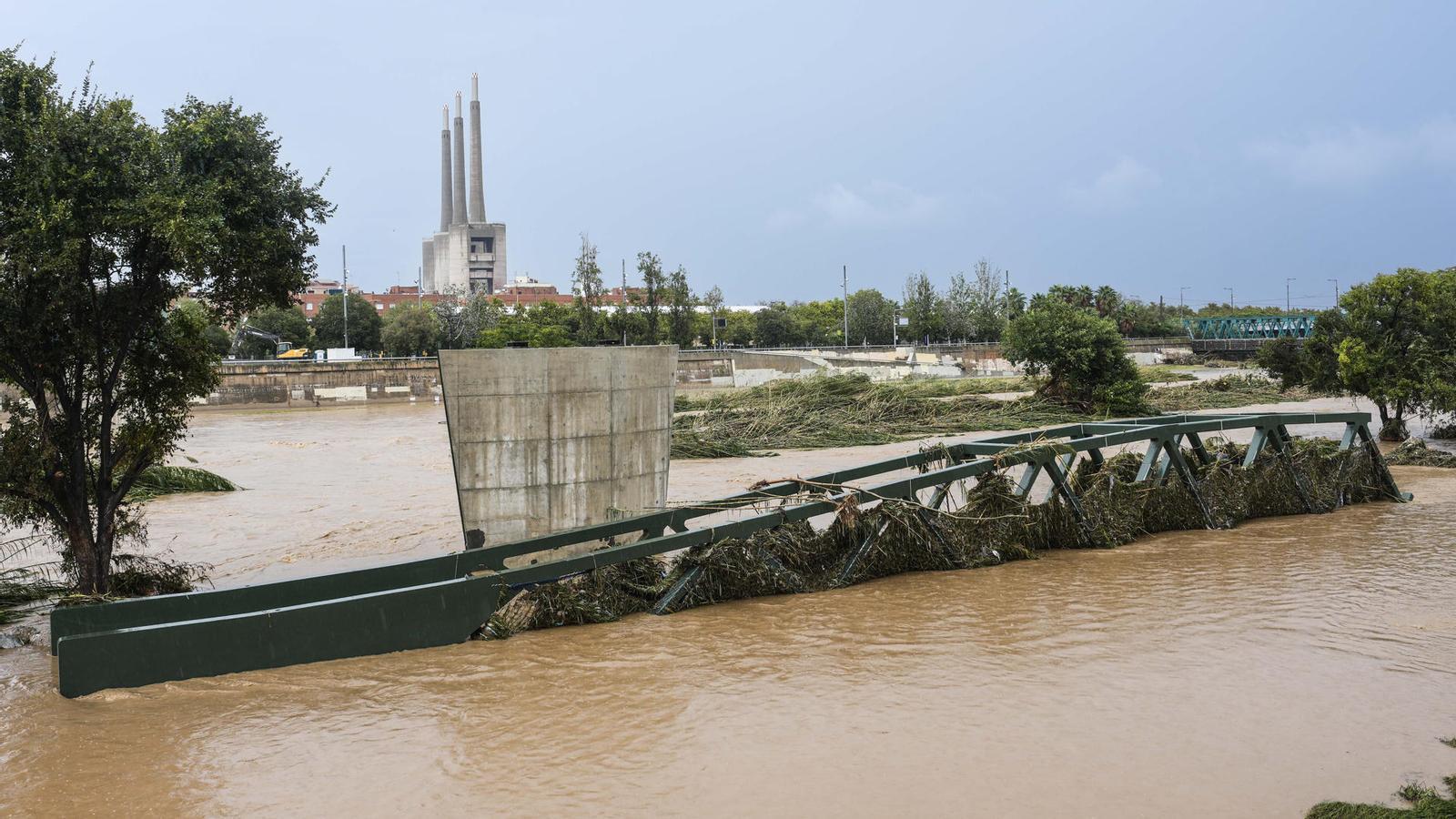
BarcelonaThe images of the Besòs river full to the brim and about to overflow a week ago have been one of the most prominent photographs left by the storm of recent days on the Catalan coast. A scene that had not been seen for decades and that not only made many in the area remember tragedies like the 1962 flood, but also put the spotlight back on the urbanization project around the Three Chimneys of Sant Adrià.
This plan, which foresees redeveloping the surroundings of the river mouth and providing continuity for Sant Adrià del Besòs to the seafront between the Forum and the port of Badalona, involves, among other things, the construction of 1,800 homes in the area. A new neighborhood that from the beginning has faced opposition from some neighborhood and environmental platforms, which denounced that it was being built in an area sensitive to environmental risks both from maritime storms and from the risk of the river overflowing. After the downpours of these days, these platforms have redoubled their pressure.
Faced with the revival of the debate around the project, the Besòs Consortium—the entity promoting the project—defends the viability of an urban plan that, they argue, "allows for what has not been done for decades." That is to say, acting on the territory and adapting it to climate change not only to reduce the risk to the new neighborhood but also in those neighborhoods that are already in the river's area of influence. "It is absurd to believe that, because it is floodable, we should not do anything there. If humanity accepted this logic, there would not be a Japanese person left in Japan, nor a Dutch person in the Netherlands," has defended these days the general director of the Consortium, Ferran Falcó.
A floodable park and a higher elevation
Among the arguments put on the table by the Besòs Consortium, it highlights that the Urban Master Plan (PDU) already provides for different measures to reduce the risk of flooding. For example, the new Llevant collector, which should allow for accelerating the water's exit to the sea in case of flooding; raising the level of the new neighborhood's main street by about three meters to facilitate drainage; the creation of a coastal park of nearly 90,000 square meters that is flood-proof and facilitates water infiltration; and the creation of underground passages that act as siphons in case of major floods.
The entity also points out that the downpour of these last few days was very significant because it caused the river to reach 937 m3per second, but they remark that this volume of water "remains clearly below" the floods foreseen in the flood risk studies that accompany the PDU. The revision of the Flood Hazard and Risk Map (Mapri) that was carried out in 2024 was done anticipating 500-year return periods, with flows exceeding 3,160.9 m3per second.
The Consortium does admit that the storm has highlighted the importance of advancing other actions that remain outside the PDU. Among the priorities is raising the level or directly replacing the railway bridge, which they consider "the main critical point" because its configuration acts as a bottleneck for flow capacity.

Urgency and limited municipal resources
Reducing the risk of floods is not just about channeling streams or expanding collectors, but also about planning urban growth, maintaining drainage infrastructure, and identifying points where water can accumulate or overflow. Less than a year ago, the Catalan Water Agency (ACA) updated the map of river, stream, and ravine sections in internal basins at risk of flooding, incorporating 90 new ones. These correspond to about forty municipalities located in the Ter-Daró, Tordera, Besòs, Llobregat, Foix, and Francolí basins, as well as various streams in the Montsià region, and they extend the sections by 172 kilometers compared to the 2018 map.
More and more areas are threatened by overflows and floods. Just during the last week, more than 360 liters per square meter accumulated in the Vallès Oriental, and serious floods were recorded there, with Granollers as the epicenter. In Barcelona, it also rained like it had not in 60 years, and in the Maresme, underpasses, streets, facilities, and roads were affected. And in August, a storm lashed the Tarragona area and brought back to the table a problem shared by many local governments: the insufficient capacity of drainage and water evacuation systems.

One of the main obstacles in this planning is the cost of the actions: not all town councils can assume the investments with their own resources. Furthermore, in some cases, to carry out works they depend on different administrations. In Torredembarra, for example, the August rains exceeded 200 litres per square metre and turned car parks and streets into swimming pools, in addition to flooding ground floors and underpasses. One of the solutions proposed is to build a storm tank there, an infrastructure that would allow temporarily retaining part of the rainwater and reducing the flows that reach the drainage network. The cost, however, is several million euros.
Ponds and trains
The ACA offers aid lines to finance actions and works to prevent flooding, such as de-impermeabilization and the maintenance and conservation of riverbeds. As they explain, in certain cases the subsidy can cover the entire cost of the actions, but the process is long: first, it is necessary to present the projects, process the applications, obtain the corresponding authorizations in accordance with certain government criteria and, finally, execute the works.
In Salou, the Barenys ravine has caused recurring floods and a new canalization is currently being built, with an investment of 20 million euros. Meanwhile, in Altafulla, the construction of a storm tank is being promoted at the entrance to the municipality to reduce the risk of flooding in the maritime neighborhood, but the project still has to receive approval from the ACA in order to be designed.
And in Roda de Berà and El Vendrell, part of the problem is related to state infrastructure, such as the N-340 road and the train tracks. According to the mayors of these municipalities, they alter the path of the water and can accelerate its flow, creating death traps or preventing the water from evacuating towards the sea. The solution, in this case, depends on coordination between administrations—the Generalitat, the State, and Renfe, for example—which the mayors are demanding, but which has not yet materialized. And in a context so prone to extreme rain, the challenge is none other than arriving in time for the next episode.
