"The regularization of immigrants is not intended for those who live on the street"
Roots advises homeless people to present documentation, despite the system's complication
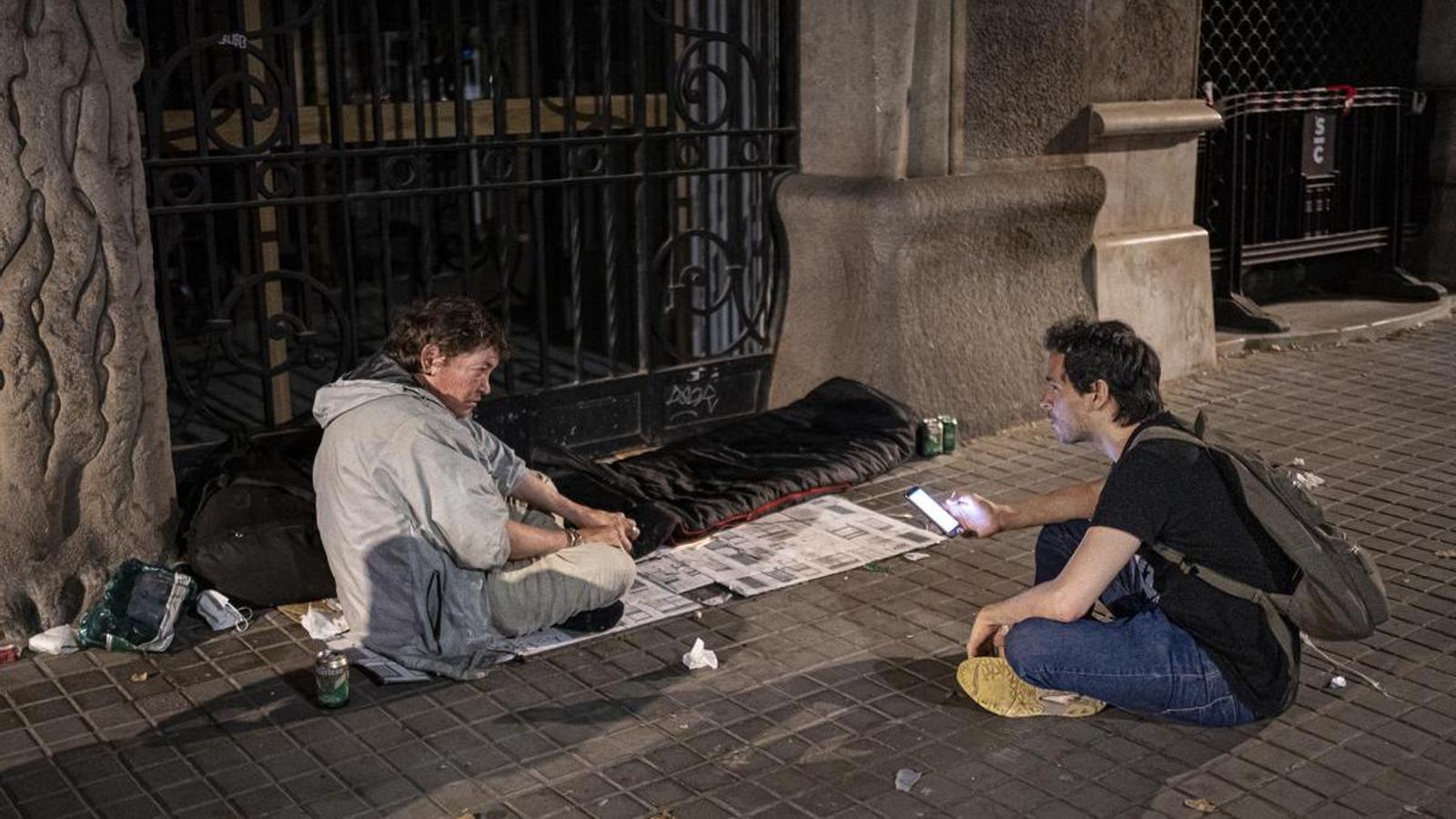

BarcelonaThe social exclusion of people experiencing homelessness is also evident in the extraordinary regularization process for immigrants, which is open until June 30 for half a million people across the country. It is evident because people who live on the street, in tents, or in settlements have great difficulty meeting the requirements – however lax they may be – when it comes to gathering the necessary documentation or even finding out that a process is underway and that they can benefit from it.
"The regularization process is designed for seasonal workers in Lleida or for those working in the informal economy, but not for those who do not have a roof over their heads," replies Anna Olesti, a lawyer with the legal team at Arrels Foundation, who, along with social educator Carla Ramos, is currently touring the city of Barcelona to inform homeless people they already know and who are not regular users of the day center run by the organization in the Raval neighborhood about the procedures.
Routines help find these people. Al Mohamed – who, like the rest, prefers not to give his last name – they find him on the bench where he has breakfast every day. Today he is eating a sandwich, oranges, and olives. He explains that his NIE – the identity document for non-EU citizens – was recently stolen, that it was expired, and that on another day a stranger injured his left hand in a surprise attack as he was passing by. Robberies, losses, and assaults are common, but often these crimes go unpunished.
to drink and urinate in the street for those who have no other homeRespecting the decision
Olesti and Ramos respect his decision and only tell him that "having papers is a first step to accessing rights." They are aware that for these people regularization is not a priority because little will change if they end up with a residence permit, just as they know that the big hurdle would be when they have to renew their papers a year from now, and then they would be required to have a one-year job offer. It is complicated to find a job for people living on the street, and impossible if they have been there for years.
On the route to regularization, Malik awaits them, who does trust that it can be an opportunity for him. He also recounts that the day before his mobile phone was stolen, but luckily a friend keeps all the documentation he has already gathered for the process to avoid last-minute scares. Malik arrived from Pakistan a year ago and had previously been an irregular immigrant in Texas, where he says he has family. He is looked after by a neighborhood resident who introduces himself as another "friend," who has accompanied him to do paperwork or to appointments with the Barcelona City Council services for immigrants and homeless people. "I have everything, everything, only the registration is left," warns the man.
However, the lawyer realizes that he has the police certificate from Pakistan, but not the criminal record certificate. Nor does he have the one for Spain. For the registration, it is not essential if residence can be proven with a library card, a mobile phone bill, or even with one of the fines that the Guàrdia Urbana imposes for drinking and urinating in the street to those who have no other home than the public highway.
The two professionals reassure him by telling him "that there is time" to apply for them before the deadline ends on the last day of June, but they also warn of the risk of making the mistake of requesting documentation from Arrels and municipal services and receiving a denial from the Immigration Office. So Ramos and Olesti will coordinate with their colleagues at the City Council to decide who will handle each task so as not to do work in vain.
"Man who always laughs"
Although both professionals affirm that social entities consider regularization as "an excuse" to get to know the people they assist more deeply. Building a trusting relationship can take months or years of visits, of talking with them, given the distrust, mental disorders, and social isolation that the streets claim.
Ramos explains that they recently managed to identify a man whom for a long time they had registered as "the man who always laughs on street X." Following the process, they asked him if he wanted to regularize his situation, and again, they received a negative response. However, they see the positive side: "Giving him a name and country of origin helps us to follow up if something happens one day and a hospital calls us because he is admitted, and that way we have him under control," argues Olesti.
