The project for the future Clínic foresees building 1,125 apartments around the campus
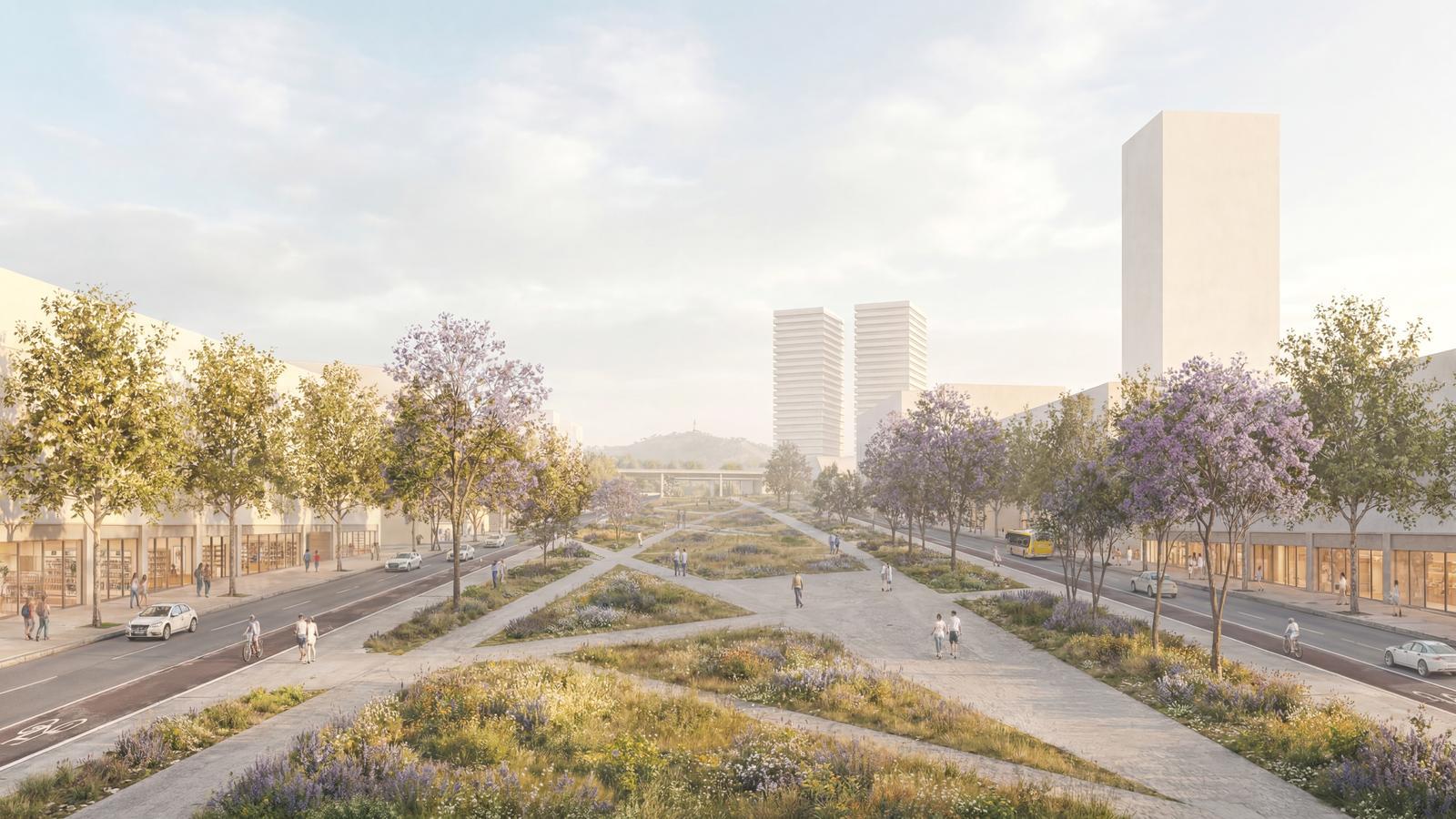
Three large green spaces of 22 hectares are foreseen that will act as ecological corridors between Collserola and Barcelona

-
CAT -
CAST
BarcelonaThe transformation of the border between Barcelona, L'Hospitalet de Llobregat, and Esplugues de Llobregat in the upper part of Diagonal, which will involve the relocation of the Hospital Clínic, continues to take shape. This Wednesday, the general council of the Porta Diagonal – Campus Clínic consortium has given the green light to the progress of the urban development plan (PDU), the document that will guide the entire metamorphosis of the area. This plan, for the first time, puts forward a figure for how much housing will be built around the campus. Specifically, it plans to build 1,125 apartments. Of these, at least half will have to be protected housing.
Regarding the distribution of this housing, the plan foresees that the majority will be built in L'Hospitalet, where nearly 800 apartments are currently planned. The remaining 325 will be on Barcelona land. The first detailed approach to the new housing is one of the novelties of an advance of the PDU that will now begin a citizen participation process until December. The objective of all the administrations that form the consortium is to be able to bring it to initial approval during the first half of 2027 so that it can receive definitive approval in early 2028.
After this Wednesday's meeting of the General Council of the Porta Diagonal – Campus Clínic Consortium – which is led by the Government and also includes representatives from the Hospital Clínic, the University of Barcelona (UB), the city councils of Barcelona, L'Hospitalet de Llobregat and Esplugues, the Barcelona Provincial Council, the Metropolitan Area of Barcelona and CatSalut – the Minister of the Presidency, Albert Dalmau, has applauded the understanding and "fit" between the three municipalities, "which have very different realities and needs".
Now, therefore, the objective is to continue burning stages of a calendar that has as its horizon the completion of the campus in 2035. It is one of the most ambitious projects underway in the country, with the transformation of 69.5 hectares of land. An initiative that must make it possible to convert a place that is currently poorly resolved, fragmented and borders three cities into a compact space that helps to reconnect the entire environment. In this regard, such as ARA explained, it is key to eliminate the "barriers" that today represent the link between the B-23 and Avinguda Diagonal and the Ronda de Dalt, to transform them into more user-friendly metropolitan avenues. In short, dismantle the escalèxtric that today welcomes the city if arriving from the south.
In some of the initial sketches that Barcelona Regional made before elaborating this PDU advance, it was planned to move the first traffic light on Diagonal –now on Albert Bastardes Avenue, next to the RACC building– to Països Catalans Avenue, in Esplugues de Llobregat. These nearly 800 meters of avenue that would be gained until reaching the new traffic light would be the continuation of a more pacified Diagonal Avenue.
All in all, stitched together by one of the key elements of the entire zone's redevelopment project: the three large green spaces that together must add up to nearly 22 hectares and that must act as ecological corridors between Collserola and the city. These are the extension of the Finestrelles promenade, the new park on Collblanc road, and the expansion of Can Rigal. Another of the keys is the arrival of the metro to the new campus. The Government's objective remains that in the second half of 2028, the works to extend metro line L3 can begin to bring it from Zona Universitària to Esplugues Centre.

Esplugues will host the new Faculty of Pharmacy
This Wednesday's meeting served to finalize another important decision. The new Faculty of Pharmacy and Food Sciences of the University of Barcelona will finally be located on Sant Mateu street in Esplugues de Llobregat. A location considered strategic because it will allow it to coexist with the Clínic-UB Health Campus, the Faculty of Medicine and Health Sciences, the Barcelona Science Park, and reference hospitals such as Sant Joan de Déu. The move will allow the faculty's capacity to be expanded to 3,000 students, 30% more than the current headquarters, which had become obsolete.
The new faculty will be financed thanks to the 135.25 million euros that the Generalitat agreed to pay the UB for the purchase of the land where the new campus is to be located and a direct subsidy from the Government of up to 17.5 million euros more. According to the planned schedule, the works on the new building should begin at the end of 2029 with the aim that the new faculty can become operational in the 2032-2033 academic year.
