The opposition attacks Collboni for ignoring social workers' strikes
Albert Batlle minimizes the labor protest of minority unions, whom he accuses of intimidating practices

-
CAT -
CAST
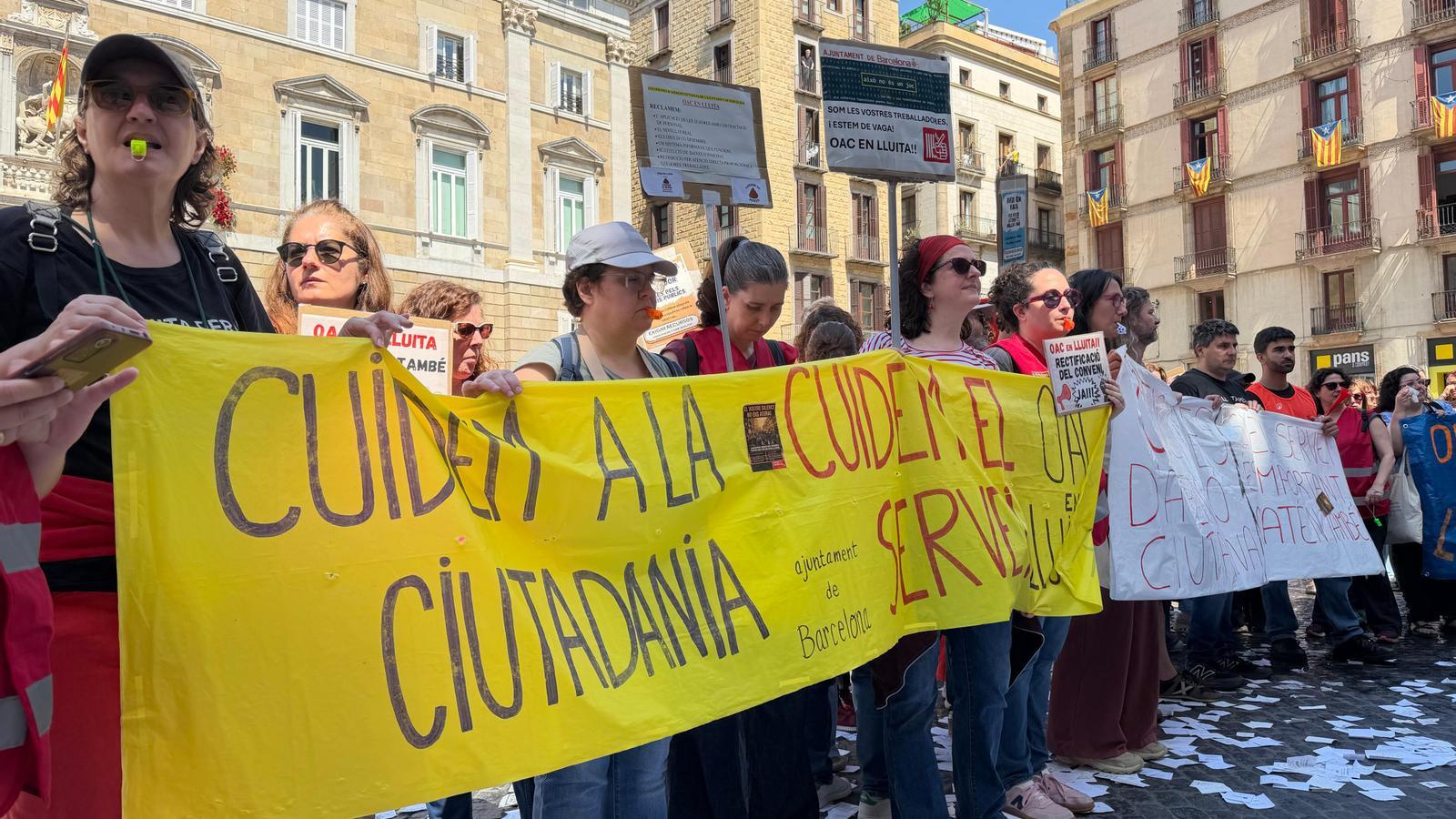
BarcelonaThere is one year left until the municipal elections and only ten days until the Pope's visit to Barcelona, and the labor conflict with part of the City Council staff is growing. In fact, social workers will maintain their strike for June 9 and 10, coinciding with the pontiff's presence. This Friday, in an extraordinary plenary session requested by the Junts, Comuns, and ERC groups, Jaume Collboni's government has been left alone with Vox against opening a dialogue space with the three minority unions –CGT, Intersindical, and ABACOS, with only 3 out of the 15 members of the negotiation table–, who have called for 30 days of partial stoppages in basic social services, gender-based violence, childhood, libraries, nursery schools, social emergencies, or citizen attention.partial stoppages in basic social services, gender-based violence, childhood, libraries, nursery schools, social emergencies, or citizen attention.
The labor conflict opened in the consistory due to the disagreement of these three unions with the collective agreement signed with the majority unions (UGT, CCOO, and CSIF) has served for the opposition groups, except for Vox, to criticize the municipal government for not listening to the demands of the striking workers, who are demanding an improvement in salaries, but also in staffing levels to reduce the overload due to the increase in users and more budgetary investment for the services.
The clue that the plenary session would not be a calm one for the municipal government is that the three opposition groups have reproached it for the delay in the extraordinary convocation. Both ERC and Comuns had supported the new collective agreement in the January vote (while Junts abstained), but in these months in which stoppages in services have occurred, they have all agreed that it has become clear that the discontent indicates that the deterioration in the quality of care is not "perceptions," but "a reality."
The Comuns councilor Marc Serra has shown the group's change of opinion, which has gone from supporting the agreement to, on the one hand, denouncing that the City Council has applied social cuts and has halved the housing units it allocates to the Emergency Table and, on the other hand, criticizing the proposal for new salary supplements for municipal executives. All of this, he indicated, "has made the cup overflow." Therefore, Serra has urged Collboni to make "a 180-degree turn" and replace the deputy mayor Albert Batlle at the head of the negotiation with the unions as the head of personnel for the City Council.
Also from Junts, Josep Rius has urged the mayor to "rectify" and "roll up his sleeves" to resolve the labor conflict. The Junts member has justified his group's abstention in the vote on the collective agreement as a "defense of collective bargaining", but has also pointed out that the doubts they raised "have proven them right".
Overload and lack of dialogue
The opposition has lamented the executive's lack of self-criticism in the face of protests by some workers and has accused it of pouring "gasoline on the fire" with statements against minority unions. Thus, it has embraced the demands of the striking workers, who, in Rius's words, are "saturated and tired and feel unheard." The republican Jordi Coronas referred to the overload suffered by all municipal services due to the increase in users, the lack of staff, and also the workers' "despair" for "not being able to meet the needs" of the population. "Putting people at the center also means improving their working conditions. They are asking for a manageable workload, they are not asking for the moon," said Coronas, who – like Rius and Serra – stressed that the deficits are not due to a lack of budget, because "there is money."
Rius insisted that the problem is "the political prioritization" by the council. From the PP, councilor Antoni Verdera has called for a detailed diagnosis of each service to know the number of professionals and their true working conditions, and also warned that "the quality of social services" in the city is at stake.
On the other hand, Batlle did not feel alluded to by the criticisms of the lack of dialogue and listening and began his speech with an "express condemnation of certain intimidating behaviors" by the three minority unions, whom he accused of attacking the headquarters of the majority unions and of wanting to boycott a municipal commission. The deputy mayor accused the opposition of listening to "the most belligerent and minority part of the conflict against the majority unions."
The agreement reached in January addresses a "historic demand" for a reduction in working hours and an automatic salary increase that cannot be ignored, according to Batlle, who has refused to open a channel with the minority unions. "Dialogue and listen to the majority unions. We must negotiate at the dialogue points, not in the square," he concluded. Later, in statements to the press, the number two of the City Council, Laia Bonet, softened Batlle's stance by assuring that there is space at the dialogue tables to discuss improvements.
