From TikTok to looting a city: the Blocus "method" that puts Europe on alert
Experts warn that social networks are not being monitored correctly to foresee massive movements

-
CAT -
CAST
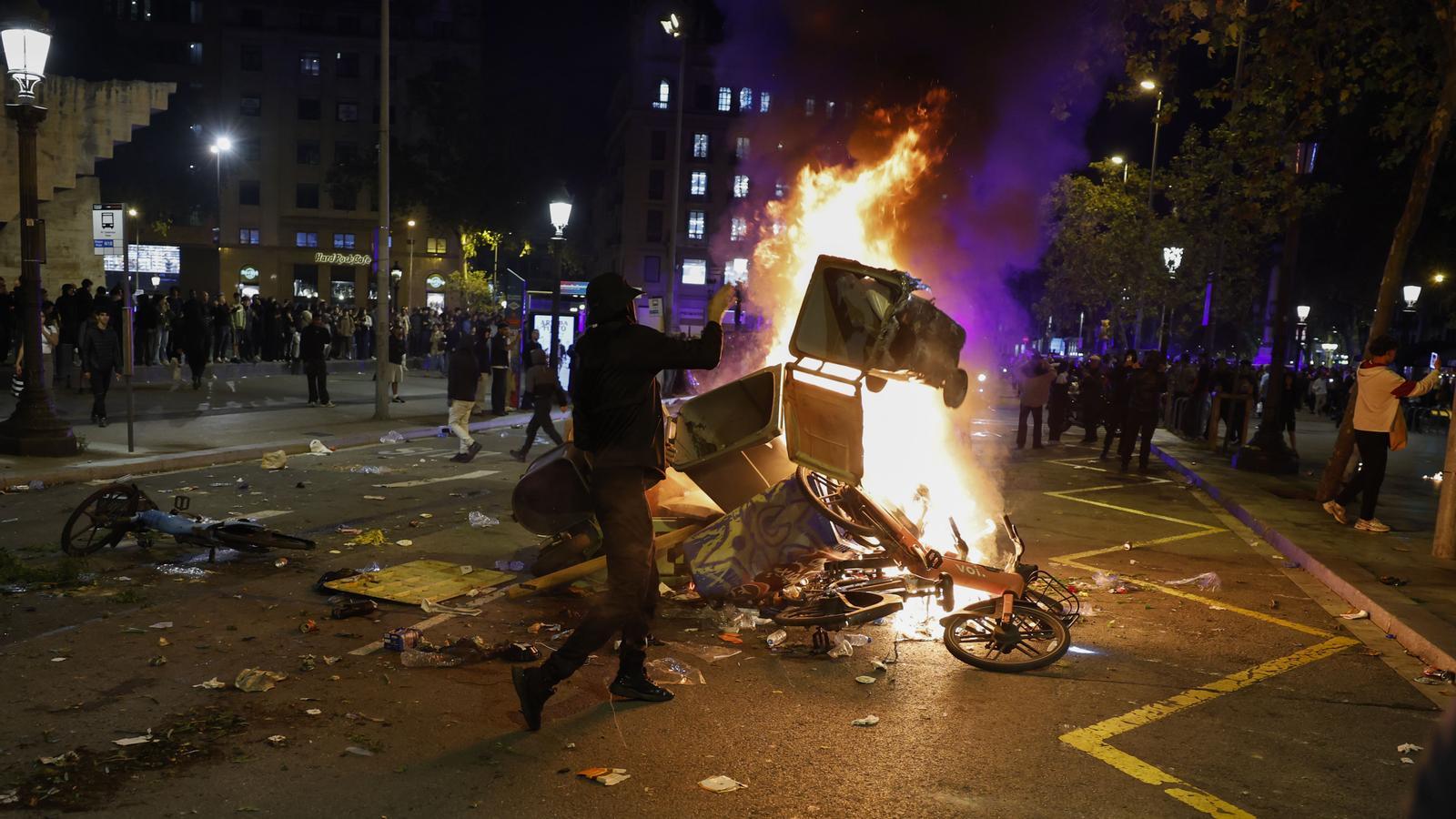
BarcelonaIt is not yet known who is behind the riots and looting on Saturday in Barcelona, but experts are already talking about a "method" that originates on social media and quickly moves to the streets. It begins with a call to mobilization shared by various anonymous TikTok users. They post posters made with artificial intelligence that aim to stimulate citizen unrest and encourage protests. They are designed to attract attention and manage to attract as many people as possible. Interested users are redirected to Telegram and WhatsApp groups, where hundreds of people meet, and it is from these groups that they organize with speed. But their goal is no longer to demonstrate, but to collapse the city and loot: the members know where they have to go, at what time, and even how they have to be dressed.
In the case of Barcelona, the Mossos d'Esquadra were expecting protests this Saturday because They had been monitoring social media for days and had detected calls to emulate the riots in Paris. They even knew that there were Telegram groups with 700 young people, but it surprised them a lot, because they did not expect that that so many of them took to the streets. The journalist Carmela Ríos, who is an expert in social networks, explains that, just as happened in France, the TikTok profiles that echoed the call in the Catalan capital used the name Blocus, which means blocking in French, and the posters had an aesthetic and imagery similar to those of the protests in the French capital. For this reason, he believes that "the work of monitoring social networks is not being done correctly" in Europe, and that with current tools, the authorities are not capable of "calibrating the magnitude" of these movements.
Security and social media expert Marcelino Madrigal argues that this "method," which begins on social networks and moves to the streets, should not be analyzed locally, but rather seen as a problem affecting all of Europe, which is why it uses a name recognizable in different countries, such as Blocus. Once it occurs and hundreds of people take to the streets, catching the authorities off guard, social networks once again play a central role as they act as an amplifier for the protests, according to Ríos. The expert cites as an example the fact that some of the young people who participated in the looting in Barcelona broadcast it live through their TikTok profiles, which has favored the copycat effect.
Ríos also links the protests in Paris and Barcelona to the massive entry of people that took place in Ceuta at the end of July, as in her view they follow a very similar pattern, and she does not hesitate to point to it as a form of hybrid warfare. Madrigal, on the other hand, believes it is premature to speak of hybrid warfare, although he acknowledges that there may be geopolitical or economic interests behind it. In parallel to the police investigation, Madrigal warns that the looting is being attempted to be instrumentalized from all political prisms: the extreme right links it to immigration, the opposition holds Pedro Sánchez's government responsible, and left-wing parties accuse far-right groups.
Tightening regulation
Given this scenario, Ríos believes that governments across Europe must ensure that companies responsible for social networks, such as Meta and TikTok, collaborate with the authorities to get to the bottom of the matter and discover who is behind these anonymous users. "The relationship with these companies must be toughened. We are seeing a power struggle," the expert maintains. Madrigal agrees with her and regrets that, although the European Union (EU) regulations provide for sanctions against these companies, they are not being applied. "Does the crime begin when someone breaks a window and takes a handbag or does it begin when looting is instigated?", asks Ríos, who insists that without the collaboration of the companies it will be very difficult to respond to these mobilizations.
The truth is that for the moment it has not yet been identified who is behind these anonymous profiles, but experts are already pointing to a modus operandi that is repeated in different parts of Europe with a defined pattern. "Now it is mass migrations and looting. What will come next?", poses Ríos.

