The medieval mill that became a refuge for anti-fascists
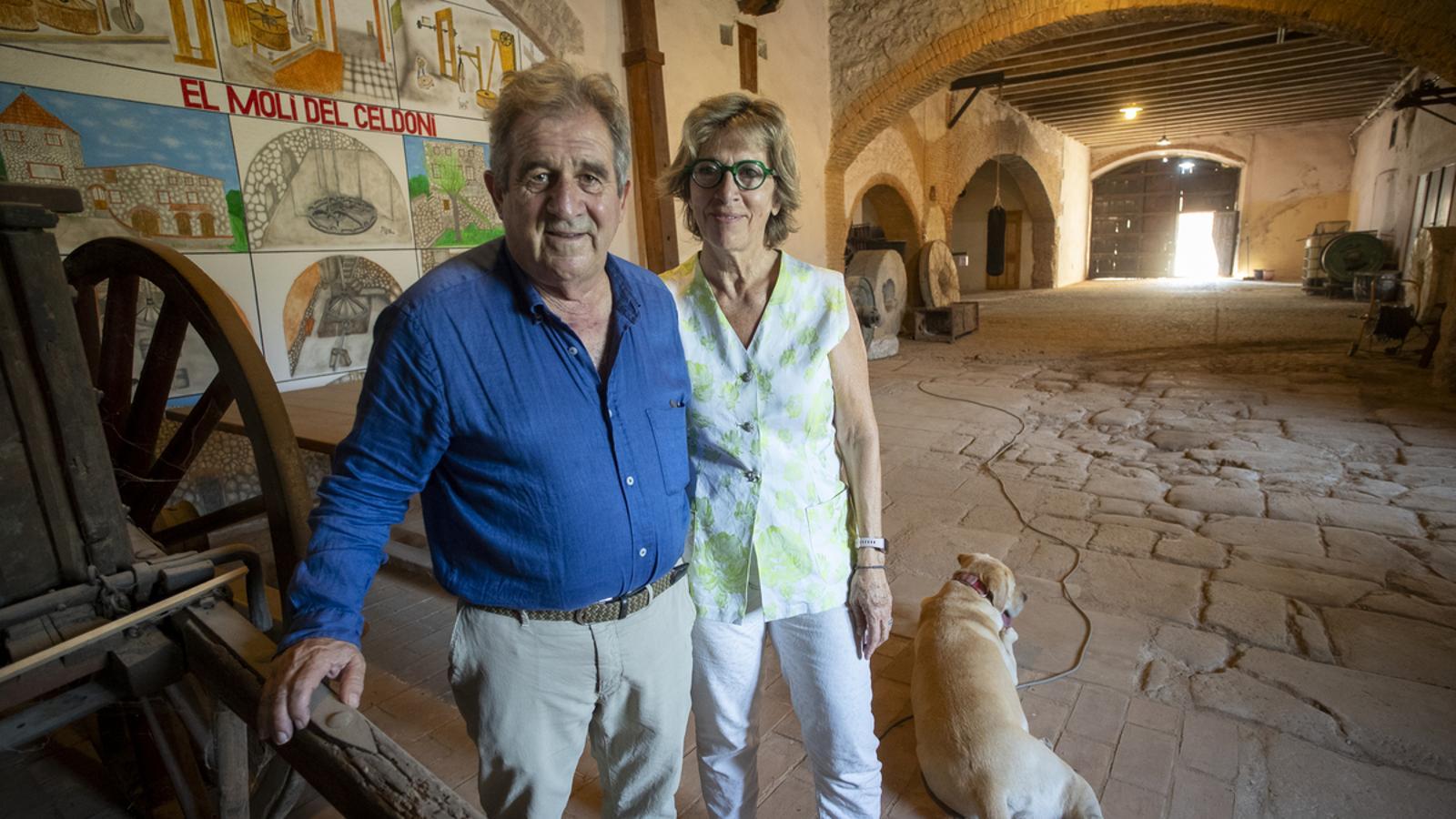
Pep and Dolors live in Montblanc on millstones and gears to crush stone

-
CAT -
CAST
MontblancPep and Dolors's house is like a time tunnel: as you go down floors, you change centuries. And after descending winding stairs and passing through rooms full of millstones and gears, you reach the medieval age. There are official documents that already mention this mill in the year 1195, after the Christians expelled the Muslims, but it's most likely even older.
El Molí de Celdoni, in Montblanc, had the canons of Santa Maria la Major de Montblanc as its owners, and over time it changed hands, always among different religious orders. It remained this way until the disentailments began, which started at the end of the 18th century and put those lands and properties that were not being productive and that, mostly, belonged to the Catholic Church on the market. At first, no one was interested in this ancient flour mill, located a kilometer and a half from Montblanc, but in 1872, in the midst of the Industrial Revolution, Pep Andreu's great-grandfather bought it and gave it a new use. The millstones stopped making flour to start crushing stone.
Pep Andreu's family came from Pira (la Conca de Barberà) and there, as in Sarral, there was a lot of alabaster, a variety of gypsum with different uses. In la Conca de Barberà and also in l'Alt Camp, paper industries proliferated, needing the calcium sulfate obtained from alabaster. “There was demand, the stone was transported by carts from the quarries of Pira to here at the mill and, once ground, it was taken to the train station of Montblanc, from where it went to the industries of La Riba and Picamoixons,” explains Pep Andreu, who was the mayor of Montblanc for eighteen years. Because he lived in a mill, Andreu is passionate about them: “On the Francolí river and its tributaries alone, there were as many as 146 hydraulic mills,” he recalls.
Exiled for being anti-fascist
When his family bought the mill, he didn't move in. It was just a business and only the miller lived there. The first of the family to settle in was his uncle, Anton Andreu i Abelló, and he did so somewhat by accident. Anton Andreu i Abelló was one of the founders of the Front Nacional Català, a patriotic movement born among members of Estat Català, and he had to go into exile in France after the defeat against the Francoists. Supporters of armed struggle, from the FNC they entered Spain clandestinely and carried out espionage tasks for the English: they helped many trapped allies to escape.
In 1947, upon returning from exile, Andreu i Abelló —who was the brother of Josep Andreu i Abelló, president of the Court of Cassation during the Republican Generalitat— was sentenced to eight years in prison, but he did not have to serve them. However, he was banished to more than a kilometer from his city: Montblanc. Without a doubt, the family mill was the ideal place. "Many meetings of the Front Nacional have taken place within these walls," says Pep, smiling. Anton and his wife, Pilar, adapted the upper floor of the mill as a dwelling and lived there until their death in 1988. After them, a cousin moved in, and in 1993, after getting married, Pep and Dolors came to live there. What did not change during all this time was the activity of the mill, which continued grinding stones until 1996.
A museum at home
With sensitivity to history and culture, Pep and Dolors preserve the Molí de Celdoni in very good condition. They even have the tools needed to operate the gears hung in an orderly manner and keep millstones everywhere. Some are completely twisted and worn out after so many years of grinding everything, but there are others that still maintain their original shape. They also preserve the large pond, which is fed by the water from the Francolí river. Since the mill no longer works and they do not need the force of the water to operate the millstones, as soon as the water reaches the pond, it flows out again towards the Francolí.
Currently, within these walls crossed by centuries of history, live Pep and Dolors along with their two children and the older one's partner. And running around the house too is Danc, a Labrador Retriever who never stops wagging his tail when you scratch his head.
