Raúl Moreno: "The immense majority of the people who sleep on the street have been evicted"
Minister of Social Rights and Inclusion
-
CAT -
CAST
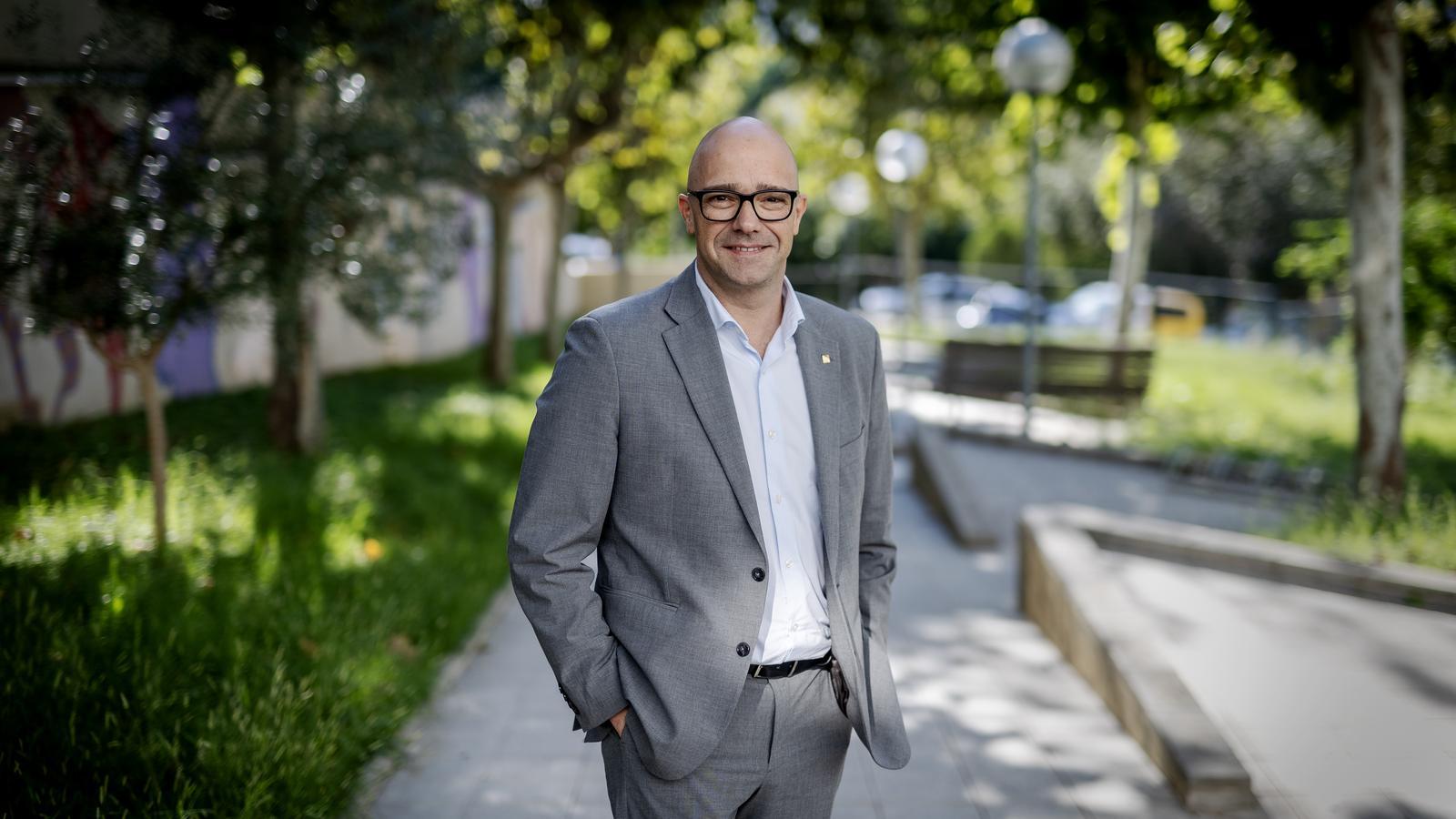
Santa Coloma de GramenetIt has been just over two months since Raúl Moreno (Barcelona, 1978) has been at the head of the Department of Social Rights. ARA interviews him for the first time since he took office as minister at the Ramon Berenguer nursing home, in Santa Coloma de Gramenet.
Why did you summon us to this nursing home?
— The renovation of all the air conditioning was finished just a few weeks ago. The Generalitat has allocated two and a half million euros to it within the Climate Plan, because climate change means we must ensure that people live in safety and comfort. We have launched a plan to install air conditioning in 50 residences in Catalonia with an investment of 58 million euros. For the rest of the private centers, which do not belong to the Generalitat, we are enabling a credit from the Catalan Finance Institute (ICF) of 50 million euros so that they are air-conditioned before 2031.
Furthermore, the sector is demanding more places and more hands.
— We committed ourselves in these four years to create 6,000 new subsidized places and by the end of this year we will have already met this goal. In two and a half years we have done everything we wanted to do in four years. It is the largest provision of residential places that has ever been made in Catalonia. President Illa said that, obviously, if we have 15,000 people on the waiting list, we need to expand, and also due to the aging of the population, it is necessary to reach 20,000 places by the year 2030.
But there are Catalans who die before getting the place. Is the volume of people who will need care in the coming years acceptable?
— Yes, it is achievable. We are going as fast as we can, but to contract places, the residences must be built, and here we need the collaboration of the sector, which has been very cooperative in enabling this. The waiting list is 15,000 people; we are proposing 20,000 places, adding these 6,000 that we have already created. Therefore, a certain increase is indeed foreseen to respond to the aging of the population. We are trying to make up for lost time and obtain the maximum number of places possible.
At this moment, what is the waiting list for the dependency benefit?
— We found a list of about 63,000 people and a 400-day wait to receive a benefit between the time they requested it and the time they received it. And that is intolerable for a country like Catalonia: the entire circuit had to be redone. We are carrying out the assessments telematically with 148 hires and this allows us to reduce the deadlines. Furthermore, in 2027, primary care centers (CAP) will be incorporated to be able to make the request. The goal is to go from 400 days to 60 by the end of 2027. We have already seen that it is viable with a pilot project in Vic.
How has the care for vulnerable children changed with the new DGPIA?
— We have tried to include a much more preventive vision, not only in situations of emergency or helplessness. It allows us to try to reduce cases of institutionalization and, therefore, that minors, whenever it is possible to work on it, can stay with the family; which is also better for the minor's development. The reports from the Court of Auditors and the Ombudsman pointed out errors prior to this Government, but we still wanted to know what happened in order to be able to make these modifications.
Were these modifications necessary?
— The system is not infallible, but it is not a bad system. It is protecting around 6,000 young people across the country. Therefore, it works. Young people have their own lives and make their own decisions. We are talking about young people who, from the point of view of their social or family situation, come with very complicated experiences. It is a system that works thanks also to its professionals and to the set of modifications we are making. It is always improvable and that is what we are trying to do.

In view of the humanitarian crisis that is still being experienced in Ceuta, can you tell us when the first children will arrive for reception?
— The Spanish government is installing a series of services to be able to take these children off the street, which is fundamental to register them. Within this process, there is a part that involves being able to contact the family and the country of origin to see if a return is possible. What we have said is that, as a Government, we will be in solidarity. Catalonia is the autonomous community that has historically welcomed the most unaccompanied migrant youths. And this must be taken into account. I believe that the rest of the communities must also make an effort to adapt their reception services to this reality. Thus, those who have already made efforts will be able to collaborate in a specific way, and those who have not yet done so will have to pull their weight. We do not have to decide whether we should welcome or not. We have a moral, but above all legal, obligation to welcome unaccompanied migrant youths who are in a situation of helplessness.
This crisis has amplified hate speech. How do you think it should be combated?
— From all sides, because it is an absolutely divisive discourse, which seeks to point out the different, and not because they are immigrants, but also because they are poor. It is a discourse used by Vox and the PP to try to criminalize in a very complicated situation. With this refusal to seek solutions, what they are doing is perpetuating the problem in Ceuta. And while politically it may be profitable for them, we have a very complicated situation from the point of view of human rights that affects adults, but fundamentally children, and that we should not allow ourselves as a society.
What will happen if a community refuses to welcome these children?
— The competence for the protection of minors belongs to the autonomous communities. They can refuse, but they will face repercussions from a judicial point of view. I would ask them if they are willing to break the law.
Minister, how many people live in a situation of homelessness in Catalonia?
— Around 8,000 people. In Barcelona, there are 2,000 sleeping on the street and another 2,500 sleeping in facilities. There are also some in Lleida, Girona, in the large capitals, and in small cities that previously did not have phenomena of homelessness and now do. The vast majority are people who sleep on the street due to housing issues, who have been evicted, who can no longer pay for their housing. Almost half of these people who have ended up on the street work, have a salary, but it is insufficient for them to be able to rent, even a room in Barcelona. Furthermore, homelessness can bring associated mental health or addiction problems. These are situations of extreme fragility.
The figure is growing, but emergency accommodation resources are lacking.
— Yes. The housing crisis also has an impact on the social emergency housing that we can set up. It is the central problem of inequality in our country at this moment. Everyone suffers from it, people who are on the street, people who are evicted, or those people who are working and find it very difficult to access housing due to the prices they have. We accompany those people at the moment they are evicted and try to provide temporary resources.

But more are needed.
— Yes, before the year ends we will allocate 10 million euros so that it is the city councils that build them, since we do not have jurisdiction in this regard. We are working to be able to have a social housing stock that allows us to also compete with other European cities and lower rental prices.
Finally, minister, the department is already managing the minimum vital income and the guaranteed citizenship income. How do you assess this?
— We have made it easier and now it can be requested online. Since October 1st, we have received 3,000 applications. There are many people who think that we have benefits that do not apply to them, but they are likely entitled to them. Right now, the guaranteed citizenship income reaches 23% of people in situations of severe poverty. Imagine the capacity we have to grow. Our goal is to have all benefits integrated into a single window and be proactive in informing citizens so that they can, in a single place, know which aids they are entitled to.
