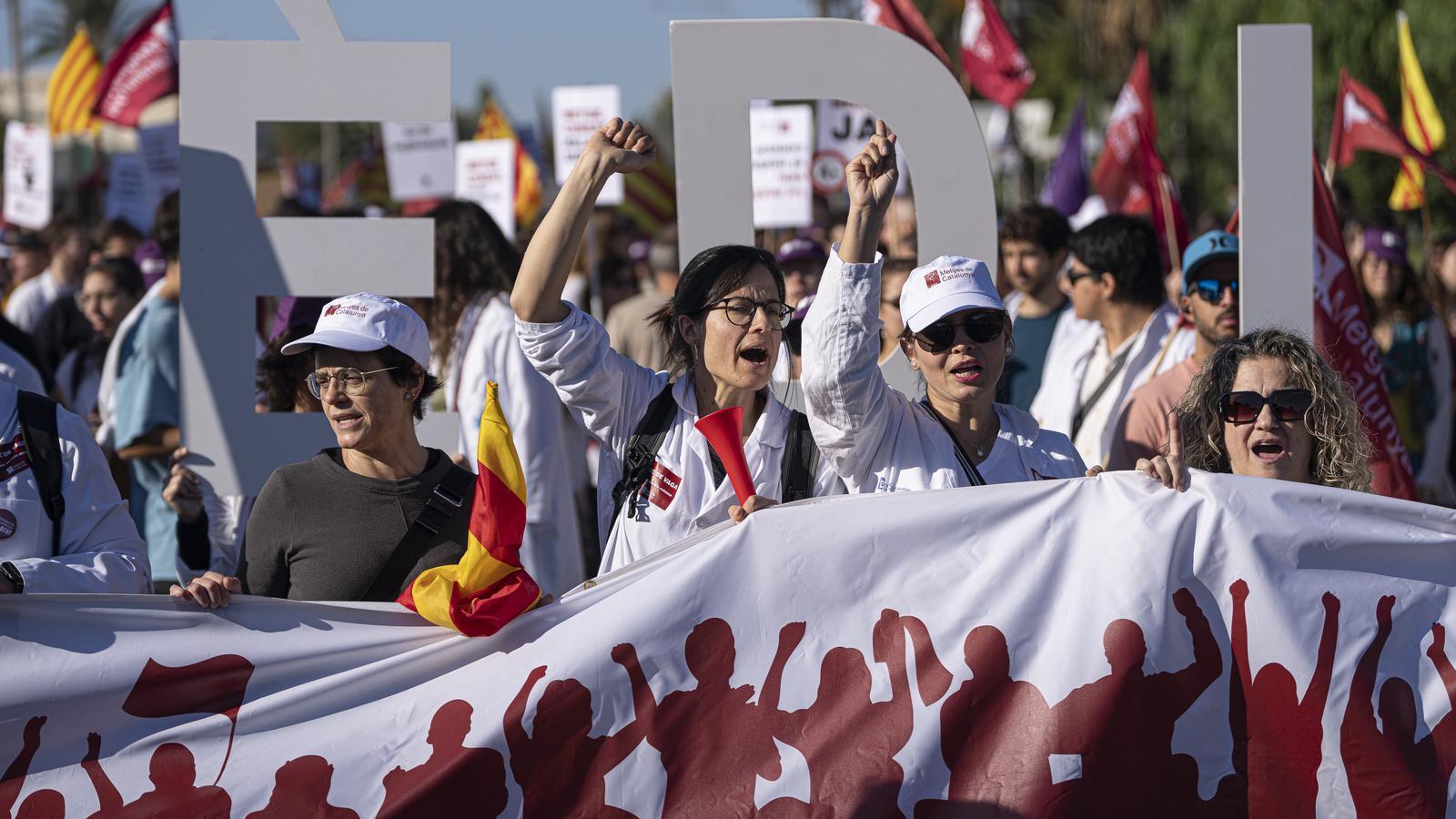
BarcelonaUnlike other unions, which have postponed sectoral strikes following the call for elections and the general strike on November 11th, Metges de Catalunya has called on medical professionals in the public healthcare system this Wednesday to go on an indefinite strike. It is the twelfth strike call this year from the group. "They can negotiate or call elections and leave for being incompetent," stated the union's secretary general, Xavier Lleonart, in reference to the "two options" that the Department of Health and, by extension, the Generalitat, have on the table to suspend the strike.
Lleonart has warned that the strike will impact the healthcare system, as it "will suffer the uncertainty of not knowing who and when will strike" and there will be effects on the service "every day". "Counselor [Olga] Pané and President [Salvador] Illa have the dubious honor of being the first to have an indefinite strike on the table," he criticized. The mobilization of doctors began this Wednesday with a blockade on the Diagonal and reached the doors of the Department of Health, on the Travessera de les Corts. According to the Guàrdia Urbana, about 400 people participated. For its part, in the morning, Health estimated the reported support at 4.9% on the first day of the indefinite doctors' strike. Regarding the afternoon shift, the adherence was 4.6%, according to provisional data.
Among the main demands of the doctors are the creation of their own agreement and measures to reduce working hours to 35 hours; the improvement of remuneration for on-call duties, which should also be voluntary and count towards retirement; the elimination of 24-hour on-call shifts, and the guarantee of having more time to visit patients at the CAPs. Metges de Catalunya has warned that, as it is an indefinite strike, the healthcare system will suffer and the management of healthcare centers will not be able to schedule activity "normally". "We don't like it, we don't want it, but this government gives us no other choice," stated Lleonart, who added: "The idea is that every day there will be people who will go on strike".
The route
The protest began after 9 a.m. from Zona Universitària and blocked the Diagonal in both directions for quite a while, until it went down Gran Via de Carles III and entered the Maternitat complex, where the Health Department is located. The protesters displayed banners with slogans such as "So much waiting drives us to despair", "Exploited doctors, mistreated patients", "Tired doctor, poor healthcare" and large letters demanding a medical agreement.
Metges de Catalunya explained that the mobilization seeks to generate a continuous impact on the healthcare system, without prioritizing the number of physicians who support the strike each day. It has also promoted the "Not a minute more" campaign, with which it denounces public healthcare's dependence on professionals' overtime hours, and has ensured that it has already collected more than 7,500 citizen signatures in support of its demands. At the beginning of June, the department estimated the impact on non-urgent interventions at 15% throughout Catalonia.
Health department asks to be distinguished from the ministry
The Generalitat has set minimum services to guarantee the “normal functioning” in hospitals, primary care centers (CAP), and urgent care centers (CUAP), as well as in Home Care and Support teams (PADES). According to the Department of Labor order, assistance must be guaranteed, especially for emergencies, ICUs, coronary units, hemodialysis, neonatology, childbirth, and vital radiotherapy and chemotherapy treatments, as well as unavoidable operations. Regarding the CAPs, on the first day of the strike, it will be necessary to ensure that 25% of the staff work, and subsequently, 33%. Medical transport must preserve care for emergency patients and those undergoing oncological, dialysis, and oxygen therapy treatments. The rest of the services will operate under the same regime as on a public holiday, except for services where the staff is the same as on working days, where it will become half.
The Department of Health has considered the medical community's demands legitimate and has assured that it shares the need to continue improving their working conditions, professional recognition, and work-life balance, including the issue of 24-hour shifts. However, it has added that in recent years improvements have already been achieved, that work is being done to continue advancing in this regard, and that there are state-level issues.
In fact, in a statement, it asked to distinguish the dynamics of state-level union representation from the specific needs of professionals in Catalonia. In this sense, it pointed out that it was initially driven by the demand for a specific statute for doctors before the Ministry of Health and, therefore, considered that "it does not respond to any recent decision by the Government nor to a cut in rights or a worsening of the working conditions of professionals in Catalonia".
In fact, Health has highlighted that in recent years in Catalonia, agreements have been reached that have led to improvements in the working conditions of the medical community. For example, it stated that staff numbers have increased by 15.67% in five years, the working day has been reduced to 1,643 hours per year in many cases – 80 hours less compared to previous agreements –, and there have been salary increases for shifts of between 25% and 30%, in addition to improvements in supplements, professional career paths, and job stability.
More calls in the State
A few weeks ago, the Medical and Faculty Union (UMYF) – of which Metges de Catalunya is a founding member – decided to postpone the sectoral strike, given that the main reason for the dispute (the draft Law on the Framework Statute) has fallen with the dissolution of the General Courts and "there is no interlocutor with the political and legislative capacity to address, negotiate and respond to the demands of the profession".
On the other hand, Metges de Catalunya argues that the Generalitat is not in an acting capacity and has the capacity to guarantee labor improvements, such as creating its own agreement. In the same way, unions in other communities, such as the Valencian Community and Madrid, have decided to maintain the strike calls.