Nobel in Medicine to the technology that can help to understand why we remember or fall in love
The award recognizes optogenetics, which opens the door to understanding how memories, feelings and behaviors are generated

-
CAT -
CAST
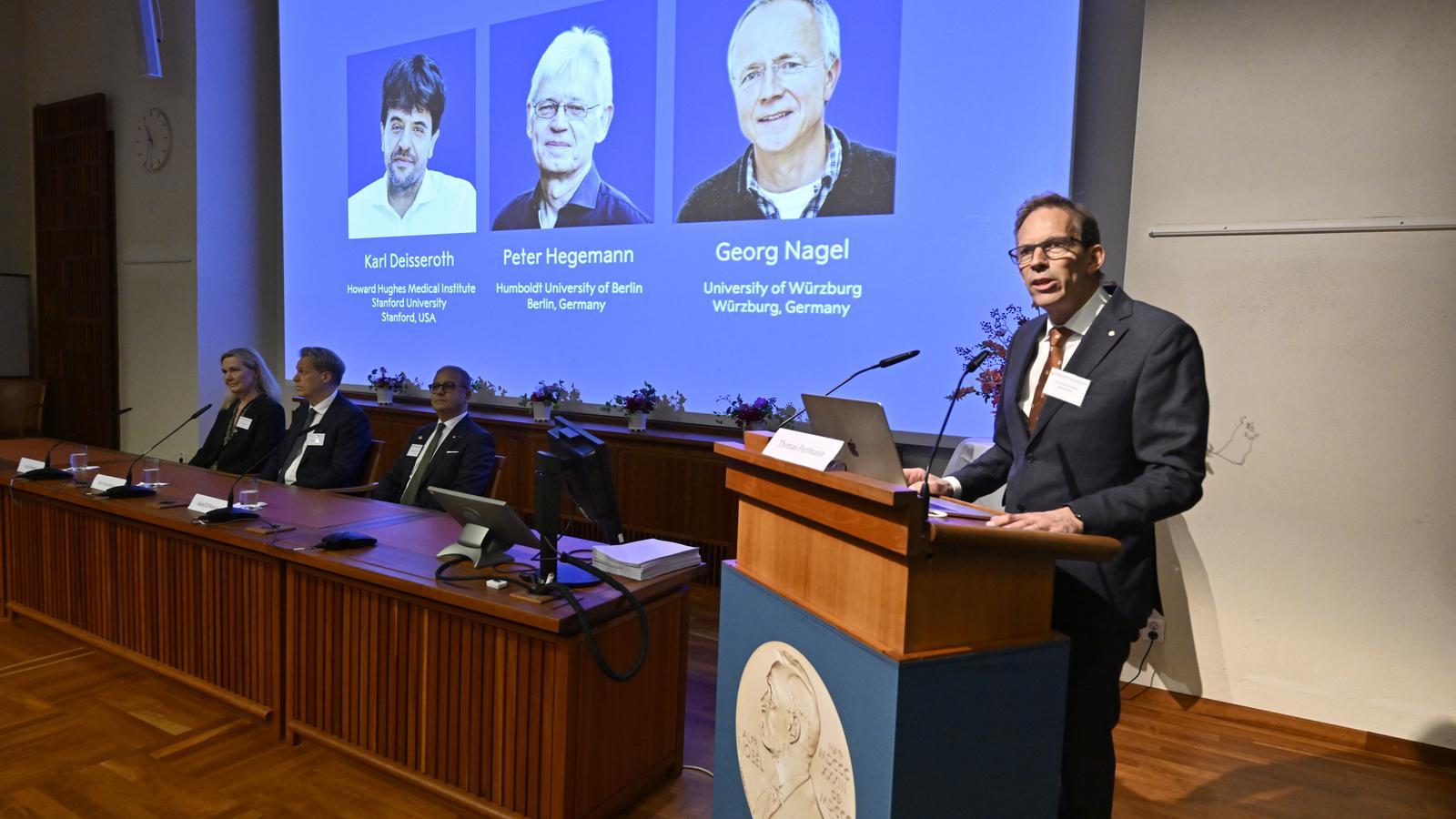
BarcelonaThree researchers have been distinguished with the 2026 Nobel Prize in Medicine, awarded by the Royal Swedish Academy of Sciences, for having developed optogenetics, a technology that has radically changed the way the brain is studied. They are Peter Hegemann, from Humboldt University of Berlin; Karl Deisseroth, from Stanford University in California, and Georg Nagel, from the University of Würzburg. The world's most prestigious award has recognized this neuroscience technique because it allows for controlling specific neurons with light in real time while an animal moves, sleeps, or performs some activity. It also opens the door to understanding how memories, feelings, and behaviors are generated. Currently, laboratories all over the world use it to try to unveil the mysteries of the brain.
"The relevance of this technology is that it allows us to demonstrate whether there is a cause-effect relationship between the activation of certain neurons in a brain region and the behavior of an animal," assesses Nicolò Accanto for ARA, leader of the Nonlinear Photonics for Neuroscience group at the Institute for Bioengineering of Catalonia (IBEC), who precisely also uses optogenetics for research. "We can no longer just observe which cells or which cell types are activated, as [Santiago Ramon] Cajal was already doing more than 100 years ago, but rather intervene on them and ask ourselves directly what their function is," states Marta Navarrete, researcher at the Cajal Institute of Neurosciences-CSIC, in statements to SMC Spain.
For centuries, science has tried to understand how the brain, an organ that weighs about 1,300 grams, is capable of remembering moments from childhood, feeling love, jealousy, anger, reasoning, or controlling the functioning of the rest of the body's tissues and organs. However, although technologies and methods have been developed that have allowed associating a specific brain area with a specific function, they did not allow demonstrating whether a concrete type of nerve cells were or were not responsible for a feeling or behavior.
This is what has made optogenetics possible. Using light, researchers can now turn off or turn on individual neural circuits in the brain, generate feelings, retrieve memories, drive behaviors, or study the neurons involved in some psychiatric and neurological disorders. Furthermore, it has shed light on how the nervous system interacts with other cells, such as those in the heart or the gut. "For years it was an option that they would win the Nobel, it appeared in all the bets," points out Accanto, from IBEC, who coincidentally is organizing a congress on optogenetics that will be held next week. "Researchers who have worked with the three laureates will come and we will ask them to tell us about their experience," he adds.
Accanto works with specific groups of neurons that encode for a type of memory. "By turning on or turning off specific neurons in certain areas, such as the hippocampus or the amygdala, we want to see if we can generate or inhibit memories linked to trauma," he explains.
A unique property of a unicellular alga
To understand this finding, one must go back to the 90s, when Peter Hegemann was investigating a unicellular alga, Chlamydomonas reinhardtii. This organism is capable of swimming towards light, and the German biophysicist discovered that a protein, rhodopsin, was involved in this process. He also identified genes that encoded proteins similar to microbial rhodopsins. Hegemann, in collaboration with Georg Nagel, introduced some of these genes into frog oocytes and observed that the cells became sensitive to light. Together they described some of these proteins, which had an extraordinary characteristic: when they received light, they would open and let ions pass through the membrane. This meant that a light stimulus could be converted into an electrical change within the cell.
Together they observed that these proteins could make a cell become sensitive to light and wondered if this same mechanism could also be applied to neurons. This is where Karl Deisseroth, a psychiatrist, bioengineer, and neuroscientist from Stanford, enters the scene, who made the definitive leap into neuroscience: he thought that these proteins could be used to selectively manipulate the activity of neurons within the brain, without affecting those next to them.
In 2007, the first demonstration arrived: they used optogenetics to activate a group of neurons in the hypothalamus of mice, so that the animals would go from sleep to wakefulness. Since then, optogenetics has become a widespread tool for studying the neural circuits responsible for memory, fear, pleasure, reward, motivation, sleep, anxiety, decision-making, among others.
For now, studies with optogenetics are carried out in animal models and there is only one therapy approved in humans for diseases linked to the retina that cause loss of vision.
A week of Nobels
The Nobel Prize in Physiology or Medicine recognizes discoveries that have contributed significantly to the understanding of life and the progress of medicine. In 2025, the awarddistinguished Mary E. Brunkow, Fred Ramsdell, and Shimon Sakaguchi for their discoveries regarding peripheral immune tolerance, a mechanism that prevents the immune system from attacking the body's healthy tissues.
The prize is endowed with 12 million Swedish kronor, after the Nobel Foundation increased the amount in 2026. The award has been granted since 1901, when German physician Emil von Behring was recognized for his work on serum therapy, especially in the treatment of diphtheria.
The 2026 announcement will open a new edition of the Nobel Prizes, which will be awarded in six categories between October 5 and October 12.
