"I live alone in a cove that Franco did not expropriate because he died two days before"
Miquel Carós has been living in s'Alguer for twelve years and only sees his wife on Sundays

-
CAT -
CAST
BarcelonaIn s’Alguer, the cove where the new Estrella Damm advertisement was filmed, one person lives all year round. This is Miquel Carós (Palamós, 1948), who has been living for twelve years in one of the fishermen's houses with coloured doors in this spot of crystal-clear waters on the Costa Brava. Now he is no longer the sole inhabitant. Six years ago, another man settled there with his son. None of the three would be living there if Franco had not died on November 20, 1975. "It was close, the machines were already prepared to demolish the shacks, but since he died, everything stopped," he explains.
The cove of s’Alguer was part of the Juny farmhouse, owned by the artist Josep Maria Sert, who allowed new shacks to be built and the older ones, some from the 15th century, to be renovated. In the 1940s, however, Sert sold it to the Puig Palau brothers, who were close to the Franco regime. This bourgeois family, which manufactured parachutes for the fascist army, managed to get the regime to declare the shacks illegal and order their demolition. "They had always wanted to get rid of us and they were very friendly with Franco, who had visited the farmhouse," points out Miquel, who reveals that the objective was to create an exclusive port. "The best thing Franco did was die at that moment because the people of Palamós rallied to save it and signatures were collected, but at that time it would have happened anyway," he makes clear.
The shack belonged to his grandparents, who bought it for about 300 pesetas in 1912, and he used to spend his summers there as a child. His grandfather settled there for longer when his grandmother died, and he used to wonder what he was doing there. "Now I am a grandfather's grandson," he says without hiding a smile. His wife has not accompanied him. She tried, but it lasted seven months: "People think we are separated, but she gets bored here and has the grandchildren at home," he remarks. "We miss each other, yes, but we have been together fifty years in the shop and we have overcome this phase and we are both fed up with each other," he adds, laughing, before assuring that "she is a very good woman and she understands". On Sundays, however, he goes down to Palamós and they have lunch together: "I do the opposite of everyone else".
Miquel ran a family haberdashery in Palamós, which is now run by three of his five sons ("there was no TV, you can tell", he says) and the day after retiring, he decided to come and live in s'Alguer without thinking about it. "I left everything, I didn't want to take care of anything, businesses between parents and children don't usually work out and I wanted to take a step back", he explains, highlighting that he doesn't even know what pension he receives because his sons handle it for him.
"Every day I do whatever I feel like"
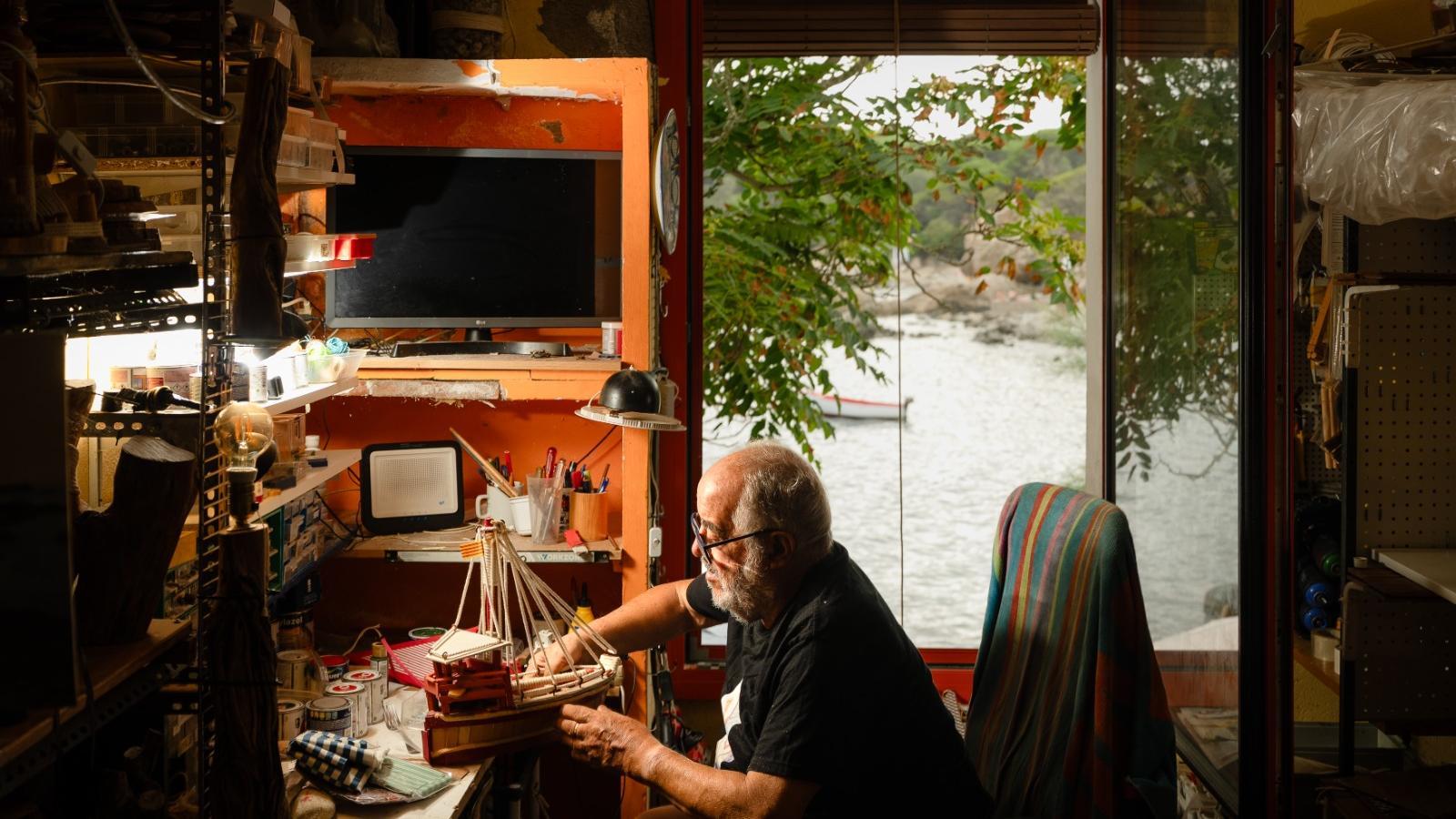
He doesn't miss anything from his previous life: "I don't worry about anything, every day I do what I feel like and that can't be bought with money." He writes about his experiences and makes lamps and boats from pieces of wood that the sea brings to the shore, which he sells for thirty euros. "I can't just stare at the sea for 24 hours and doing all this distracts me a lot." He also chats with people. "With mobile phones, the habit of chatting has been lost," he laments.

Only during the Civil War did more people live there because Palamós was bombed on several occasions. In fact, his parents lived in different shacks during that time. None of the owners were fishermen. “It’s an urban legend, most of them were farmers from surrounding villages who came on Sundays to have a rice dish and fished for a hobby, to change the scenery.” He’s not a sea dog either: he neither likes fishing nor swimming. He had a boat, but he doesn’t go out anymore because to fish, he explains, you have to have patience and he doesn’t have it. He wouldn’t find much either: “Before there were prawns and mussels, now there aren’t even any algae, which is what gave this cove its name.” And the heatwaves haven’t made him get into the water either, which he always finds cold, and he wets himself with a bucket that he fills with water and warms in the sun. “There are a lot of rocks and one day I slipped and fell and if I break something, my good life is over,” he reasons.
In the little house he has air conditioning, which makes the heat more bearable. He also has heating and a fireplace for the winter, when the cold bites to the bone. He doesn’t live disconnected from what’s happening in the world: he has a television and internet access. And people always pass by the cove, even in winter. “I don’t feel lonely, now the retired people walk a lot and everyone knows I’m here and they come to greet me to chat for a while.” He admits that with the new Estrella Damm advertisement, more people are coming to the cove. “More come, but it’s already the third one from the brewery and now with the internet you can’t discover anything anymore,” he says, sitting in front of his window, where the last scene of the commercial was filmed. “It’s better than the one at Dalí’s house in Portlligat,” he concludes, proud to live in a place he wouldn’t trade for any other.
