From academic scandal to culture war: the Jason Arday case puts Cambridge in the spotlight
The complaints of the dead professor have become ammunition against diversity policies
-
CAT -
CAST
BarcelonaIn late July, the British newspaper The Telegraph published an article accusing Jason Arday, a professor at the University of Cambridge, of being involved in a plagiarism controversy. A scandal that splashed a millennia-old prestigious institution and permanently tarnished the academic's reputation. How could it be that, despite occupying world rankings, it had a professor accused of lying on his resume?
Two weeks after the scandal, Jason Arday, 41, was found dead at his home in the Battersea neighborhood of London, in a case being investigated as suicide. For two weeks, he had been in the crosshairs of the British media, especially the conservative ones, which scrutinized not only his professional career but also aspects of his biography. Arday had broken records: neurodivergent and, according to his account, mute until the age of eleven and unable to read and write until eighteen, he became, at 37, the youngest black professor in Cambridge's history in 2023. TheTelegraph, however, questioned his work and accused him of plagiarism: in an article they explained that more than 100 passages from his doctoral thesis were very similar to those published six years earlier by Paula Zwozdiak-Myers, a student at Brunel University London.

Following journalistic investigation, it was discovered that the apparent prodigy academic had built a life of half-truths: books he had not published, prestigious positions he had not held, and universities where he had not studied. It was even questioned that he had run thirty marathons in thirty-five days, and also that he had been threatened with a knife at the same university, facts that did not appear in any police report. Deborah Prentice, the Vice-Chancellor of Cambridge, admitted that the case had caused "harmful and difficult" damage to the institution.
Cambridge, in response to the scandal, announced that Arday's "academic qualifications and honorary appointments" would be investigated, as would the academic's selection process. That same day, the professor stepped aside. However, he denied the accusations. "I am not a liar," he defended himself in an interview with The Times, explaining that any errors in his research were due to his autism, as he often resorted to imitation to make sense of information. The academic claimed to have suffered "an incessant level of public scrutiny and personal attacks".
A war against the woke
"Arday found himself caught in a culture war over diversity policies," explains to ARA Alan Rusbridger, former director of The Guardian and Prospect Magazine, and former director of the Reuters Institute for the Study of Journalism at the University of Oxford. Accusations against Arday have been, from the outset, squeezed by conservative media and political parties to question the policies of many institutions and companies across the country, DEI (acronym in English for Diversity, Equity, and Inclusion), implemented in England to guarantee the diversity and representation of different social and ethnic groups in the workforces of companies and institutions.

The right accuses the university of being woke –extremely liberal– and argues that the DEI system is designed to "favor" minorities. The leader of the far-right party Reform UK, Nigel Farage, wrote in the tabloid The Sun that Arday had been chosen before other "academic talents" just so the university could boast of being a diverse center. For Rusbridger, however, "they cannot sustain this argument": despite Cambridge's efforts to increase its diversity in the professoriate in response to an avalanche of criticism in 2023, there are only 0.4% black professors. "The data shows no sign of recruitment "woke", aim.
A racist background
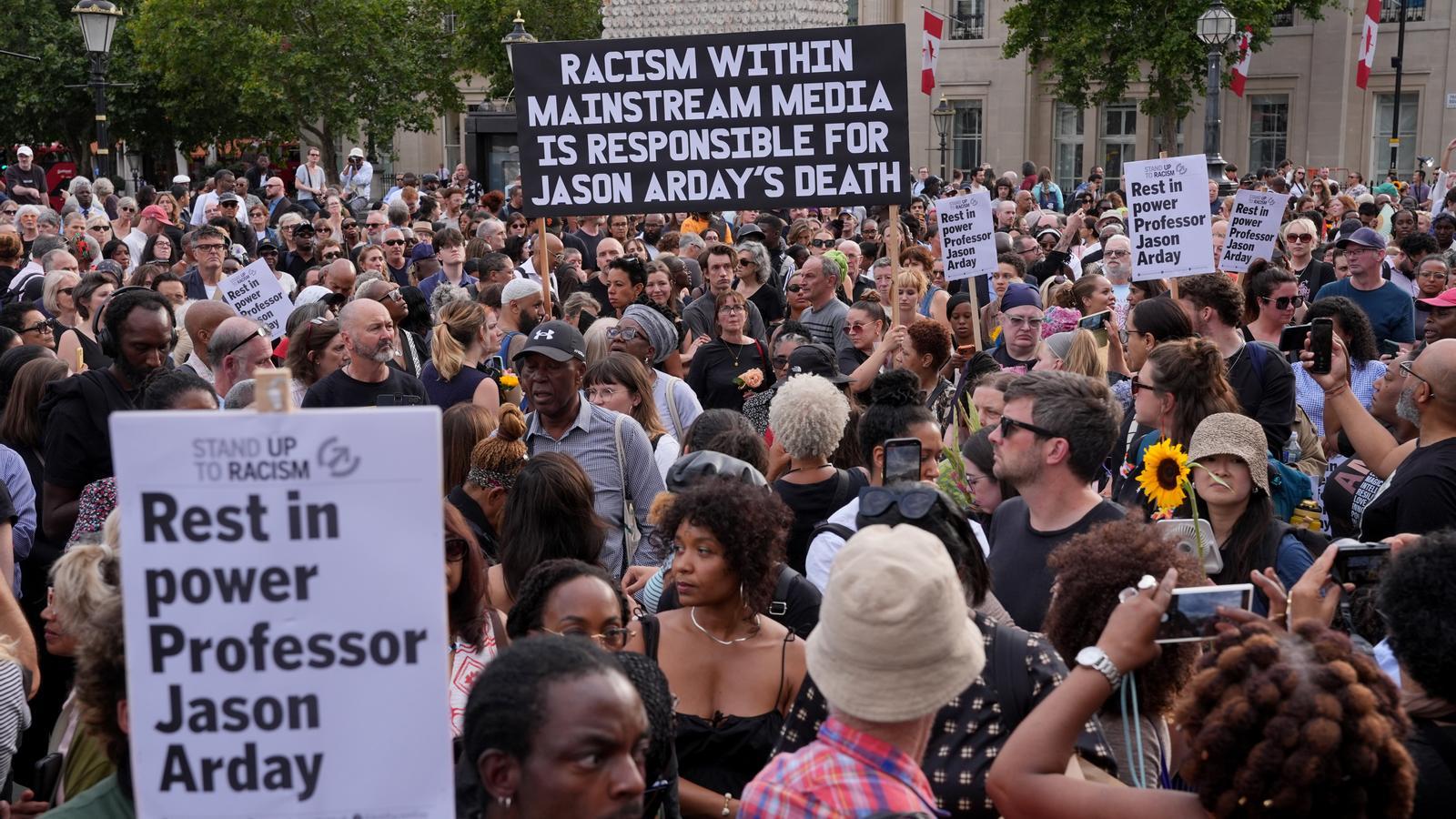
Arday's death has led to the suspension of the examination of records and theses in order to find culprits. Those who defend Arday do not exonerate him: although parts of his academic and personal trajectory do not seem entirely true, they argue that the persecution was motivated by racism and assure that an academic in an equal position, but with a different skin color, would not have been questioned in the same way. Simon Woolley, director of Homerton College, Cambridge, described the controversy as a "racist witch hunt".
Another fact that explains the possible racist motivations behind Arday's persecution is the man who made the first accusations of plagiarism of Arday's thesis: Nathan Cofnas. The American philosopher has been repeatedly accused of racism and supremacism. In an interview with Times Radio, Cofnas stated that Arday "was not smart enough" to be a Cambridge professor, and in an apology to "eugenicist logic," he said that black people "would disappear from high-ranking roles outside of sports and entertainment." In fact, his students gathered 1,200 signatures to have him removed from the university. Although Cofnas was expelled from Emmanuel College, Cambridge, in 2024, this fact again raises questions about how an academic with such a controversial ideology can become part of the university.
Rusbridger describes the British media's coverage of the scandal as "disproportionate." "Arday was the victim of the worst kind of massive media attack," he states. The former director of the Reuters Institute for the Study of Journalism explains that there were about 250 articles talking about the case. "There have been white professors accused in the past, but in this case, there were four or five articles," he explains. Although Arday expressed that he could not bear the pressure the media was subjecting him to, the pressure persisted. "Matters of humanity and care were disregarded," he concludes.
