Free fall in PISA tests: Spanish students, with the worst level in history
The average level of the OECD as a whole drops by one tenth of a point in these two competencies compared to 2022


-
CAT -
CAST
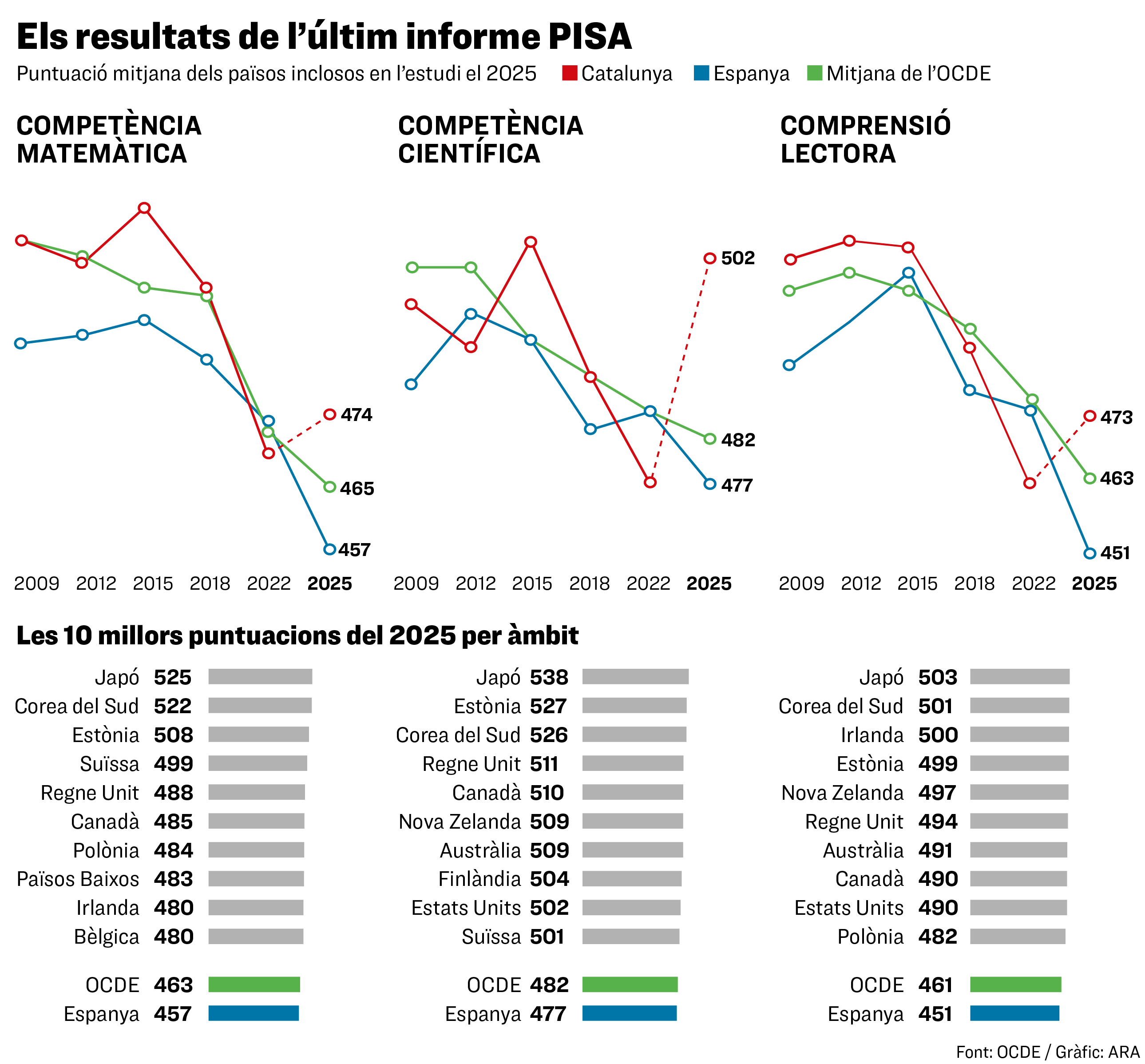
BarcelonaEducational results in the State are in free fall, as evidenced by the PISA 2025 report made public this Tuesday, from which Catalonia has been excluded for excluding more students than permitted. The OECD report confirms that 15-year-old Spanish students –between 3rd and 4th year of ESO– have the worst level in the history of the State in the PISA tests. Furthermore, the drop is significantly higher than that suffered by Spain in the last edition when, after the pandemic, there was a drastic reduction in scores around the world that set off all alarms.
To get an idea, Spain has lost seven times more points in reading comprehension than in the last report and twice as many points in mathematics. Another example of the gravity of the situation is the confirmation that Spanish adolescents are more than one grade behind their English peers in mathematics and reading. In fact, the OECD has already warned that the most worrying point of this edition of the tests is reading comprehension and how the decline in level impacts the rest of the competencies. In this sense, the Spanish results have also led the minister Esther Niubó in Catalonia to open the door to recovering mandatory readings, assuring that she would be "in favor" of it and admitting that the Government has the power to do so, "but consensus is needed".
However, the decline in level is not exclusive to the State; around the world, most countries have seen how they have lost points in international exams. In fact, the OECD average has fallen 10 points in mathematics and 14 in reading comprehension –the equivalent of half a school year of knowledge.

- If you want to see the chart in more detail, open the high-resolution version in another tab.
23 points lost in reading
The most worrying setback, therefore, is found in reading levels. Spain has obtained 451 points in reading comprehension, a loss of 23 points compared to the last report. According to OECD calculations, this drop represents a loss of knowledge equivalent to a little more than one school year (one year is equivalent to 20 points). In this regard, it is important to take into account that the students evaluated suffered the pandemic when they were 10 years old, a key moment in the development of reading comprehension. In this sense, the OECD itself is concerned that across the OECD as a whole, 28 points have been lost in 10 years – more than one school year – in a single decade. "This trend is especially worrying because reading skills underpin learning across the entire curriculum and are essential for finding, evaluating, interpreting, and reflecting on information in an increasingly digital world," they point out in the report.
With this decline, the reading level of Spanish students is half a school year lower (12 points) than the OECD average and 8 points lower than the European Union (EU) average. Spain's score in the PISA reading tests is similar to those obtained by Croatia (453), Norway (453 points), Hungary (452 points), or the Slovak Republic (448 points).
Conversely, students in the country who have just finished their compulsory secondary education (ESO) are two and a half school years behind their peers in Japan (503), South Korea (501), Ireland (500), Estonia (499), or the United Kingdom (494), who occupy the top positions in the OECD ranking.
This Tuesday, the Minister of Education, Milagros Tolón, admitted that Spanish students have a deficit in reading comprehension "which is the root of all problems." "It may be related to screen habits, to hasty reading, to the short messages that are imposed on adolescents on social networks..." she assessed in an interview with La Ser.

Behind Turkey in mathematics
The results in mathematics are not more encouraging either. With 457 points, Spain has suffered a drop in level of almost one school year (16 points) compared to 2022. In fact, the state's level has fallen twice as much as in the last PISA edition, when Spain lost eight points. In this sense, Spanish adolescents are more than ten points behind the European and OECD average (both of which reach 463 points).
In mathematics, the difference between the countries that fare best in the OECD tests is even more drastic. Students in the state are more than three school years behind the Japanese (525) and the Koreans (522); two school years behind the Swiss (499) and a year and a half below the English (488).
Again, the Spanish level is similar to that of Croatia (455), Norway (452) or France (458). It is also surprising that Spain is behind in mathematics compared to countries like Turkey (462) or Latvia (460).
One in four does not reach the minimum in science
The 2025 PISA tests have focused primarily on science, precisely the competency where Spain has suffered the least, despite losing 8 points in level compared to 2022. With 477 points, Spanish students are only four points behind the European average (481) and five points below the OECD average (482). Once again, however, the gap with the top of the ranking is more than three school years: Japan (538), Estonia (527), and the United Kingdom (511).
In this competency, the OECD also provides data on the percentage of students at each level. In this regard, Spain has only 6% of students with a high or very high level in science, while in the OECD as a whole and in the European Union, this proportion rises to 8%. In contrast, in Japan it is 17%, and in the United States and the United Kingdom, 13%.
Regarding students considered not to reach the minimum scientific knowledge –a level below 2 on a scale that goes up to 6–, in Spain they represent 24%, a proportion identical to the OECD as a whole and close to the European average (25%). In contrast, in Japan, students who do not reach the minimum level account for 12% of the total, and in the United Kingdom, 17%.
Less curiosity, less discipline and waste of time to learn
The OECD also sets out the main reasons why there has been, once again, a generalized decline –except for occasional green shoots– in the PISA tests. They explain that, in general, students have "a decrease in positive attitudes towards learning" with a "loss of scientific curiosity" and also of "the perseverance to finish difficult tasks" and the motivation for effort. They also point out that they read little for pleasure and that they do it too quickly, which makes them answer incorrectly, and prevents them from being able to understand long and complex texts.
Regarding the situation at school, the authors of the report warn of a drop in discipline in much more complex classrooms and a lack of support resources that lead to a waste of time for learning. They also warn that this hinders the development of the capacity for sustained concentration. Furthermore, they also bring to the table the "delayed" effects of the COVID pandemic, digital distractions –they are teenagers who have grown up with a mobile phone– and the decrease in involvement by families.