First internal shock at the White House over the Nvidia espionage scandal
The Treasury Secretary blames his Commerce counterpart for not having taken measures despite the intelligence reports
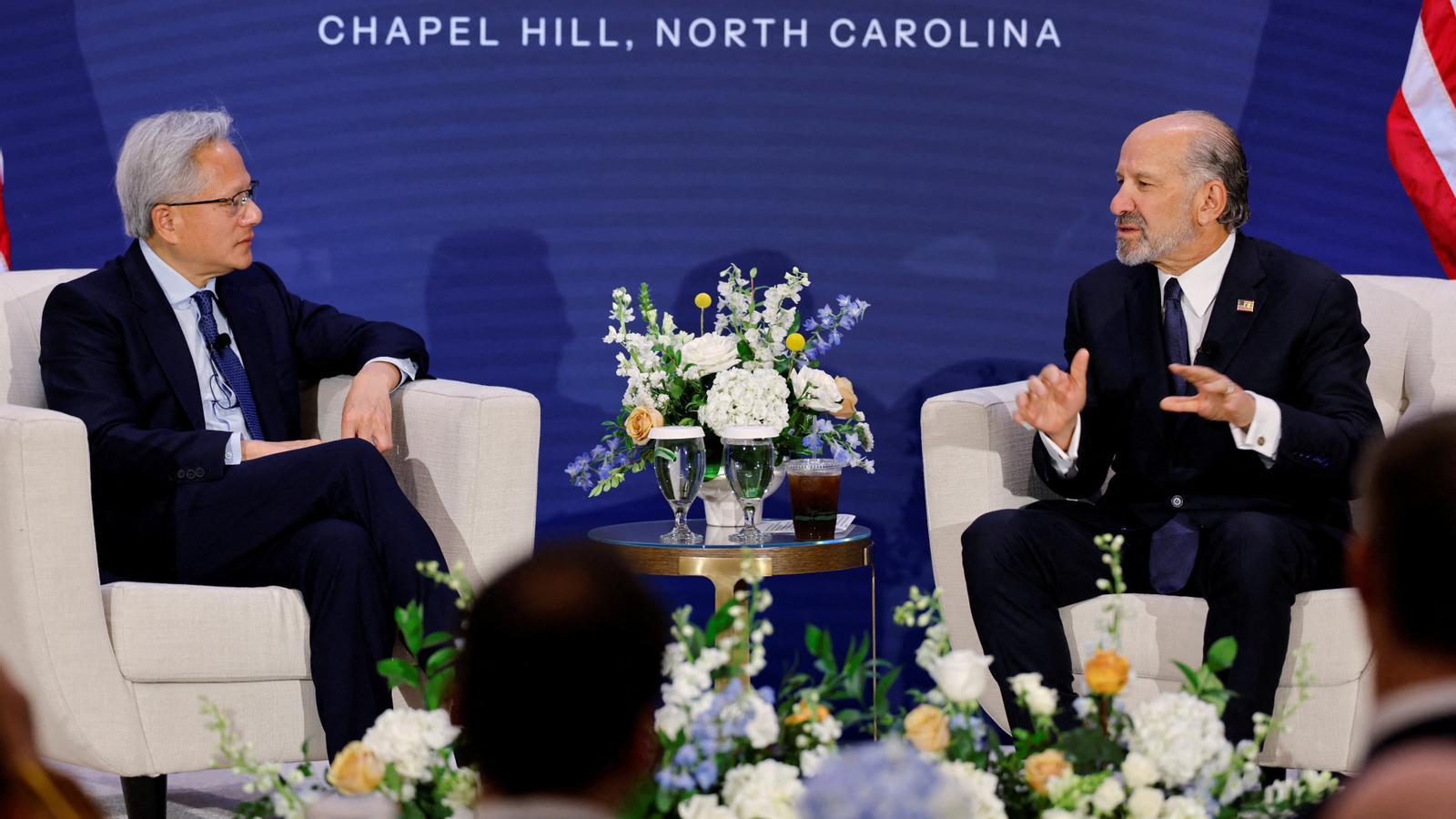

-
CAT -
CAST
WashingtonThe role of the White House in the entire scandal of possible espionage involving Nvidia can no longer be ignored. What could be a massive case of negligence regarding national security issues—especially with the entire AI race with China—has led to a public clash between the government's two main economic departments. Treasury Secretary Scott Bessent pointed the finger this Friday at Commerce Secretary Howard Lutnick for being too lenient with the sales of restricted Nvidia microchips to China.
Following the sexual scandal that caused the fall of Jensen Huang as CEO of the tech company, the focus is now on how the White House acted despite suspecting for a year that the Singapore-based company Megaspeed was diverting Nvidia microchips to Beijing. The person responsible for making all these purchases, valued at more than 7.5 million dollars, was Alice Huang, a Megaspeed executive, Huang's lover, and a possible Chinese spy.
Bessent has accused Lutnick of failing to ban microchip sales to Megaspeed despite being aware of the case. As the Treasury Secretary explained in an interview with CNBC, officials from his department, the Pentagon, and the State Department had been calling for months for restrictions to be imposed on Megaspeed, “but Commerce is the one holding the reins” when it comes to adding the company to the list. “You should ask them about their internal processes,” Bessent said.
The Department of Commerce has the authority to add suspicious companies to the export restriction list, but it never took this step with Megaspeed, despite it being at the center of the alleged espionage plot. In fact, the New York Times already revealed that Commerce had halted the investigation into Megaspeed, opened months ago, following a request from Nvidia, and had transferred it to the Department of Justice.
Although the focus is on Lutnick, it cannot be overlooked that the US president, Donald Trump, is the one who always has the final say. Last year, Secretary of State Marco Rubio already drafted a report explaining the case and the suspicions that Huang's lover was a Chinese spy. When Trump was asked earlier this week if he had read the document that had circulated within the White House, the mogul responded with vagueness and downplaying the matter. He asserted that he “probably” read it, but that it had not impacted him much. Throughout this time, Huang has been the Republican's main advisor on AI policies and is one of the advocates for allowing exports of microchips banned to China. A relaxation of the restrictions that Trump has applied on several occasions during these two years.
Meanwhile, the Congressional Foreign Affairs Committee has already summoned both Huang and Lutnick to testify regarding the possible implications for the country's national security. The Republicans who have initiated the case are in talks with Huang, who has agreed to submit to questioning by congressmen behind closed doors after Thanksgiving. Meanwhile, Lutnick has said he will do the same on December 10, but it will be before the Senate Banking Committee.
The scandal of a possible Chinese espionage plot arrives at the worst possible time. Next week, Trump is scheduled to meet face-to-face with his Chinese counterpart, Xi Jinping, during the Asia-Pacific Economic Cooperation (APEC). It will be the first time the two leaders meet since Xi visited the White House in September.

