Another of the groups demanding the withdrawal of the pilot test is that of social educators. "Police forces should not be contemplated in educational settings, and social education professionals are the ones truly entrusted with functions of conflict prevention, mediation, and support for students in vulnerable situations," they denounce in a statement from the Col·legi d'Educadores i Educadors Socials de Catalunya (CEESC). In fact, educators criticize that the Government has promoted this plan without consulting them. "It is difficult to understand that clearly educational, preventive, and community work functions are delegated to security forces," they insist, and emphasize that they are specifically trained to perform these functions. In the CEESC's opinion, the measures proposed by the Government "prioritize more economical short-term solutions, instead of reinforcing socio-educational action." The group also warns that, in the long run, this can lead to "less social cohesion, less adequate interventions, and a negative impact on children, young people, and families".
Students from a high school where a moss will be sent: "We can fix problems without an intimidating cop"
Education says the pilot plan centers to integrate an undercover agent participate voluntarily

-
CAT -
CAST
BarcelonaEsmeralda has been taking her children to the Eugeni d'Ors Institute in L'Hospitalet de Llobregat for 25 years, one of the centers that will integrate an undercover police officer as part of the pilot plan that the Government wants to test in 13 schools and institutes to "improve coexistence". Through her children, she has seen how the atmosphere of the center has changed over the last two decades. It's Monday, a few minutes before half past one, and she waits while waiting for Aliana, the youngest, to come out in La Sènia square, which at this hour is almost deserted. In a few minutes, the hubbub invades the street: hundreds of teenagers leave – in a rather disorderly manner – through a single door.
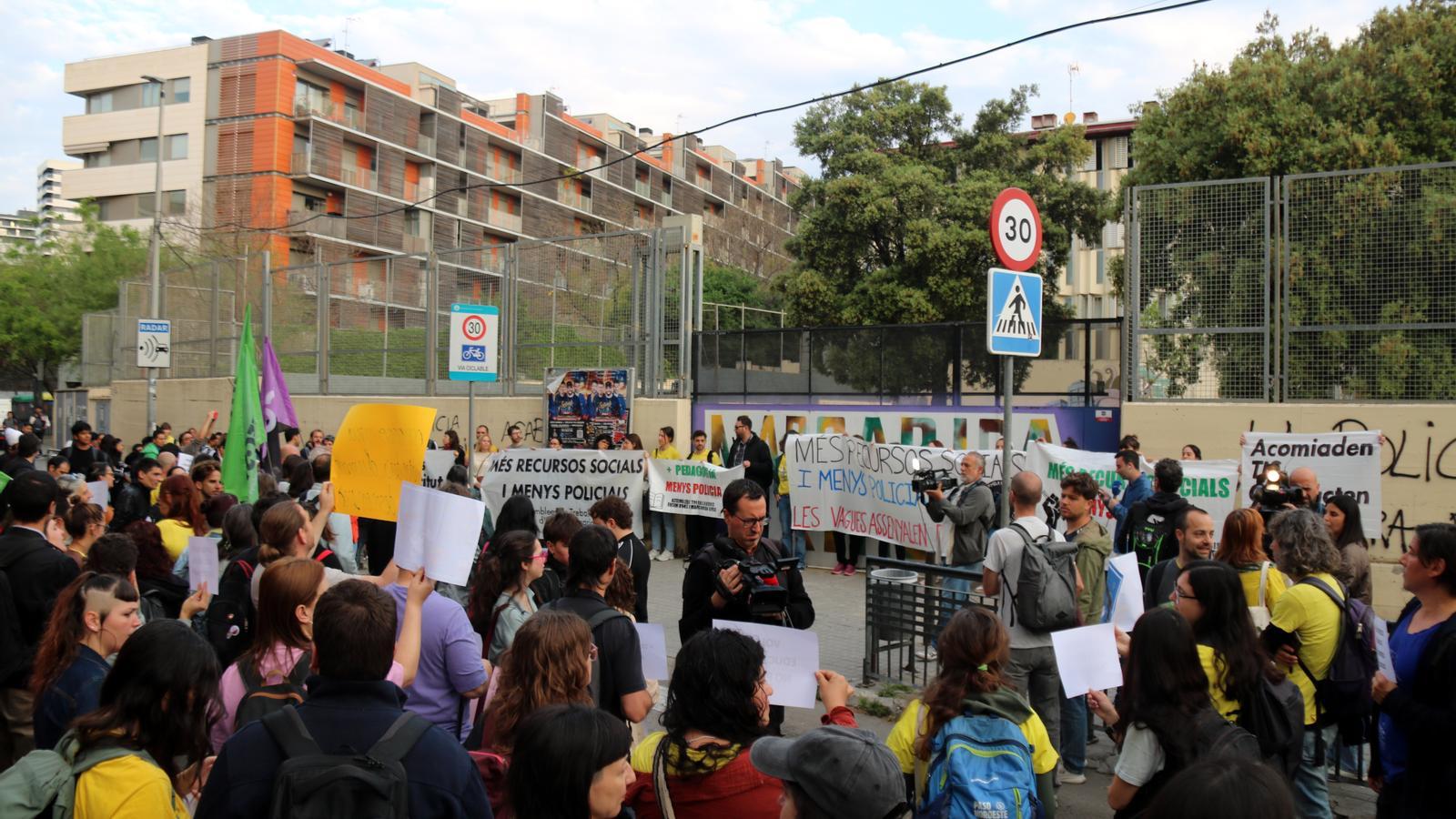
The Eugeni d'Ors is, along with the Margarida Xirgu institute – just 100 meters from the square –, one of the centers where teachers, families, and students protested this Monday morning against the pilot test. "It's a tough institute because they pressure students to learn, but it's great. I can tell you that because I've seen three different principals come and go. It's very negative that they want to bring in a police officer because it gives a bad image to the center where our children study," laments Esmeralda. She explains that 10 or 15 years ago there were indeed more problems at the institute and police cars were often seen parked in front, but that, in recent years, "a great deal of mediation work has been done" and now "there are only the typical teenage fights".
A few meters further down, down the stairs where eighty people demonstrated this morning against the police pilot plan, there are three teenagers: Melani, Perla, and Aliana. They laugh and comment on videos they watch on their phones. When asked about the idea of incorporating a police officer into the daily life of the institute, their faces change. "We had seen it on social media and today the teachers explained it to us a bit" – Melani details –. "They told us that [the officer] will walk around the institute looking at what we do and... well, protecting us. It's true that sometimes there are problems, but they can be resolved without a cop coming to intimidate us," insists the teenager. "What we need is more people to come and do what Marta does – "to mediate", Perla finishes, referring to this role –. "They told us he will come to prevent conflicts, but I think the institute's mediation service is already there for that. There are many things that happen outside that can be more important for the police than watching children in class," complains Aliana.
On the other side of the square are Luis and Elías. They left class a bit early and are killing time while waiting for their friends. "The teachers explained it to us today," Luis briefly explains. "What do I think? I think it's bad. It's not like this is a prison. We're not criminals," Elías replies indignantly. Ahad, who is going home alone, also thinks it's bad. "I found it very shocking. I don't think a police officer is necessary because there are the same conflicts here as in other places. If they put it on us, why don't they put it on all the high schools
?" he wonders.
When asked why their institute was chosen to test the measure of integrating a Mossos d'Esquadra agent into the faculty, the teenagers and also some families point out that, on the one hand, the center "has a certain bad reputation". "Before there were more fights, but now it has calmed down. When two people start playing in the yard and end up fighting, the teachers come, separate them, and they go to mediation," details Aliana. Esmeralda also offers a hypothesis: "they chose it because for some time fewer students from Spain have been coming and more immigrants, and it is associated that if there are more immigrants there will be more problems".
Voluntary program
The Department of Education insists that the thirteen educational centers that will integrate a plainclothes Mossos d'Esquadra agent into their daily lives are participating in the pilot test on a voluntary basis. Sources from Education assure that no center has been forced to participate, despite the fact that the measure has caused strong criticism among teachers, families, students, and unions. In fact, last week sources from the Interior department also admitted that they were "aware that it is an initiative that can generate debate" and that therefore they had opted for "a pilot, voluntary, and evaluable model, which will allow its impact to be measured and improvements to be incorporated before any extension".
For the moment, a police officer will be introduced into the staff of schools and institutes in the educational areas of L'Hospitalet, Vic, L'Alta Ribagorça-Valle de Arán, and Tárrega; and also in two centers in El Prat de Llobregat and Sabadell. Sources from Education already explained that the plan will be applied "to all types of centers", meaning that it is not solely intended for problematic or complex centers. They also detail that the project "stems from the increase in complexity in the environment of educational centers and the need to reinforce the well-being of students and the entire educational community".

