Plainclothes Mossos will be deployed in schools and institutes in a pilot test to improve coexistence
Teachers and families ask Education to rectify and not place agents inside educational centers
-
CAT -
CAST
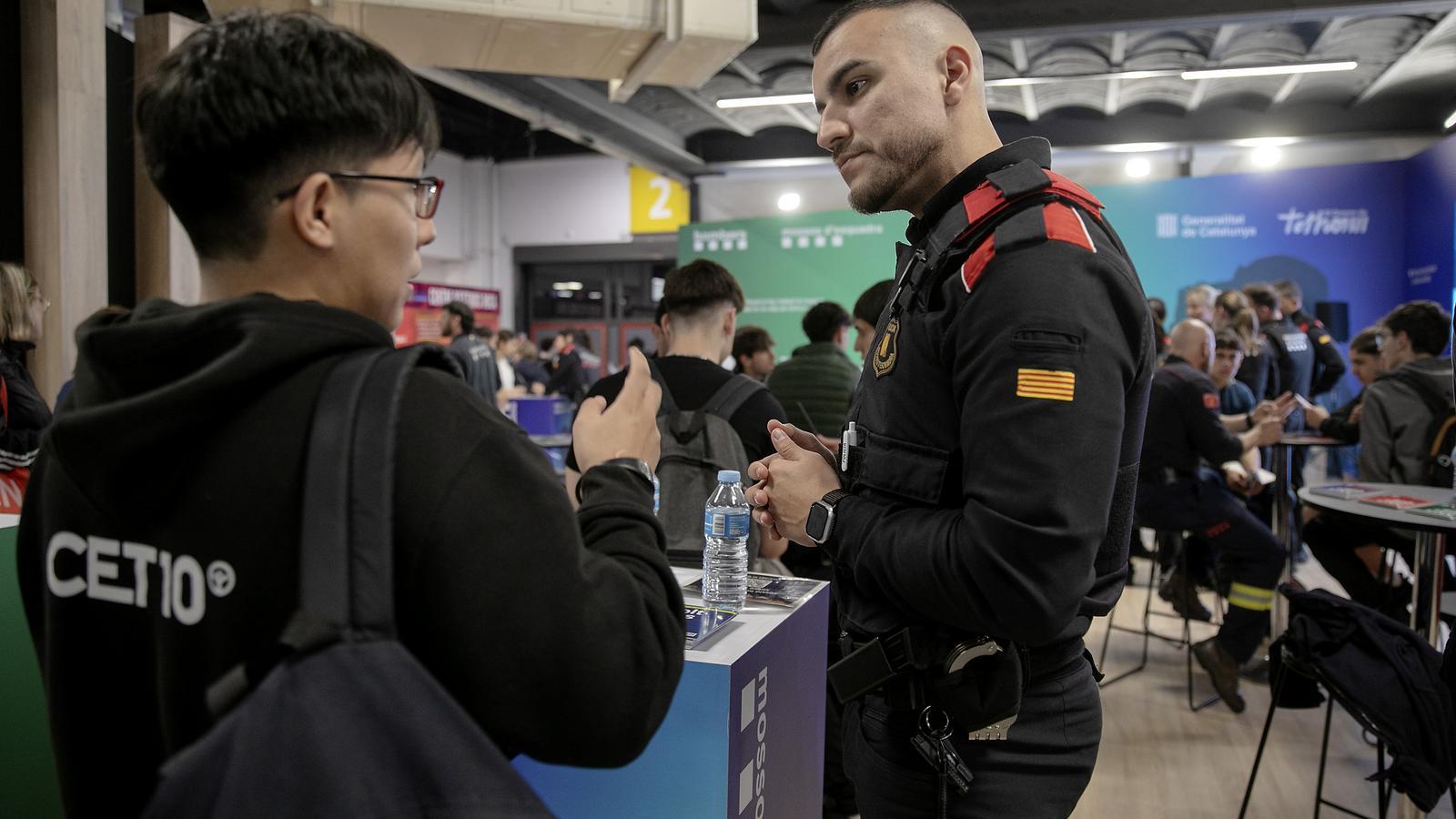
BarcelonaCatalonia will test a new strategy to address coexistence problems in some schools and institutes: Mossos d'Esquadra officers will be deployed undercover in various educational centers. The move is part of a pilot plan that will be activated this April in thirteen centers to test a new collaboration model between the departments of Education and Interior, as reported by El País and confirmed by ARA.
For now, a police officer will be introduced into the staff of schools and institutes in the educational areas of L'Hospitalet, Vic, L'Alta Ribagorça-Vall d'Aran, and Tàrrega; and also in two centers in El Prat de Llobregat and Sabadell. Sources from the Department of Education explain that the plan will be applied "to all types of centers," meaning it is not solely intended for problematic or complex centers. They also detail that the project "stems from the increased complexity in the environment of educational centers and the need to reinforce the well-being of students and the entire educational community."
The plan foresees that an unarmed undercover officer will have a stable presence in the center and will carry out prevention, support, and intervention tasks "to ensure school coexistence." "It is a pilot project that aims to promote the figure of integrated officers as points of reference in educational centers," state the Department of Education.
According to sources consulted by ARA, the plan has been designed by the police's Proximity Division, based at the Egara Central Complex in Sabadell; one of the municipalities where the plan will be tested. They believe that the profile of a reference proximity police officer in schools can help with coexistence both inside and outside the center. In fact, consulted sources emphasize that this officer will also be a key figure in preventing conflicts outside the classrooms, such as fights or drug use. These are often situations that fall outside the scope of teachers' intervention. In parallel, this officer will also be used to conduct training for students and mediate in day-to-day problems.
In Catalonia, the presentation of the plan in the educational centers that will implement it was completed on April 21st. Furthermore, in recent days, the project has already been explained to the family associations of the involved centers.
Teachers and families, against it
Government sources assure that this is "a demand strongly claimed from the teaching world". However, despite the fact that for the moment the plan is only intended to be rolled out in thirteen centers, the measure has already provoked indignation among teachers, principals, unions, and families. The USTEC union considers the presence of mossos in schools "very serious". "Coexistence is not resolved with police," they assure in a statement. The majority union in the education sector believes that Education responds with "a police logic" to an educational and social problem, and that the decision "diverts the debate from the resources that the centers really need". For all these reasons, the union asks the department to rectify. "If you really want to reduce conflict, stop looking for headlines and provide the resources that the educational community has been asking for years," they insist.
The Union of Secondary School Teachers has also criticized the pilot plan, assuring that "in no case" have the unions asked for this measure, nor has the teaching staff. "Authority in the classroom must belong to the teacher, not the police," they defend. For their part, the CGT has also rejected "the presence of police forces in schools to resolve conflicts". Furthermore, they assure that "international studies and experiences show that police presence in schools does not increase security and tends to criminalize the most vulnerable students".
Several school principals have also questioned l'ARA about the extent to which it is advisable or effective to launch this test. "Most centers already have constant contact with the Mossos and local police, they come at the beginning of the school year, give talks and, if we need them, we call them and they are at the center in a few minutes," explains the director of a high school in Tarragonès, who points out that the measure "solves nothing." The plan has also been rejected by the Association of Directors of Public Education of Catalonia (AXIA), which brings together more than 300 school principals. "We find it totally excessive and we don't understand what need they have based on to draw up this test. What we need are resources to implement the health plan in the centers. We don't see the point in normalizing the presence of an agent in the centers. It is not practical or viable," defends the president of AXIA, Jordi Satorra. Nevertheless, the director asks for "prudence": "For the moment it is a pilot plan and we will have to wait to see what it ends up becoming".
Family associations also do not have a good opinion of the plan. From AFFAC, which encompasses most of the family associations of public schools and institutes in Catalonia, they assure that they are “completely in disagreement” with the pilot plan and demand that the Government not implement it. “It goes in the opposite direction of what is needed in high schools, especially public ones. We have to understand that the centers with the most conflict are those where more students in vulnerable socioeconomic situations are concentrated.” From the AFAs they assure that student well-being cannot be guaranteed with security policies. “We have to understand that, in the end, what security forces know about is control and the use of force, but in no case about educating. What we have to do in high schools is educate,” they insist.
Unlike educational unions, among the union forces of Mossos d'Esquadra, there is no unanimous opinion on the new initiative. From FEPOL, its spokesperson, Imma Vidues, insists that they still do not have the details of how it will be, but, "from the outset," they positively value the measure. She highlights that it is in the direction of betting on "proximity," "prevention," and "mediation," and adds that there are already police officers who are references for some schools, but she understands that now it will be a more "surgical" measure. In turn, Albert Palacio, spokesperson for USPAC, doubts that there are enough agents and concludes that "the police must be on the street."
Other territories already apply it
Although in Catalonia this new coexistence plan is still in an early stage, similar measures have already been implemented in other territories. In Spain, up to nine autonomous communities have projects underway, including Galicia, Navarre, Andalusia, Madrid, and the Balearic Islands. Furthermore, the Generalitat emphasizes that, according to the OECD, one in two developed countries has similar collaboration programs between schools and law enforcement officers "for preventive and community purposes".
In this regard, sources consulted by this newspaper compare the measure to an initiative existing in many parts of Spain, such as the tutor police officer, who is normally a local police officer. For example, in Valencia this figure was activated at the beginning of the year with the aim of "preventing, detecting, and intervening in risk situations affecting minors in the school and social environment". Among their functions are monitoring school absenteeism, mediating in conflicts, drug use, and bullying, among others.
This figure also exists in 64 municipalities in the Balearic Islands, especially in the most populated cities. According to the same government's data, there are 60 tutor officers working part-time and 43 full-time. The tutor police officer, as it depends on the local police, is immediately the responsibility of each town hall. This means that it does not have the same format everywhere. In any case, it also exists in cities such as Madrid, Cartagena, or Talavera de la Reina.
