Morocco prevents a new entry of migrants into Ceuta
Moroccan authorities expel Spanish media covering police charges in Fnideq
-
CAT -
CAST
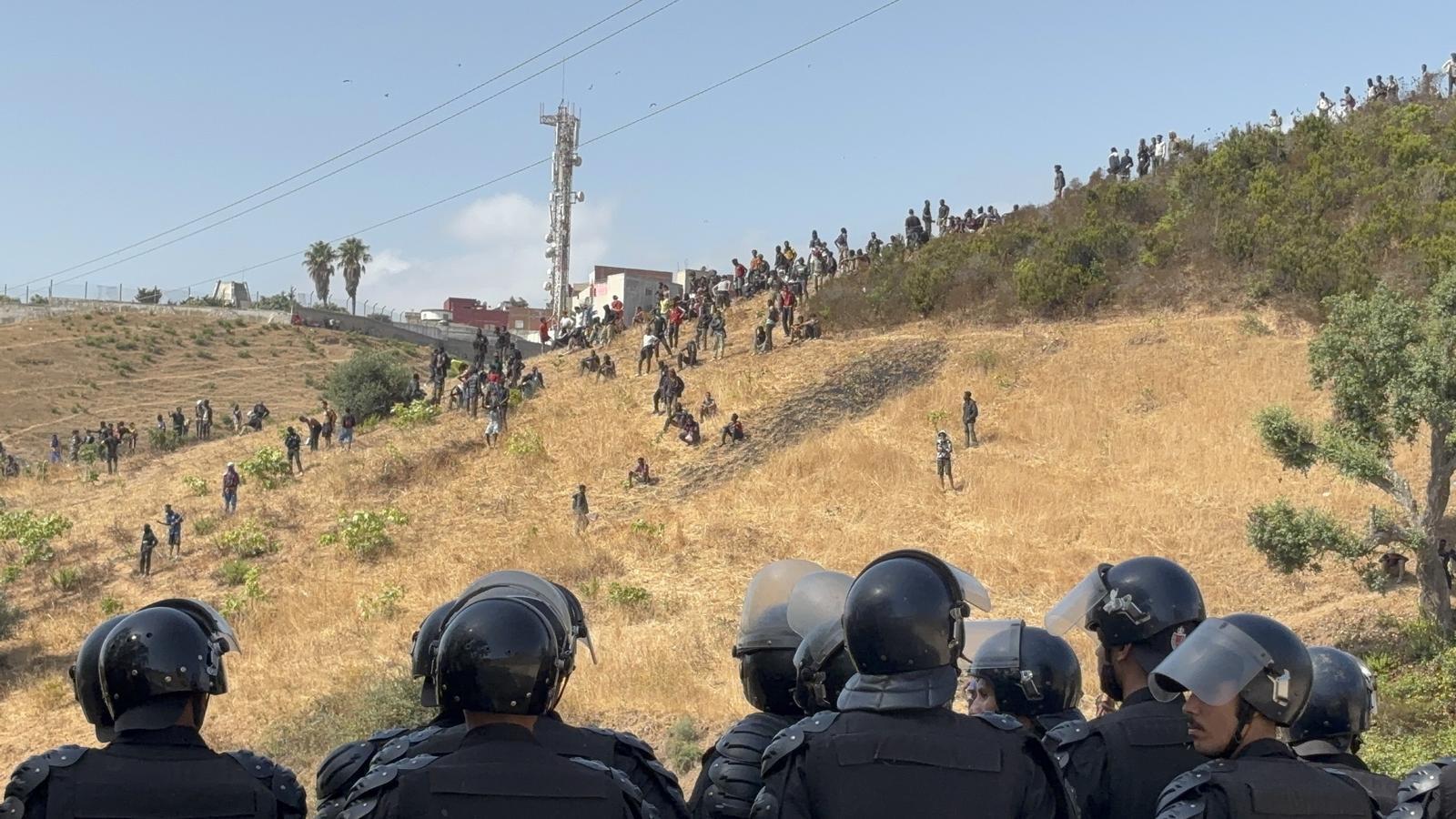
The migratory crisis in Ceuta continues. Morocco's security forces frustrated a new attempt at a mass entry into the Spanish autonomous city this Saturday. Hundreds of people, mostly of sub-Saharan origin, tried to access it and were intercepted by Moroccan soldiers. This group was waiting for the moment to jump the border hidden in Fnideq, a city on the Moroccan side near the Spanish enclave. The massive jump attempt took place in a mountainous area, according to Moroccan sources reported to the Efe agency. In any case, the complex situation in the Spanish border town continues, which has caused an internal political earthquake and the clash of the Spanish government with Morocco by having questioned the Spanishness of Ceuta.
On the other hand, this same Saturday, an order arrived from the Moroccan authorities for Spanish journalists from the Efe agency and TVE to leave the town of Fnideq "without any explanation." A representative of the Moroccan Ministry of the Interior gave the instruction for them to leave a municipality from which they were covering the police operations to prevent the entry of hundreds of migrants into Ceuta. For this reason, the Efe agency has made a strong defense of freedom of information and its management has contacted the Moroccan Ministry of the Interior, so far without success. RTVE has also expressed the most "energetic rejection" of the Moroccan action, while the Spanish government assures that it is seeking a solution.
According to the Moroccan version, they managed to detain 294 people trying to cross the border: 248 from sub-Saharan Africa and 46 of Moroccan origin, according to the Moroccan newspaper Hespress, cited by Europa Press. In addition, Morocco claims to have detained 61 more people as part of the operation carried out in recent days to prevent a new mass entry into Ceuta, and they are accused of inciting and promoting irregular migration through social networks. During the operations to prevent the immigrants' incursion, the Moroccan police used tear gas to disperse them, as well as batons, and the agents had the support of helicopters, drones, and police dogs.
Thousands of personnel, between soldiers and police officers, are participating in the security deployment that Morocco has activated for days to prevent a new massive entry into the Spanish autonomous city. Ceuta, fortified on the Moroccan side by Moroccan personnel, and on the Spanish side by members of the National Police, the Civil Guard, and the army, is living these days with the fear that a massive incursion will be repeated. Security forces from both Spain and Morocco have coordinated in recent days in anticipation of the possibility that the entry of late July would be repeated, which resulted in a still unclear number of migrants who accessed Ceuta on foot or by sea (around 80,000, according to the latest estimates) and which led to a tragedy, with at least 141 people dead.
For days now, a new massive entry had been called for this Saturday on social media, which has led to the reinforcement of the borders, both on the Spanish and Moroccan sides. The Spanish government has increased the number of agents in Ceuta, compared to the deployment that existed the week the massive entry occurred: 880 National Police officers are deployed, an increase of 270 officers compared to July 30, and 714 civil guards, almost 200 more than at the end of last month. As an extra reinforcement, a Spanish police prevention and reaction unit (UPR) of 45 personnel has been sent to guarantee public safety and twenty officers from the Central Brigade of Immigration and Borders to assist in processing international protection files that may be presented.

On the Moroccan side, controls have been considerably reinforced on roads and at maritime access points leading to Ceuta. Furthermore, searches have been carried out on taxis and buses at various points in Morocco to intercept any individual or group considered suspicious.
The right attacks Sánchez
Amidst the new attempts to enter the State, the PP and Vox criticize the lack of forcefulness of the state executive, in their opinion, to defend Spanish sovereignty and territorial integrity. Thus, the popular party has once again lamented that the Spanish president, Pedro Sánchez, remains "hidden" in La Mareta, where he spends the summer, as the popular deputy secretary Jaime de los Santos repeated this Saturday. In the case of the Madrid president, Isabel Díaz Ayuso, she has gone so far as to say that Sánchez has shown in this crisis that he is a "traitor", the same term used by Vox, which has even announced the activation of Article 102 of the Constitution, which allows for the formulation of an accusation for the crime of treason against a sitting president if he attacks "the security of the State", even though it is an unprecedented path that would have to be judged by the Supreme Court. The leader of Vox in the European Parliament, Jorge Buxadé, has stated that Saturday's intervention shows that "if one wants to, one can" defend the border.
