The profile of Blocus followers: adolescents, boys, without a criminal record and driven by FOMO
Political indefinition and the lack of hierarchy are some of the keys that help to understand the phenomenon behind the riots in Barcelona
-
CAT -
CAST
BarcelonaA phenomenon without a shared cause, without identifiable leaders, and with a propagation logic that is difficult to decipher. Blocus still offers many questions. ARA proposes five keys to try to understand how it spreads, who might be behind it, and the profile of the young people (many of them minors) who join in.
They do not share an ideology
Neither the defense of labor rights, nor access to housing, nor the improvement of education or gender equality. Neither is the defense of a specific religious confession, supremacist or xenophobic postulates, or anarchist demands. Until now, the Mossos have not identified any cause or shared ideology that explains the Blocus calls. In fact, diverse symbolisms can appear in the same message or poster, without any common ideological denominator or even contradictory ones among them.
Precisely because it does not seem to be articulated around a shared demand, the phenomenon moves away from the traditional concept of a social movement. The young people who join it may have social or economic concerns on an individual basis, obviously, but it has not been identified that these are the engine of the meetings. Blocus does not have an unknown ideology; simply, it cannot be proven that it has a shared one.
Without a hierarchical organizational structure
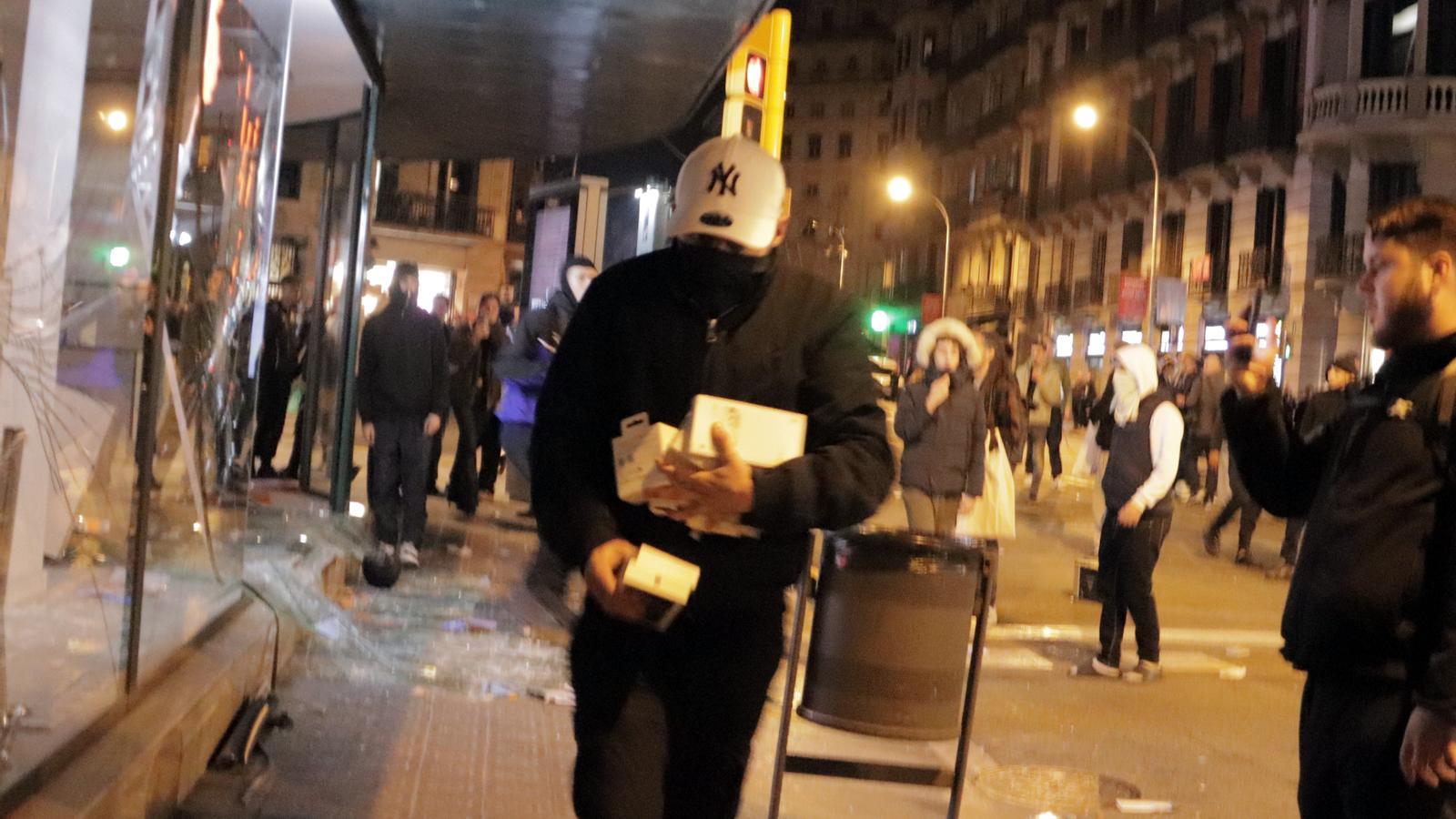
Neither does it seem that there is a rigid structure behind Blocus. There is ad hoc organization regarding how, where, and when to meet, reach more people, and, in case of achieving a quorum to transfer messages to real life, carry out acts of vandalism and looting. Some participants exercise leadership roles, as if it were a coordinator, who founds the groups or communication channels from which the information is spread.
They may have the capacity to influence, but, as always happens in the digital world, it can be ephemeral. There is no hierarchy, understood as a core group of founders directing the whole of Blocus. In fact, the agitators detained so far –among whom a young man from Valencia who had proclaimed himself the leader of Blocus Spain, but it has not been verified that he is– do not have an accredited relationship with each other and also do not share any ideological denominator. It is also not stated that they are computer experts. The majority amplify the message and many others are moved by a concept as well-known currently as FOMO (fear of missing out, that is to say, the fear of missing out on something).
It spreads through the networks
Unlike traditional mobilizations, Blocus spreads primarily through TikTok, Telegram, and WhatsApp, although police pressure increasingly pushes these groups toward other platforms, such as Signal. The phenomenon leverages its ephemeral nature and viral potential: calls to take to the streets appear, are replicated, and disappear from platforms with a speed that makes them difficult to track. However, these virtues are also its Achilles' heel, as the calls can have wide reach and generate great anticipation without prompting actual mobilization.
Another question is what fuels this spread. In Catalonia, the Mossos are investigating whether platform algorithms, video game chats, the use of artificial intelligence (AI), or deliberate amplification by some actor may have played a role. It also cannot be ruled out that Blocus is related to some form of foreign interference or a hybrid warfare strategy, that is, actions that seek to destabilize a society by exploiting social networks, disinformation, or polarization.
It draws from a trivialization of violence
The calls also escape any idea of a conventional demonstration or protest. Until now, it has been seen that they are either ghost calls –no one ends up participating or the meeting ends up being stopped, as was the case this Saturday in a dozen Catalan cities–, or they have turned into riots, looting, and clashes with the police, as happened last weekend in Barcelona. Some calls do explicitly incite violence, but not all participants go with that intention.
However, the authorities are focusing on one element to understand the viral nature of the phenomenon: the trivialization of violence. That is, repeated exposure to violent content may contribute to normalizing these behaviors among some young people. The Mossos point out that the massive dissemination of videos of young people attacking police or looting shops in Paris may have played a role in this process. Nevertheless, Blocus in France is an exception in the international police diagnosis: there, a protest basis has been detected, although it does not prevent some from having taken advantage of it to commit vandalism and looting.
Appeals to young people and minors
At least from the executor's point of view, Blocus is a phenomenon carried out by young people, adolescents and minors, much more easily influenced by dynamics of belonging, notoriety and imitation, which are very common on social networks. And this greatly complicates the police and sociological task: until now they are not the usual profile of street violence. Many are boys who study or work. In fact, at this moment, none of those identified for the riots or arrested have a history of radicalism or notable violent trajectories.
However, confronting the police, destroying street furniture, looting luxury shops or multinationals or not participating actively, but recording everything and uploading it to social networks, can be seen, among these adolescents, as a way to obtain recognition, gain visibility on the networks, feel accepted within a group or avoid FOMO. All this at an age when it is difficult to discern what weight group pressure has and what individual will has and to be aware of the consequences of their actions. Understanding what pushes these young people to go from the screen to the street is one of the great unknowns.
