What is the orbital railway line? Seven keys to understanding the project
The plans to connect the second metropolitan ring without passing through Barcelona have been gathering dust for almost 16 years
-
CAT -
CAST
BarcelonaIt has gone from being a project kept in a drawer since 2010 to becoming the protagonist of the budget negotiations between the PSC and ERC. At ARA we explain what the Orbital Railway Line (LOF) is in seven key points:
What is it?
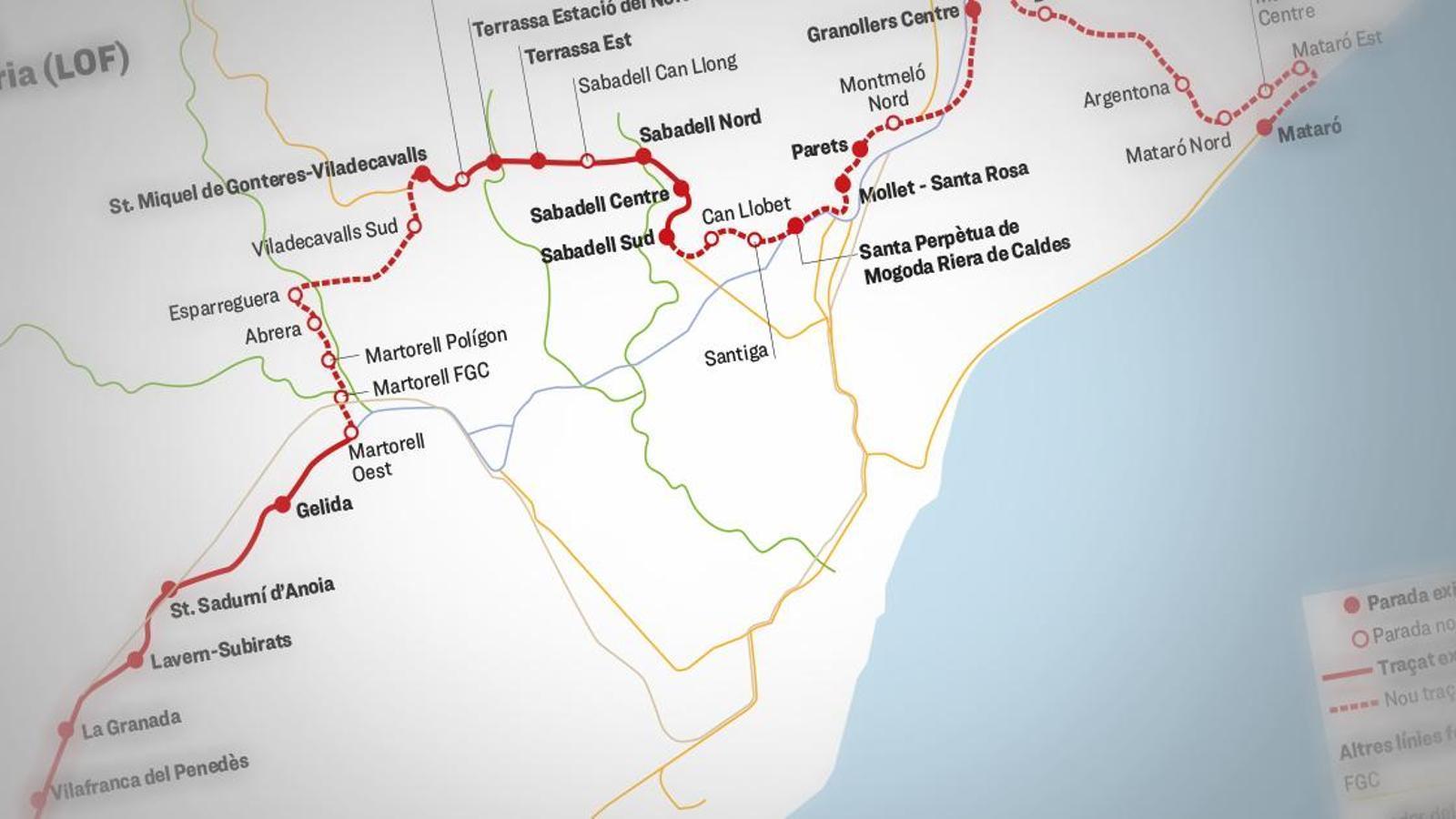
The Orbital Railway Line (LOF) is a macro-project that aims to connect the cities of the second metropolitan ring without passing through Barcelona. The idea is not new; it has been part of Catalan railway plans for over 20 years. It was first conceived during Pasqual Maragall's tripartite government in 2004, but in 2010, complexity and bureaucratic problems — as well as political priorities — shelved it. Now, Salvador Illa's executive has revived it as one of the country's major mobility initiatives at the behest of ERC, which has requested the project's reactivation as a bargaining chip for budget approval.major national bets on mobility at the behest of ERC

- If you want to investigate the chart in more detail, open the high-resolution version in another tab.
On paper, the infrastructure will be about 120 kilometers long, of which 68 will be newly built tracks. 40 stops are also foreseen: although some already existing ones from Cercanías and Ferrocarriles de la Generalidad (FGC) would be used, 23 would be completely new.
Territorio points out that it would be a commuter train, for passengers, in Iberian gauge. The project is designed to travel at an average speed of 60 kilometers per hour, with peak speeds that can reach 120. Furthermore, the creation of this transversal network would serve, according to the department, to alleviate traffic congestion in the tunnels of Barcelona. However, the project is not expected to be ready until 2040, if the schedule is met without unforeseen events.
What would the works be like?
The works would be divided into 5 phases and the execution period would extend from 2027 to 2041. The first action would consist of reinforcing the current R8 of Cercanías between Granollers and Martorell, a line underutilized according to experts and the Government itself, which is now seen as the embryo of the new orbital.
The rest of the phases would include the construction of the new sections between Santa Perpètua and Sabadell; Mataró and Granollers; Terrassa and Martorell and Vilafranca and Vilanova, to complete the entire route and its stations.
Cost and financing
When the project was proposed more than 20 years ago, the estimated cost was around 4 billion euros. Now, the Government expects a total investment of 5.2 billion euros will be needed. The State should finance it. Phase 0 is already on track because the Government of Pere Aragonès made the management assignments to move forward with two of the planned interchanges. A third one on the R8 would be missing. As for phase 1, the section between Santa Perpètua and Sabadell is already included in the 2026-2030 Commuter Plan.
Socialists and republicans are now working to include the project within the investment company that ERC has also agreed upon with the Government and which should serve to scrutinize State investments in Catalonia. The Generalitat-State Bilateral Commission this Wednesday in Madrid should specify this matter, reports Mireia Esteve.
A change of model
The great transformation that the orbital railway line (LOF) promises is to move from a network where almost everything passes through Barcelona to one that embraces it (from the outside) from Mataró to Vilanova i la Geltrú and which, along the way, connects the main cities of the second ring, which currently have to pass through Barcelona to relate to each other.
The LOF would avoid this dependence on the central node and would decongest the capital's railway tunnels, one of the main bottlenecks in the system. At the same time, it would allow for a better separation of freight, high-speed, and commuter traffic.
According to Territorio's calculations, the project has a potential demand of 30 million users per year and an area of influence of 3.2 million people, and would help to remove up to 29,000 vehicles daily from the road and reduce 45,000 tons of CO₂ emissions annually.
Other rescued projects
The LOF is not the only project that the PSC has rescued from the drawer. The same happened with the extension of the L2 metro, the undergrounding of the Gran Via in l'Hospitalet, the transfer of Rodalies (also promoted by ERC in the previous legislature), the B40 project, the Hard Rock one, and the maintenance of the model of interurban bus concessions, with a new extension for six more years.
Social agents
Both Foment del Treball and Pimec agree that the LOF "is not a priority infrastructure for the country" but value that it serves to facilitate the approval of the Budgets.
From the employers' association chaired by Josep Sánchez Llibre, Lluís Moreno points out that ""it is not among the 100 measures" that Catalonia needs most. Along these lines, the head of Pimec Logística, Ignasi Sayol, calls for the establishment of a National Infrastructure Pact: "It is basic that we all agree, because they take 15 or 20 years to be executed".
"not among the 100 measures" that Catalonia needs most
