Juan Manuel García-Ruiz: "The key is silica!"
Professor of crystallographic studies

-
CAT -
CAST
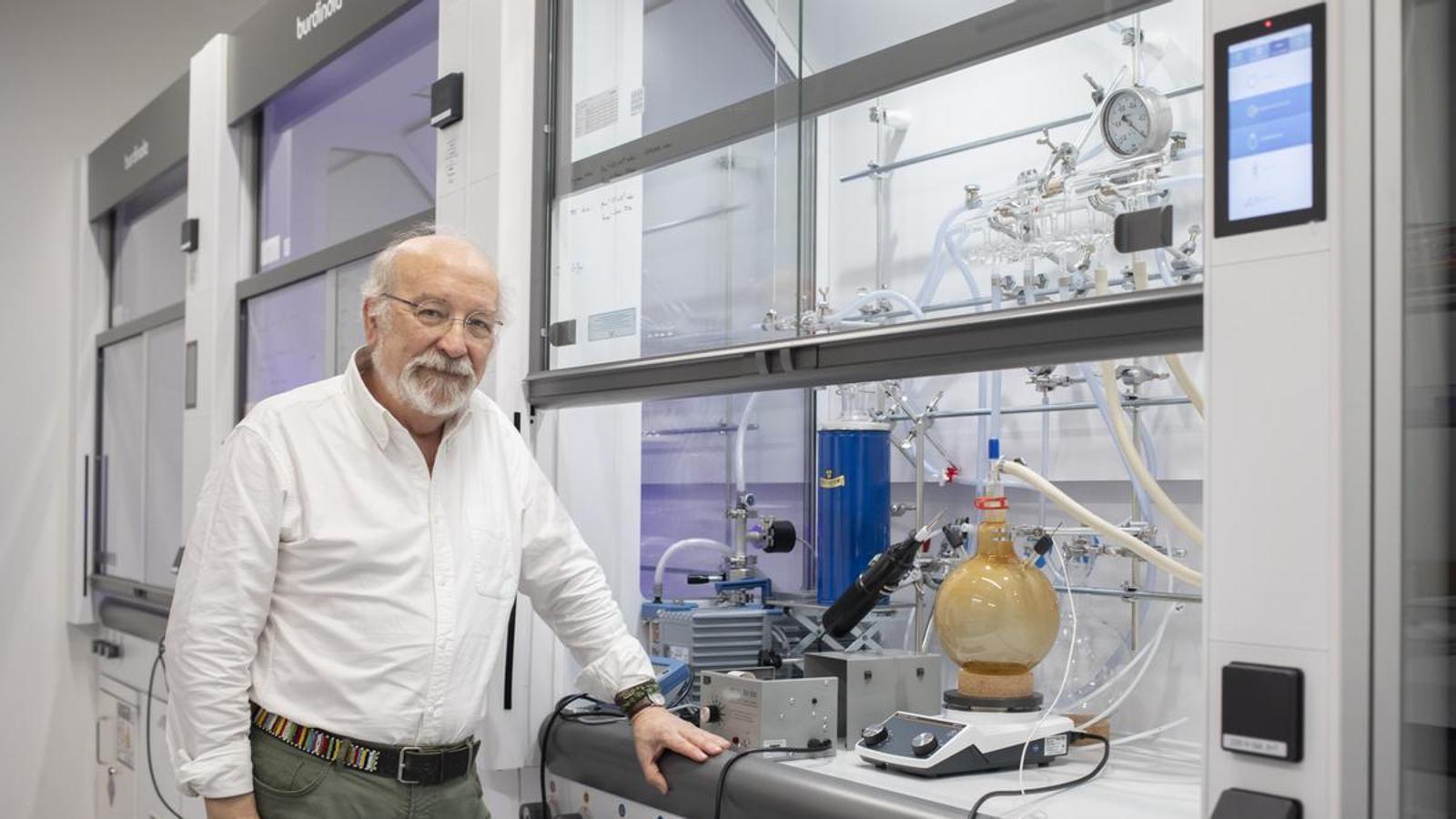
Juan Manuel García had just retired when he was awarded a grant of ten million euros with an objective as ambitious as it was complicated: to study the origin of life. And, specifically, the role that silica played in making this possible.
What do we know about the origin of life?
— Very little. There are two big questions, I think, in science: where are we going and where do we come from. The origin of life is a big question, and we are nowhere near answering it.
How long has there been life?
— There is controversy. We study it with fossils, and as you go back they are smaller structures and it is more difficult to discern their origin. But, without a doubt, more than 2.5 billion years ago, because there are remnants of life in ancient rocks. Some say these remains are from 3,000 or 3.5 billion years ago. In other words, a long time.
The Earth is even older.
— 4.56 billion years. And some believe that the conditions for the molecular building blocks of life to form already existed 4.3 billion years ago. But if there was life, there are no remains, because there are no remains of these rocks on Earth.
What was the Earth like 4 billion years ago?
— Did you know that what we think has changed very recently? Only 15 years ago it was thought to be a Earth full of volcanoes. That's why it's called the Hadean period, which comes from hell in classical Greek. Now we think that the primitive Earth was a planet with large areas covered with water, a reducing atmosphere –which has methane, hydrogen, ammonia, and nitrogen– and with many lightning bolts and volcanoes.
What do we understand by life?
— A chemical system that is capable of metabolizing, that is, of producing reactions and obtaining energy from them and reproducing itself.
How should we imagine this life?
— Very small helical structures. In fact, one of the problems in studying it is that it is studied taking morphology into account, because there is no evidence of what chemistry these structures had.
In fact, this led you to prove NASA wrong.
— In 1996, NASA announced that it had found evidence of life in a meteorite.
Clinton said it could be among the most surprising revelations science had ever made about our universe.
— But one of the pieces of evidence they gave was that the structure, due to its shape, had to be organic. They argued that they were fossilized microbes. I had already studied it years before: they were mineral microstructures that looked like living beings and they were not. That's why I went to NASA, they presented the data and I told them: I'm very sorry, but this is not necessarily life. Morphology is not an unequivocal criterion for identifying it.
Time has proven you right. How is the origin of the Earth investigated?
— In the year 1953, a fundamental experiment was conducted by Stanley Miller. He took a glass reactor, added the gases found in the atmosphere, electrodes to create lightning, and discovered that amino acids, the building blocks of life, were formed.
Why bricks of life?
— Because they join like Lego pieces, forming proteins. Miller's experiment was fundamental because it demonstrated that the molecules necessary for life could form naturally without living organisms.
But you will repeat it… and it will not work.
— We introduced a change: instead of using a borosilicate container we use Teflon, which is an inert material. What happened? Nothing at all. Because the key is silica!
Silica…
— One of the most abundant substances… It is found in many rocks and minerals. So, borosilicate contains silica. We have also tried the experiment by putting silicas from that time, and it already works. In other words, we have discovered that the experiment only works if there is silica in the system.
In other words...
— The Miller experiment forms a primordial soup. It is a very thin broth when made in Teflon and it is pure bouillon cube when made with silica minerals. This allows us to continue investigating the role of silica in the origin of life, and one very important thing: everything that has to happen before life arrives. That is, we have the building blocks, but how do they self-organize to create this complex structure? We don't know, and it's complicated.
You have been given 10 million to investigate it.
— Exactly. There is a fantastic program in Europe that is designed to exclusively study fundamental problems. They cannot ask you: and what is this for? You just have to convince the court that with the research, the opinion on the fundamental topic you have raised will change.
You were already retired...
— Yes, I retired when I had already applied for the project.
You could be resting.
— But I hit the lottery, it's a project I love, it's exciting, I can work with very intelligent people and research in privileged places like the Rift Valley in Kenya, which is the closest area from a chemical point of view to Earth that we believe was primitive Earth.
Do we know when water appears?
— It should be just after the formation of the Moon, that is, about four thousand four hundred and something million years ago. The Moon forms because there is an enormous meteorite that practically splits the planet in two. Before that, we don't know anything.
Why do we know there is water?
— There are no rocks from that era. But there is a kind of small crystals that have been found in rocks and that, due to their characteristics, must have formed from water. And they are more than four billion two hundred million years old.
Have you always been interested in glass?
— Always, I did geological work to do crystallography. I believe crystals have a huge impact on our culture. From a scientific and technological point of view, our society is based on glass.
How?
— All electronics –superconductors, semiconductors…– are glasses. When we talk about medicines and drugs, glasses are fundamental. And for years I have been trying to convince people also of the enormous impact they have had on the history of art and the mind. In the way of thinking.
Why?
— It turns out that the first objects collected by Homo erectus are quartz and calcite crystals. Why did they do it? It was suggested that perhaps they served as tools for something. No, they were of no use.
So...?
— We have conducted experiments with chimpanzees, which are the last species to separate from us, and what we have discovered is that the two attractors are transparency and shape. The most inhuman thing there is is a crystal, because it is a shape that does not exist in nature. So crystals would be one of the first experiences of symbolic thought. That is, when a mind is capable of saying: I want this, not for utility, but because I like it.
Is there life out there?
— Probably, but what is clear is that no evidence has been found. This is also important to say. What we have been able to demonstrate is that the basic components for life are already present not only on Earth but on other similar planets and moons. From here, the step towards life depends on a complex and partly also random process, like a game of chemical combinations. That is why we also try to understand how life appeared on Earth and if something similar could have happened on other worlds. Here it took hundreds of millions of years and a very particular combination of conditions, almost like winning the lottery.
What does someone who studies the origin of the Earth think of God and Genesis?
— The Bible does not interest me much. It is a text written two or three thousand years ago that does not serve as a premise from which to investigate.
But what would I say to someone who believes God created the Earth?
— I don't need to convince anyone. People can think whatever they want. What is clear to me is that life was not a divine breath.
Will we know the origin of life?
— Can we know exactly how the fall of the Roman Empire arose? Man, we will probably know a lot, but everything, no. What we are doing is getting closer to how the process was and trying to understand also how there is a chemical evolution before life appears.
