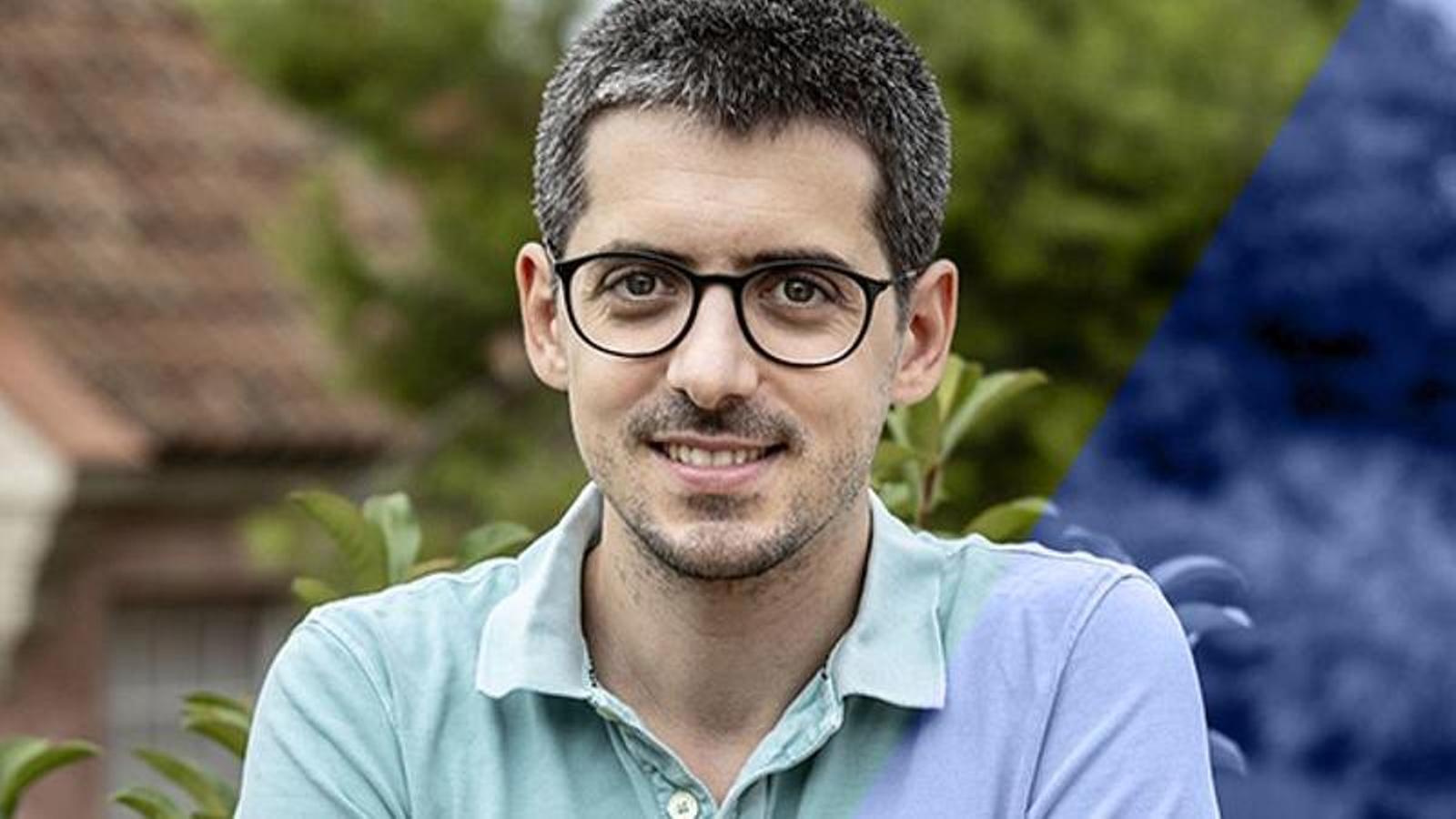
Guillem Blanco Fernández, the mathematician who solved a problem that had resisted for 40 years
UPC professor and CRM researcher, he is one of the young talents in mathematics with the most projection in the country
-
CAT -
CAST
BarcelonaThere are mathematical problems that persist for decades after being formulated and challenge generations of brilliant minds around the world. The Yano conjecture was one of them. Proposed in 1982, it suggested how to classify and compare singularities of curves, that is, points where a curve stops behaving in the usual way, as happens with black holes, places where the rules we know from physics stop working the way they do in the rest of space.
Forty years later, Guillem Blanco Fernández (Barcelona, 1992) finally managed to close it. And today, this assistant professor in the Department of Mathematics at the Polytechnic University of Catalonia (UPC) and researcher at the Centre de Recerca Matemàtica (CRM) is considered one of the young talents in this discipline with the most international projection.
“The best part of my job is being able to face problems for weeks or months that may have been open for decades, and solving them,” he confesses with enthusiasm. “It is very satisfying to prove that a conjecture is true and that it will always be true,” he asserts, “unlike what happens in other fields of science, such as physics, where theories or ways of understanding some aspect of the Universe can change.”
Math had always gone well for him, and in high school, where he had “very good teachers,” it became clear to him that he wanted to dedicate himself to it. He graduated and earned his doctorate from the Faculty of Mathematics and Statistics at the UPC, when the boom in data analysis and artificial intelligence had not yet exploded. “The possibilities that a student of this discipline now has are much greater than those we had back then,” he considers.
After five years in Belgium, as a researcher in the Department of Algebra at the Catholic University of Leuven, in 2025 he returned to Catalonia, to the UPC, with two prestigious awards under his belt: the Vicent Caselles awarded by the Royal Spanish Mathematical Society and the BBVA Foundation and the José Luis Rubio de Francia, one of the main Spanish recognitions for young mathematicians.

“I have been lucky enough to stumble upon problems that have been open for a long time and that I have been able to solve,” he says, with humility, while remembering that, in mathematics, reaching a solution is almost never a solo race. “Often a researcher poses a question, which remains open. For years, different mathematicians work on it and advance the conjecture, until someone manages to solve it,” he explains.
Blanco's research is pure mathematics, without any –for the moment– direct application. “Many applications that are used today in physics or engineering originating from mathematics were discovered decades ago. Perhaps in the future, the theories I work with will end up being used in some technology.”
Blanco is now also beginning to lead younger researchers and to train a school of thought. And perhaps this is the most beautiful paradox of his story: while he tries to find the answer to questions that resist being solved, he accompanies other mathematicians so that it is they who formulate the questions of the future.
