Dizziness, nosebleeds, headaches: learning in classrooms over 30°C
Schools and institutes in Catalonia register temperatures above the limits established as safe, while experts warn of the detrimental effects this has on health and learning.

-
CAT -
CAST
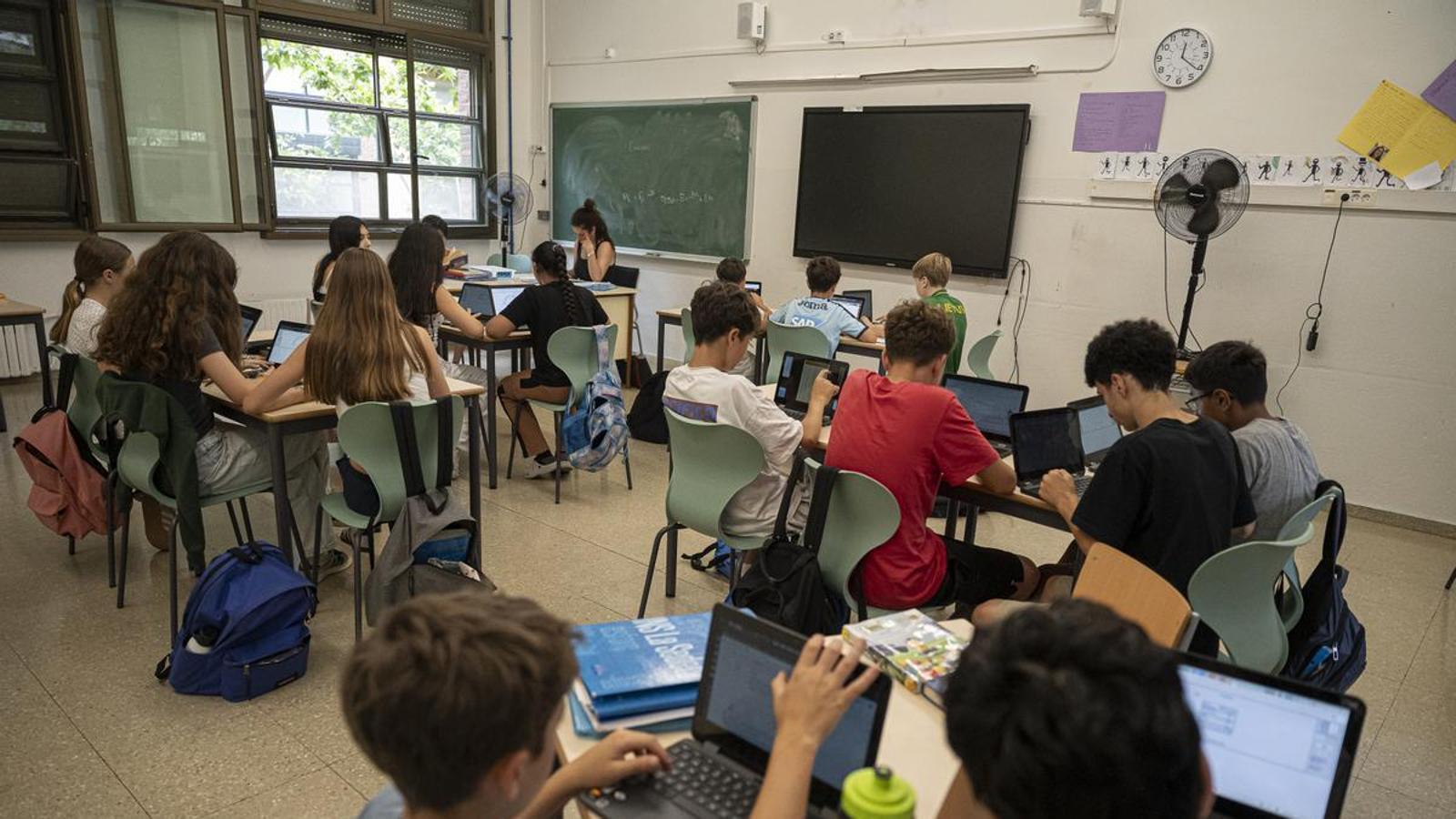
It's not even 9 AM and in the classrooms of many schools in Catalonia, thermometers are already climbing above 27 degrees, despite being in a week of relative climate respite. This is the case at Institut La Sedeta, located in the Gràcia neighborhood of Barcelona, where since mid-May they systematically exceed 30 ºCin most areas of the center every day. During heat peaks, they have even reached 35 and 36 ºC, and the high humidity of the Catalan capital further exacerbates the feeling of suffocation experienced by students and teachers in the building.
And they are not the only ones, judging by the temperatures reported by educational centers across Catalonia: on the day we are writing this, at Escola Camí del Mig, in Mataró, they recorded 44 ºC in a second-grade classroom; at Institut La Mitjana, in Lleida, they are at 31.7 ºC; and at Els Picots school, in Lliçà d’Amunt, they are at 33.4 ºC in the third-grade classrooms.
All this data comes from the real-time recording that the centers are doing with sensors and thermometers distributed throughout the buildings, which are automatically sent to the platform Aulesquecremen.cat. This is a new initiative promoted by teachers and families that aims to objectively demonstrate what they have been denouncing for years: that school classrooms are boiling, that the temperature limits set as safe in labor regulations are being exceeded.
The idea for this platform comes from a secondary school technology teacher at an institute in Baix Llobregat, Pau Sánchez. “We started with 30 schools and today we are over 220, a figure that increases by about 10 or 20 centers almost daily. We already have more than 500 devices transmitting information about the temperature in classrooms in real-time,” explains this teacher.
This is not an exceptional situation. Episodes of extreme heat fueled by the climate emergency will increase. According to data collected in a recent report by Equitat.org (formerly Fundació Bofill), days of intense heat have already tripled in the last century, and the forecast for 2050, if nothing is done to prevent it, is that they will quintuple. It is impossible for them not to coincide with the school calendar.
“With this heat, it is impossible to maintain student attention, and it is dangerous for their health,” denounces Pedro Mariscal, director of Institut La Sedeta, who explains to ARA that they have had several cases of students who have fainted, vomited, or had nosebleeds due to heatstroke. High temperatures also take their toll on teachers and other school staff. “I have found teachers leaning against the wall completely dizzy and unable to teach,” says Mariscal.
In this regard, and as an extraordinary measure, last week some teachers from this institute chose to move classes to the street, a symbolic act to highlight this “unsustainable situation.” “As a secondary school teacher, the feeling we have is that we are more like camp counselors during the central hours of the day than teachers, because managing the classroom is very difficult,” adds Sánchez, who points out that it has been calculated that each student emits about 115 watts, which in a classroom with an ambient temperature of around 30°C and twenty-five students is equivalent to having a heater plugged in for nearly 3000 watts.
“Last Monday, a group of 4th-year ESO students decided not to enter the institute because it was too hot,” recounts Mariscal. Those same students wanted to personally report this situation at the headquarters of the Consorci d’Educació de Barcelona. “They were received and, in addition, were given 20 fans, after we had requested them from the center and were told no,” says the director of this institute, who questions: “What are we going to do with twenty fans? We have 400 students and a listed historic building not at all prepared to face temperatures like the ones we have, with old windows that cannot be opened completely and do not allow air circulation. The situation is very dramatic.”
A very vulnerable group
Children are a highly vulnerable group to extreme temperatures. “Their thermoregulation system is immature. It is difficult for them to identify that they are very hot or thirsty; they produce more heat per kilogram of weight than adults and it is also more difficult for them to cool their bodies, because they sweat less,” summarizes Elena Codina Sampera, pediatrician and head of the Pediatric Environmental Health Unit at Sant Joan de Déu Hospital. Codina also participated in the Equitat.org report on heat in classrooms.
Being constantly subjected to episodes of high heat impacts children's physical and mental health. Frequently, they experience dizziness, irritability, fatigue, headaches, and minor nosebleeds. In some cases, Codina points out, the consequences can be more serious, such as heatstroke with very high fevers and even loss of consciousness. “Through our Instagram account, we receive alarming messages, such as teachers from the Lleida plain explaining that an I5 student in the playground had heatstroke and they were about to call 112. Or from Les Borges with 37.5°C inside classrooms, with dizzy students. In Manresa, even, a girl fainted and an ambulance had to be called,” reveals Sánchez.
Regular exposure to high temperatures also negatively influences their learning. "It is proven that on days of extreme heat, academic performance drops,” points out Codina. Several scientific studies, one of the latest from Harvard University, confirm learning difficulties, less memory, impacts on behavior (heat makes them more aggressive, irritable, distracted) and also on the neurodevelopment of children.
“Another factor to consider is whether children have the capacity to recover and break the cycle of exposure to intense heat,” points out epidemiologist Mònica Ubalde, from the urban health impact group at the Barcelona Institute for Global Health (ISGlobal). “Children spend a good part of the day at school, and if they don't have thermal comfort conditions at home afterwards, their bodies cannot recover to regulate thermal discomfort, which builds up,” she emphasizes.
A study published in Nature Human Behaviour analyzed the school performance of 58 countries and concluded that the learning pace at school decreases as the number of hot school days increases. In fact, this study quantified that for each day students are exposed to heat at school, PISA scores are reduced by 0.18%. These results align with a report from the Society of Pediatrics of Southeast Spain, which indicates that for every degree increase in temperature above 25 ºC, math results drop by half a point. And they are in line with what the Equitat.org report highlights, which warns that from 2030 onwards, children will spend a quarter of the school year with temperatures above 27 ºC, and this could lead to a decrease of seven PISA points per academic year.
Furthermore, the effect of high heat is cumulative. “Teachers have a regulatory framework that limits sedentary activities to 27 ºC. But there is no legislation that protects children, that establishes at what temperatures they can learn,” laments Codina, who says we are depriving children of “achieving their maximum learning potential, which perpetuates the cycle with less quality of life and fewer future options.”
Adapt the school to the climate emergency
“We know that boys and girls are among the most vulnerable populations to extreme heat and that episodes of high temperatures during May and June will become increasingly frequent in the coming years,” stated this week the Minister of Health, Mónica García, who urged the autonomous communities to take urgent measures to adapt educational centers to the climate emergency. “How do we adapt schools designed for a 20th-century climate to our children who study in a 21st-century climate?” the minister asked.
According to Education data, one in four centers in our country was built before the 1960s with the aim of retaining heat during winter, oriented south to gain light and warmth, because the months of high temperatures, then July and August, were supposed to be empty. However, newly built buildings are not saved from the heat either. The school in Vallès Oriental, which was inaugurated in 2008, where primary school teacher Aleix Vidal works, “is a greenhouse.” “At 8:30 in the morning we are already at 29.5°C and we only have two fans per classroom that do nothing but stir the hot air,” he laments.

Educational centers are also the only publicly owned buildings that are not air-conditioned. In fact, a recent report by Equitat.org, prepared with a group of experts in the climate, social health, and education fields, has analyzed the situation of schools and institutes in the country in the current climate. It states that 1,220 out of 2,500 school buildings have insulation, ventilation, or obsolete material deficits. This means that these centers cannot guarantee adequate thermal comfort conditions, which is why the report proposes a plan to adapt them to the climate emergency in less than ten years, at a cost of 200 euros per student per year for ten years.
For the moment, the Government has only announced a short-term investment of 20 million euros to purchase ceiling fans and has approved carrying out the necessary studies to define the air-conditioning actions to be carried out in the different educational buildings, an action that the Federated Associations of Students' Families of Catalonia (aFFaC) had been requesting for at least four years.
Nature as a solution
As short-term measures, Equitat.org proposes installing ceiling fans in all classrooms, improving night and early morning ventilation to reduce indoor temperature before the start of the day; also installing natural or bioclimatic shading systems, such as awnings that prevent building facades from being exposed to the sun, and water fountains in the courtyards, in addition to enabling strategic air-conditioned spaces, such as the gymnasium or the dining room, for moments of maximum heat.

They then propose a five- to ten-year plan to transform buildings and ensure permanent climatic comfort. The report estimates that an investment of between 500 million and 1.3 billion euros is needed, a figure far lower than the health and learning costs associated with not adapting the educational system to heat.
In this longer-term plan, the re-naturalization of centers is a key element in helping to combat the effects of heatwaves. “We need to incorporate more soil, remove cement from courtyards, paint roofs white, plant much more vegetation, which is a natural barrier against excessive heating and generates a whole natural system that improves thermal comfort both outside and inside. A single tree generates the same coolness as five air conditioning units,” highlights Ubalde, from ISGlobal, who adds that “air conditioning should not be demonized, but it should be the last resort and complementary, because it does not generate thermal comfort, but rather cold, and contributes to the heat outside, fostering the urban heat island effect”.
aFFaC has also joined teachers in demanding the urgent need to climatically adapt educational centers, especially older buildings with obsolete facilities. We must guarantee the right to quality education for all, equity between schools, between territories, and this implies adapting buildings and environments to the new climatic conditions,” claims Lidón Gasull, director of this entity.
