Matilde Ferrer: "After Hiroshima the oleander blossomed; a flower is hope"
Rosary devotee
-
CAT -
CAST

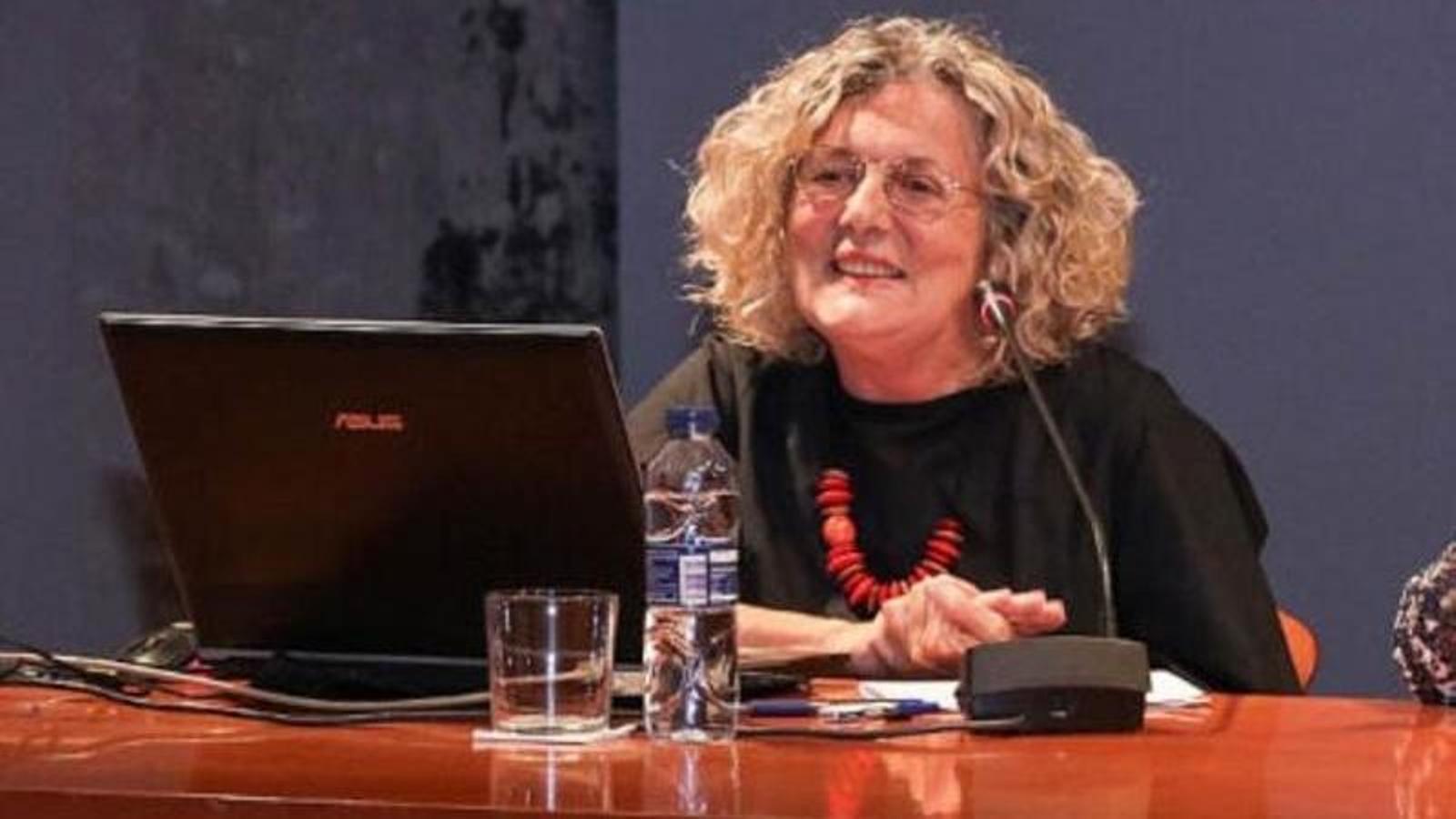
The sunglasses in her hands betray the age of the image. "It's not that I want to look younger," Matilde Ferrer excuses herself with a laugh, it's that the photograph in that Berlin restaurant reminds her of the happy trip she took with her children and she always likes to look at it again. In the background, there is no green or any plant to be seen. Nor any of the flowers that she has dedicated herself to hybridizing for more than forty years.
How is a rose made?
— The rose is hermaphroditic: it has both male and female organs. I take the pollen from the one that will act as the father and apply it to the stigma of the one I have chosen as the mother. I look for healthy plants, resistant to diseases, easy to care for, that bloom almost all year round. And that have a scent.
Why do so many not do it?
— Because the perfume is difficult to obtain. The ideal way to achieve it is to cross a fragrant father and mother.
Are there stallions among the roses?
— You have to choose the parents very well. The mother must bear fruit. If it is an interesting rose but does not bear fruit, we use it as a father.
What does it mean that a rose is new?
— Which is distinct and homogeneous.
Homogeneous?
— Each stem must produce the same color. If one comes out yellow and the others red, it is not a yellow rose.
Who checks it?
— There are competitions. Each winter you can submit up to five varieties. A committee of technicians monitors them all year round: their health, their reblooming, what makes them different.
How many years does parenting last?
— I pollinate in the spring. The fruits are harvested around December 1st, when they have already ripened and taken on color. The seeds germinate in January and February, and in March and April the first colors appear. Then the selection begins: three, four times, over a few years. Only the one that overcomes everything receives a name.
And before the baptism?
— A code: FE (for Ferrer) and some numbers.
Is there any Matilde rose?
— Yes, Meilland is going to dedicate it to me. It is a cut-flower rose, although I am more interested in the garden rose.
Why?
— It is closer to my ideas, to nature. The cut flower is the industrialization of the flower.
To whom does he dedicate his roses?
— To people of science and culture. Almost always, to women: Margarita Salas, Irène Joliot-Curie, Núria Espert, María Vallet, Ana Lluch. There is also one for Ramón y Cajal, and another for Georges Moustaki, which we presented at the Teatre Grec, with Marina Rossell singing.
And one for Setsuko Thurlow, an Hiroshima survivor.
— She is 94 years old and still perfectly remembers the explosion of the bomb. She was at school, she was trapped, and they pulled her out from among the bodies of her classmates. And she remembers that after Hiroshima, the oleander bloomed. A flower is hope: a mountain can burn, but the next year little flowers grow there again. Setsuko says that her rose is the flower of hope.
How did they meet?
— For a friend who runs the culture department at the 12 de Octubre Hospital in Madrid, where roses dedicated to Margarita Salas and other female scientists are planted. When Setsuko visited Madrid, she asked her if she wanted us to dedicate one to her. She said yes.
And which flower do you remember from when you were little?
— The Peace rose, by Meilland. It was called Madame Meilland, and at the end of the Second World War they renamed it. And the Chrysler Imperial: red, velvety, very fragrant.
Is it a profitable trade?
— It is very slow. It gives more prestige than money. A cut flower rose generates significant royalties; a garden one, very small ones. It takes a long time to get a return from it. But the satisfaction is enormous.
How does his family get to the roses?
— My father started in the forties. In Catalonia there were great breeders, such as Camprubí and Pere Dot, at the Torre Blanca estate, and he used to go there to learn how to graft. He reproduced the varieties of the Germans from the Hamburg area, Kordes and Tantau, and of the French from Lyon. He used to go to Hamburg without knowing a single word of German. In the sixties, he partnered with the Meilland house, and we still reproduce their rose bushes.
And where did you learn that?
— At the Meilland house, in Provence. I used to go there when they were pollinating, when they were harvesting the fruits and, in the spring, when they saw the result. The fields were full of colors. My passion came from there. I did my first hybridization around 1980.
What does this job require?
— You have to be very scientific, because otherwise, you don't advance. It is necessary to have observation capacity and take notes. And patience.
Does it have tea?
— I am very nervous [laughs], but when I pollinate I am calm.
Do you have any specific flowers in your dining room at home?
— In Xàbia, which is where I do the hybridizations, I have a great many plants. But in Valencia, I don't have a single rose, not even half.
In my neighborhood there are no flowers. Only green.
— Green is just easier. They take the brush cutter and that's it. But, in reality, a rosebush doesn't ask for much. On a balcony, you can have a miniature one: you just need good soil and not to forget to water it; not much else.
Why should I dedicate time to this?
— Because finding a flower is a joy. A rose is therapeutic.
