This is the golden age of professional lobbying in the State
Political fragmentation and the rise of regulations have boosted a business in which politicians and former public officials abound
-
CAT -
CAST
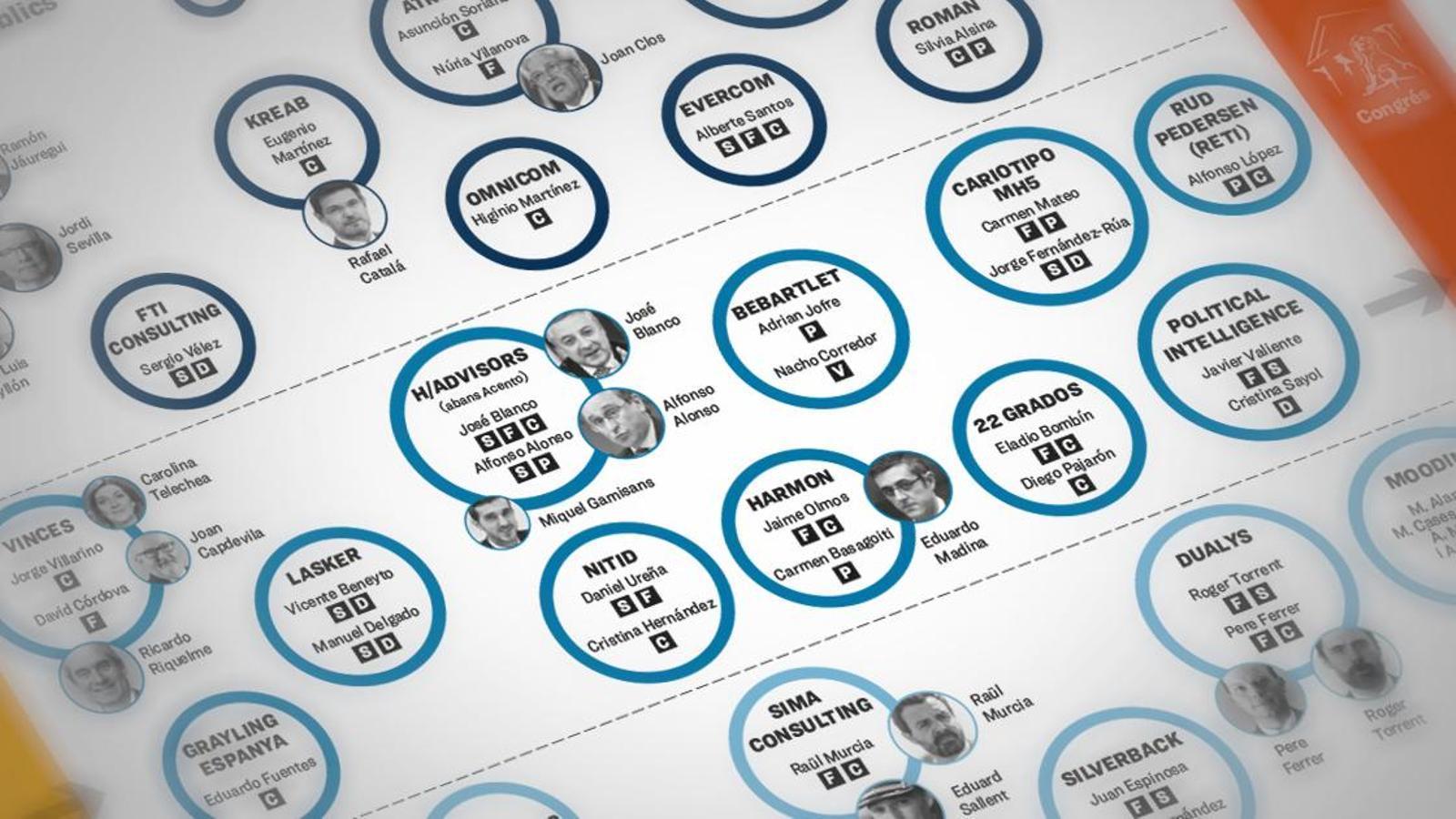
MadridThere is a sector in the State that is living a golden age, which is growing without yet having comprehensive regulation and which is increasingly relevant in the decision-making process of governments and Parliaments: public affairs consultancies. A type of bridge between the public and private worlds, which is unknown territory for a good part of the population and which in recent years has been proliferating strongly in Madrid, but also in Barcelona, due to political fragmentation, the ever-increasing complexity of decision-making processes and the rise of economic and geopolitical crises. What do these companies do, however? Is it a professionalized sector? Why is it fertile ground for former politicians? El ARA has X-rayed the main companies established in the State, speaking withpeople from within the sector, professional associations, politicians, and also experts who point to the lack of regulation as the main problem.

If you want to investigate the galaxy in more detail, open the high-resolution version in another tab.To the question of what these companies do, the answer is to influence the public sector, especially governments and Parliaments, on behalf of a third party, usually companies. They do not engage in traditional lobbying, as they are not the directly affected sector, but rather it is a professionalization of this task. They work for different companies at the same time and are located close to power. This is why many have been founded in the capital of the State, where the decisions of the Boletín Oficial del Estado (BOE) are brewed.They bring to companies' tables advice, market strategies, "contact lists," or innovative methods of public influence. They offer a new, more "propositive" culture to influence the public sector rather than a "reactive" response to a problem that may arise from administrative decisions. For example: "It is different to go and knock on a politician's door asking them to consider a proposal, than to do so after they have seen an opinion piece in a newspaper or attended a debate forum," says a person linked to the sector. In other words, there are opinion leaders who, without saying so, agree to be paid by these consultancies to defend private interests, with fees of 2,000 euros per month, according to knowledgeable sources. A task that is far removed from the informational work done by traditional media.Who are we talking about?
The names heading the crown jewels –at least by seniority– of public affairs consultancies are Estudio de Comunicación (founded in 1983), Llorente y Cuenca (1995), Swedish Kreab (1979), American McKinsey (also landed in Spain about forty years ago), Atrevia (1988), Roman (1989) or Omnicom Public Relations Group (1989). The so-called "Big Four" of Spanish auditing –Deloitte, PricewaterhouseCoopers, Ernst & Young and KPMG– have also opened business lines in this field. Apart from these large corporations, in recent years what are called "boutiques", which are small-format, with more direct contact with the client, have appeared. "Less "excel and more coffees", says a professional in the sector. Veterans of politics have dared to launch their own projects. The prime example in Madrid is the consultancy Acento, launched in 2019 by former ministers José Blanco (ex-PSOE) and Alfonso Alonso (ex-PP) and recently acquired by Havas Group. It has a strong Public Affairs department through which Fernando Moraleda (ex-PSOE) has passed, as senior advisor, or now former official of the Generalitat Miquel Gamisans (ex-ERC). Specialists in the sector confirm that the people in charge send a message of direct line with Moncloa, regardless of who is in government.Also of recent creation is beBartlet for new communication strategies and new politics, promoted by Adrià Jofre and Nacho Corredor, who was an advisor to the Spanish government. Projects have also been launched from Catalonia, such as Pascal and Partners, by former PDECat coordinator Marta Pascal; SIMA Consulting, whose promoter is Raül Múrcia, a former ERC official in the Ministry of the Interior, and which has recently hired former police chief Eduard Sallent; or former ERC minister Roger Torrent, who has founded Dualys, with former police director Pere Ferrer, to advise Catalan companies on defense. Vinces (founded in 2009) can also be considered one of the most relevant boutiques–if we consider the footprint of former politicians or former high-ranking officials–. Behind it is David Córdova, and it has former high-ranking ERC officials such as Joan Capdevila and Carolina Telechea, or from the PP, Ricardo Riquelme. Córdova, in parallel, has launched a media outlet focused on parliamentary proceedings, where he has also linked former PSOE high-ranking official in Moncloa Francisco Gómez Loarte. Vinces specializes in influencing regulation –ensuring that what is legislated does not harm its client–. On the other side of the boutiques is the historic Roman, led by Silvia Alsina, which has great prestige for achieving a good reputation for its clients. There are also those focused on a specific territorial area because some autonomous communities have their own powers: this would be the case of Catalonia, with Moodin; the Basque Country, with Silvan&Miracle; or the Canary Islands, where 22Grados stands out.
Also, large firms often incorporate former public officials as senior advisors. Joan Navarro or former minister Jordi Sevilla, linked to José Luis Rodríguez Zapatero's government (PSOE), or José Luis Ayllón, former chief of staff to Mariano Rajoy (PP), have been linked to Llorente y Cuenca. Former counselor Àngels Chacón (exPDECat) is responsible for the firm in Barcelona. At Atrevia, former PSC mayor of Barcelona Joan Clos stands out; or at Harmon, former socialist Eduard Madina; while Josep Antoni Duran i Lleida (ex-CiU) has worked at Burson. At Kreab, there have been names like former Minister of Justice Rafael Catalá (ex-PP), Xavier Cima (ex-CiU), or Miguel Ferre (former Secretary of State for Finance under the PP), who left his job following his indictment in the Montoro case, at the center of which is the consultancy Equipo Económico. Nor do the Big Four dispense with people from the administration. For example, Andoni Ortuzar, former leader of the PNB, worked at PwC as an external advisor. Why is the profile of a former politician interesting for these companies? The consulted sources assure that they know how ministries and legislative procedures work, they have the expertise and know the informal codes, in addition to the ideal moment to act. Politics also provides them with transversal knowledge for public affairs. But not only that: they have the contact agenda, and this is what generates more controversy, as some boutiques –critics from the sector itself– sell more the name of the former politician than the specific expertise.
“The problem arises when the former politician uses this capital of contacts in gray areas that can border on influence peddling”, states Irene Matías, vice-president of the Association of Public Relations Professionals (APRI). For this reason, APRI has been demanding government and parliamentary regulation of lobbies —a registry— for almost two decades, which is currently non-existent at the state level, although it does exist in some regions, such as Catalonia, which was a pioneer. They consider it essential to “normalize the profession”, guarantee access for all entities in “equal conditions”, and provide transparency about who influences and engages in this activity. For this purpose, one tool would be the regulatory footprint, to know which interests have intervened in a regulation. And what do current politicians think of this sector? Several consulted deputies assure that these public affairs consultancies usually act as intermediaries to put them in contact with companies and for these to explain their problems or interests and proposals. They are also interested in having extra information on the status of parliamentary proceedings, as this is key to knowing when public campaigns need to be intensified. A good lobbyist, argues a deputy, is one who knows which door to knock on, who presents amendments to parties that may have ideological alignment. However, another parliamentarian reflects: "Companies could also contact me directly. My email is public."The lack of regulation
To control revolving doors, the Office of Conflict of Interests (OCI) is responsible for ensuring there is no incompatibility regarding government positions. By law, they must allow two years to pass before taking a job that could generate a conflict of interests. It has been common, however, for this body to validate all these hires. In the case of deputies, the OCI does not operate and there is no body that monitors what they do afterward because "they have not managed" as government officials do, according to Joan Ridao, a lawyer in the Parliament and a specialist in the matter. Only during the parliamentary term does the Deputy Statute Commission examine possible incompatibilities. Ridao considers it essential to move forward with regulation to bring transparency to the sector. Currently, the public integrity bill is being processed in Congress, but it is stalled.Matías (APRI) notes that the business has grown significantly in the last twenty years, driven by the wave of lobbyists in Brussels. "Growth occurs in the most regulated sector," he clarifies. The price of services also varies depending on the company and location. "In Madrid, you pay more than in Barcelona. It's the capital effect," recounts one of the sector's professionals, who jokes: "The robberies are easier" in the Spanish capital, to the point of speaking of a possible "bubble." Another voice, however, normalizes the growth of consultancies as a global trend, also in the Catalan capital. Laia Bosch, APRI coordinator in Catalonia, explains that the Generalitat's regulatory advances in areas such as housing, tourism, and mobility have highlighted the need for specialized consultancies. She also points to the most important economic sectors such as industrial, healthcare, and digital.
A clear indicator of the sector's rise is the emergence of specific training, such as that promoted by AP Institute, an academic entity chaired by Joan Navarro, for many years a recognized professional in public affairs. This same entity reports a 25% growth in the sector, with a state-level forecast of 200 million euros in business volume by 2030 and around 5,000 active professionals.
