Vox prepares the ground to question the result of the next Spanish elections
The PP also subscribes to some of the conspiracy theories about a possible fraud without going as far as those of Abascal
-
CAT -
CAST
MadridThe remaining time of the current legislature in the State is one of the great unknowns in Spanish politics at the moment. While Pedro Sánchez proclaims his will to resist as long as possible and the PP relies on the wear and tear that the Spanish president may suffer from the succession of scandals, from Vox the strategy is to proclaim the "danger" that the coming months could pose if the socialist leader remains in power. The reaction of Santiago Abascal's party to the Supreme Court ruling against José Luis Ábalos has been to warn that what they call the socialist "criminal mafia" is willing to do "anything" to stay in Moncloa until 2027. And even beyond that electoral date. "The worst is yet to come," they predict. The almost apocalyptic scenario presented by the far-right includes the hypothesis that Sánchez could "steal" the next Spanish elections.
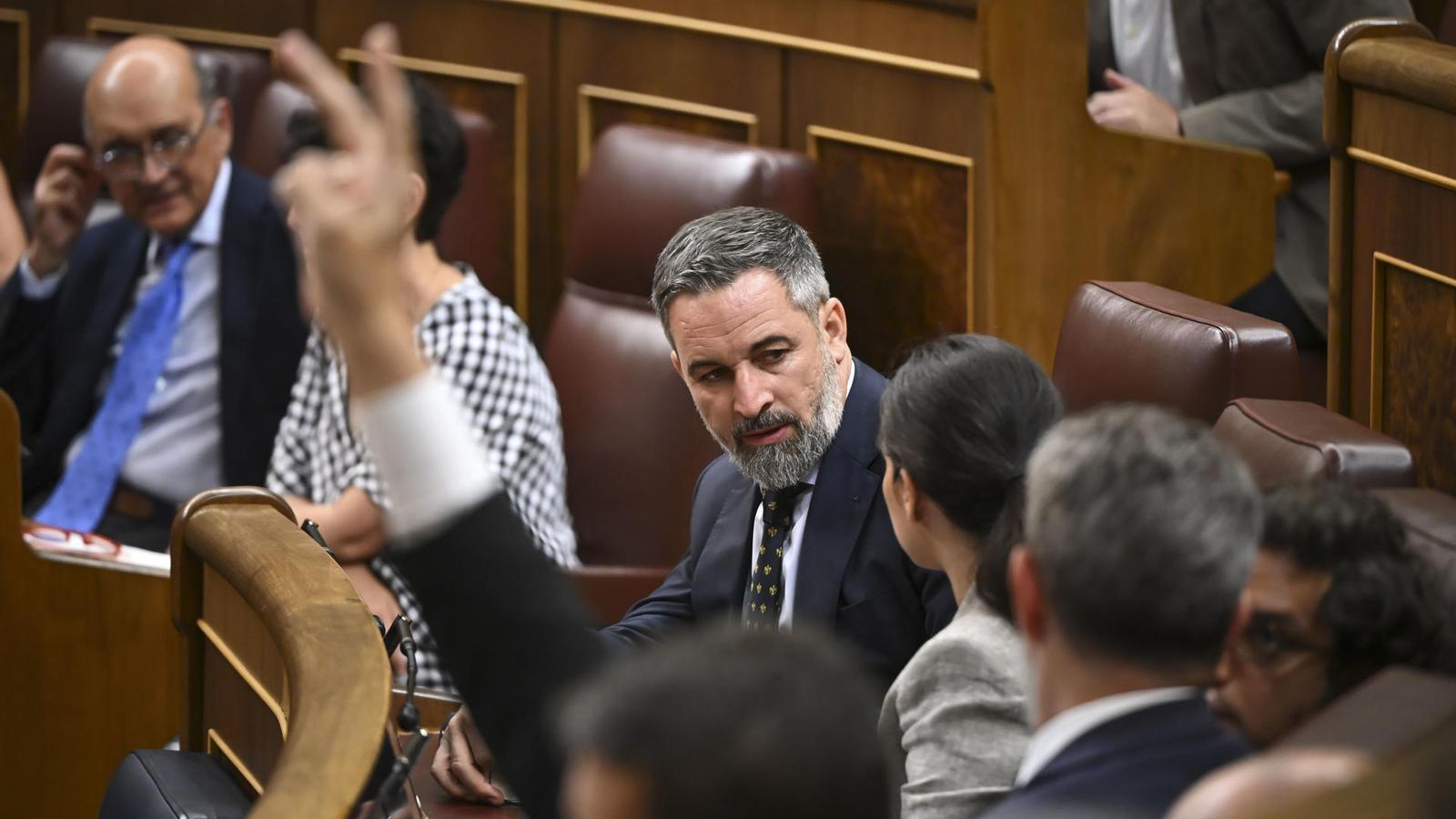
This is a thesis that Vox has been raising and feeding for some time, in line with the global far-right. Abascal deployed it this Wednesday during Sánchez's appearance in Congress when he openly denounced an alleged "plot" to "alter the outcome of the next elections." The Spanish president replied that the "more than 40 electoral processes" held since he has been in government have been carried out "exemplarily." "Your electoral flat-earthism is not defending democracy, it is preparing the excuse for your next defeat," replied the socialist leader. The PP, especially Isabel Díaz Ayuso in Madrid, have also incorporated some of the arguments with which Abascal's party deploys this theory of a supposed risk of electoral fraud. However, the far-right goes even further and in this week's plenary session of Congress also proposed the processing of an initiative that did not even have the support of the Popular Party, who abstained.
The text from Vox that the lower house did not consider proposed reforming the electoral law to "reduce the possibilities of potential fraud" in postal voting. How? By establishing that the scrutiny of ballots that have arrived via this non-personal route must be placed in a separate ballot box and that the scrutiny must be done separately. "One thing is to distrust the government and another very different thing is to distrust the electoral system," stated PP deputy Rafa Hernando during Tuesday's debate, in which he defended the "multiple guarantees" of the current legislation, arguing that there is "no proof" that the outcome of an election could ever have been altered by the custody of postal votes. However, what the Popular Party and Vox do agree on is the decision to sow doubts regarding the granting of the right to vote.
The clean law
"For years, this government has been promoting increasingly questionable formulas to expand the electorate by incorporating into the census people who do not live or have never lived in our country to compensate for the growing disaffection caused by scandals and corruption [around the PSOE]," Hernando stressed. The popular deputy was thus referring to a provision of the Law of Democratic Memory, known as the "clean law," which has opened the door to granting Spanish nationality to descendants of those exiled during the dictatorship and also to other people with ties to the State, as an extensive interpretation is being made, as an extensive interpretation is being made. According to data from the Ministry of Foreign Affairs, as of March 31 this year, approximately 2.4 million people had initiated the process to obtain it, and 545,000 applications had already been approved. Obtaining Spanish nationality gives these individuals the option to vote in elections by registering in the electoral roll of Spaniards residing abroad (CERA). Participation in this group is usually very low: in the last general elections of 2023, only 10% of those eligible to vote did so. The count is done by provinces, and in most of them, the PP also emerged victorious with the PSOE as the second force, to the point that in Madrid, the Popular Party took a seat from Sánchez, making him need Junts's 'yes' for the investiture.
In Vox's opinion, in any case, one of the reasons why Sánchez wants to hold on until the end is because he is working on an "electoral coup through the clean law." The longer he can "stretch the deadlines," the more nationalizations he can grant in order to "reverse" the results in favor of the PSOE, claim those from Abascal, who take for granted that these are voters who would predominantly opt for the left. That is to say, their theory is based on assuming what these new Spaniards would vote. In Wednesday's debate, the leader of Vox accused Sánchez of distributing passports in Cuba, "only to regime adherents," and with the complicity of local authorities, to "control" the envelopes to send them to key constituencies that can alter the distribution of seats.
Along similar lines, Ayuso has even quantified the impact it would have on the Madrid elections, also scheduled for 2027. According to the president of Madrid, it could alter the distribution of up to 10 seats. The PP has also accused Sánchez of having approved the regularization of immigrants with the aim of altering the census, although their beneficiaries will not obtain the right to vote in either Spanish or regional elections in the short term. "They are driven by the toxic and destructive strategy copied from Donald Trump," proclaimed ERC deputy Francesc-Marc Álvaro in Tuesday's debate, in which the plurinational majority threw their hands up at Vox's "quirks".
