The Spanish government faces the largest migratory crisis in Ceuta since 2021
Italy studies suspending the Schengen agreement with Spain due to the crisis, and the Ministry of Foreign Affairs summons the ambassador in Madrid for consultations

-
CAT -
CAST
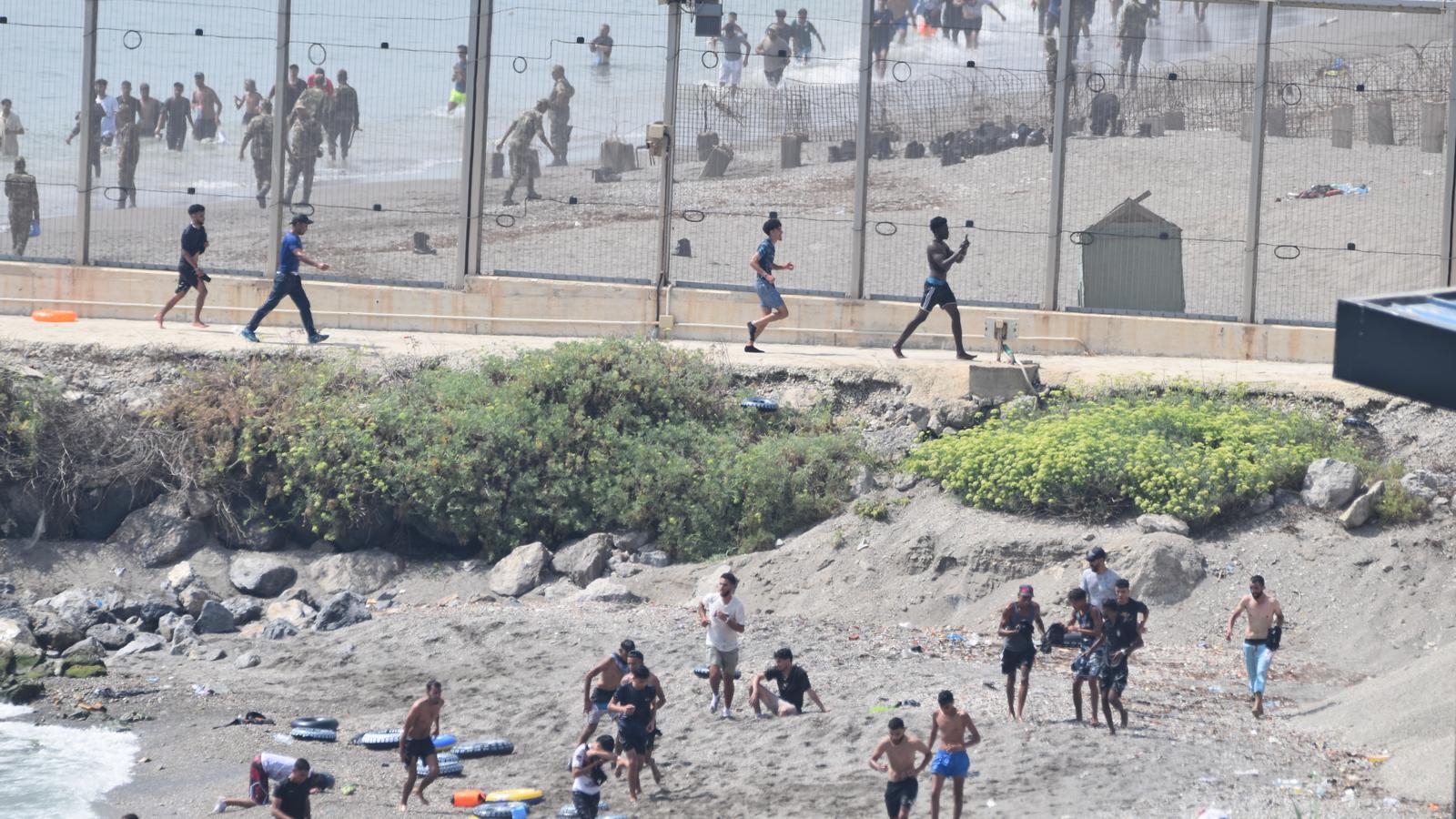
MadridWe have to go back to May 2021 to see images of such a large influx of migrants from Morocco to Ceuta in a few hours. At that time, the diplomatic shock between Rabat and the State led to the arrival of 8,000 migrants in just two days –including many families with small children– swimming to the coast of the autonomous city.
Since this Thursday, memory has turned to that migratory crisis. The Spanish government, however, has pointed out that this time the events do not stem from a discontent with the Alaouite country: "We are mobilizing all necessary resources, working with Moroccan and international authorities, and preparing the necessary measures to restore normality [at the Ceuta border] as soon as possible. It is time to build solutions, with responsibility and cooperation," stated the President of the Spanish Government, Pedro Sánchez, on social network X. Sánchez is traveling urgently to Ceuta this Friday, accompanied by the Minister of the Interior, Fernando Grande-Marlaska.
The Spanish president, who this week began his summer holidays after an end of term marked by serious fires, has assured that the central executive is "focused on giving an immediate response to the situation". The Ministry of the Interior has also spoken in the same direction, from where they have pointed out that they are already working with Morocco for a "return" of migrants.
But they do not see it the same way from one of the formations that make up Sumar, the minority partner in the coalition government. "[Morocco] Will never be a trustworthy country as long as it is governed by a feudal monarchy. You cannot negotiate with a regime that resorts to the instrumentalization of human desperation," stated Tesh Sidi, spokesperson for Más Madrid in Congress, on social media.
Italy's reaction
Quickly, the reaction to the crisis has also arrived from outside Spanish borders. The Italian government of Giorgia Meloni would be studying suspending the Schengen agreement of free movement with Spain due to the crisis. Meloni herself has assured through the social network X" that her government "will not stand idly by". "We are already convening the competent bodies [...] and we are prepared to intervene with extraordinary instruments to defend our borders, such as the suspension of the Schengen space with Spain", she stated.
The Italian Minister of Foreign Affairs, Antonio Tajani, has also shown himself in favor: "I am in favor of closing the Schengen space with Spain and I have full confidence in Minister Piantedosi's actions. Irregular and uncontrolled immigration represents a danger to national security," he said. Tajani assured that "the images coming from Ceuta show how the decision to grant Spanish, therefore European, citizenship to more than 500,000 irregular immigrants is profoundly wrong and encourages human trafficking", in reference to the Spanish government's recent extraordinary regularization.
Spain targets "mafias and criminal organizations"
The statements by Meloni's executive have not pleased Moncloa. The Minister of Foreign Affairs, José Manuel Albares, has summoned Italy's ambassador to Madrid for consultations and has called the government's statements "improper." In fact, sources from the Ministry of Foreign Affairs assure that the crisis "has nothing to do with regularization."
"This crisis originates from an interpretation of the Supreme Court's decision, which prohibits the return of individuals arriving by swimming, which has been instrumentalized by mafias and criminal organizations to take advantage of the extreme vulnerability of migrants," indicate the same sources, who reiterate that the relationship with Morocco is "excellent" and "migration coordination is very intense."
The PP attacks the government
For its part, the PP has seen in the events a new vein from which to attack the central executive and its management. The leader of the popular party and head of the opposition, Alberto Núñez Feijóo, has criticized that the situation in the autonomous city is "desperate": "The government [of Pedro Sánchez] cannot look the other way in its obligations because we are facing a national security crisis," Feijóo stated in a social media post. Later, he called for a "massive deployment of resources" to deal with the arrival of migrants.
In parallel, other popular leaders, such as MEP Dolors Montserrat, have not hesitated to accuse Pedro Sánchez's government of "fostering the crisis," while the president of the European People's Party (EPP), Manfred Weber, has called the situation "shameful." "This only shows one thing: the [new] European migration pact must be applied today, not tomorrow. And Frontex must be reinforced," Weber added.
The new migratory reform has come into effect this June and it is a text that the right and far-right have championed, while different social organizations in favor of human rights have criticized it. The regulation is much tougher on migratory policy: it facilitates returns and detentions at the border, leaves a voluntary distribution of migrants, and toughens asylum.
The PP has also claimed its bill registered in Congress just two weeks ago in which it asks that "foreigners who are detected or intercepted on the border line of the Ceuta or Melilla demarcation during an attempted entry into national [Spanish] territory may be rejected to prevent their entry into the State".
In turn, the far-right party Vox has registered a request this Thursday in Congress for the appearance of different government members.
What was the origin of the 2021 crisis?
In 2021, the diplomatic crisis between Morocco and Spain was triggered by Spain's reception of Brahim Ghali, leader of the Polisario Front, via an air ambulance. Considered public enemy number one by Mohamed VI's regime, the Alaouite country stated that Ghali's reception would have consequences and, indeed, days after the warning, Moroccan police inaction allowed more than 8,000 people to enter Ceuta.
However, relations between the two countries took a turn in 2022 when Pedro Sánchez's government, specifically the socialist wing, supported the Moroccan plan for Western Sahara. This, however, opened a rift with Algeria – a country with a historical tension with Morocco over the Sahara – that has not healed to this day. The crisis in Ceuta comes just a week after the Spanish Prime Minister's visit to Algeria.
In 2022, Spain shifted to supporting Morocco's autonomy proposal (instead of self-determination historically defended by Spain), a decision that did not have the endorsement of the political left. By the end of 2025, the two governments defined their bilateral relationship as "excellent" at a high-level summit at the Moncloa Palace.
