
The police also claim to be at their limit. Professional associations of the Civil Guard, Jucil and Independents of the Civil Guard (IGC), have demanded this Thursday that the Spanish government take measures in the face of the "unsustainable" situation in the autonomous city of Ceuta. In a statement, Jucil demands "immediate action and direct political responsibility from the Government," specifically from the Ministry of the Interior and the Ministry of Defense for their "inaction" and "endangering the lives of the immigrants themselves."
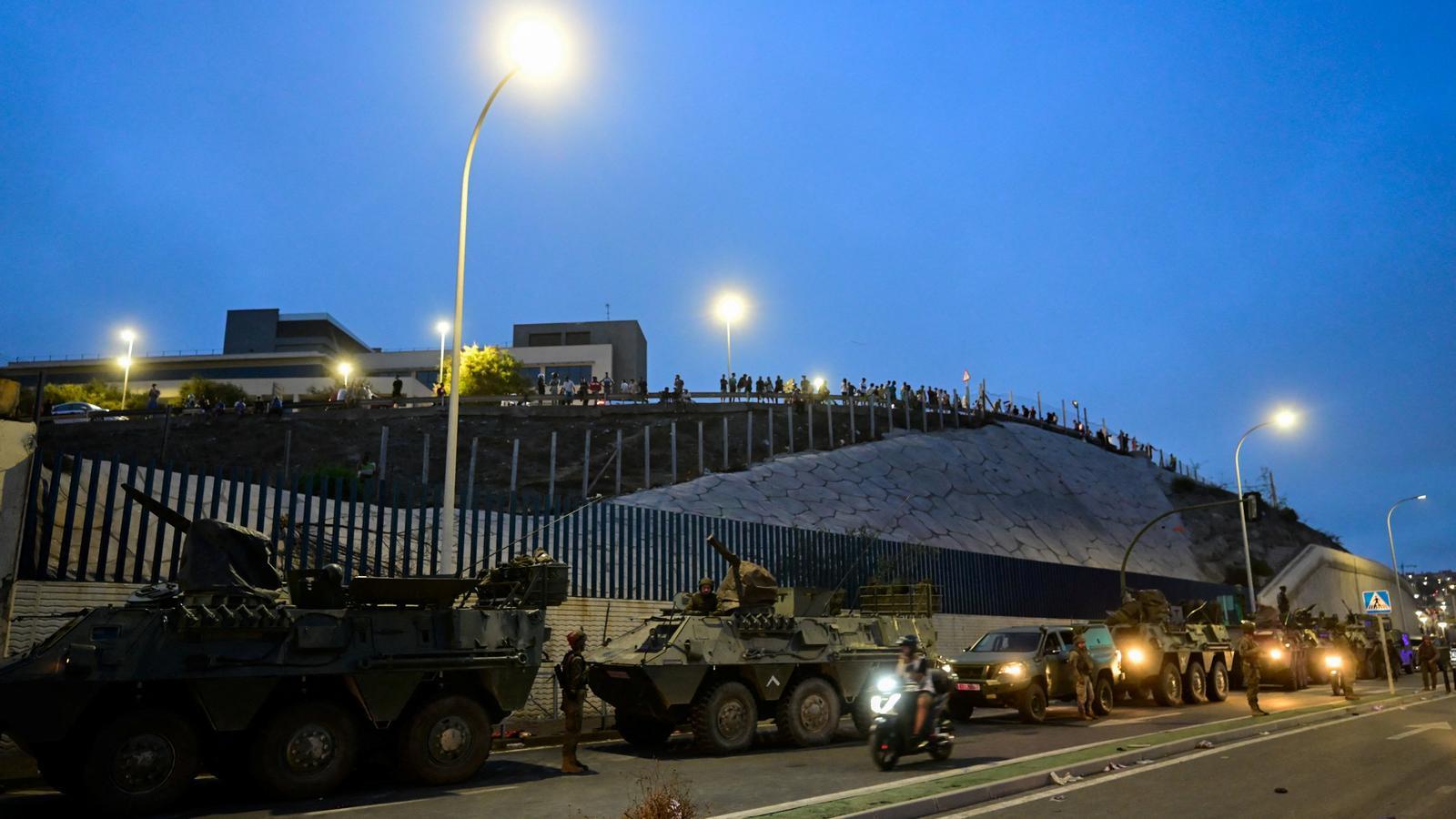
Migratory crisis in Ceuta: Spain mobilizes the army and Europe offers Frontex support
The State closes the border of Melilla while it agrees with Morocco on the return of migrants, eighteen of whom have died
31/07/2026 - 07:30 h
-
CAT -
CAST
BarcelonaAt least eighteen dead and thousands of illegal entries in a single day. Ceuta has been experiencing a day of high migratory pressure since Wednesday night. In the early hours of the morning, hundreds of Moroccan citizens - and some Algerians - had thrown themselves into the sea from the coast of Castillejos to try to reach the Ceuta coast by swimming, about two kilometers away. The attempts did not stop, both by sea and by land, throughout the day. While at noon thousands swam to the border fence and jumped over it, from 3:30 p.m. onwards, other thousands skirted the Moroccan jetty to access the city on foot. In the evening, the pace of entries through the Tarajal border crossing continued, even though Moroccan authorities used tear gas and water cannons to try to disperse the crowd. And at night, the Spanish government closed the Beni Enzar border crossing, the only one operating between Morocco and Melilla, due to the numerous groups heading towards the border at night.
The executive of Pedro Sánchez has announced that the army will be mobilized in the area to assist the Civil Guard and maintain the security of the autonomous city. The European Commission, which is in contact with the Spanish and Moroccan governments, has also opened up to "provide more support to Spain, financial, technical and operational, including through Frontex [the European agency responsible for protecting borders]". This was indicated by sources from the community executive and later conveyed by the European Commissioner for Migration, Mangus Brunner, to the Spanish Minister of the Interior, Fernando Grande-Marlaska. This Friday, the minister and the Spanish President, Pedro Sánchez, will travel to Ceuta.
In parallel, Spain and Morocco have agreed this Thursday to strengthen coordination and efforts to confront the migratory crisis and have committed to reviewing and implementing measures for the return, as soon as possible, of all those who have entered illegally. For the moment, neither written agreements nor clear deadlines have been made public. In a statement, the Ministry of the Interior highlighted Spain's "exemplary collaboration" with Morocco in all areas, and the Moroccan government has confirmed that work is being done to "repatriate" its citizens soon. The EU has insisted that Morocco is a "key and trusted partner of the EU". Meanwhile, the queues at the border are kilometers long and from Ceuta they warn that resources are at their limit.
Let the State take control
The president of Ceuta, Juan Jesús Vivas (PP), had warned in the morning that the situation in the autonomous city is overwhelming: he reported that in just ten days between 1,500 and 2,000 people have arrived and that the trickle does not stop, and he even demanded that the State take control by declaring a national emergency and closing the border with Morocco. Sources from the Spanish government have defended that "the State has been, is, and will continue to exercise its powers and permanently guarantee security throughout the territory of the autonomous city", but that the declaration of a national emergency is part of the state civil protection regulations, which do not foresee migratory flows.

The Spanish police estimate that more than 200 migrants were able to cross the border by sea on Wednesday night. On Thursday, however, thousands of young people and families also crossed the border by land. "We are going to the fence, not by sea, to the border. Inshallah! [we hope we achieve it]," shouted one of the young men. This massive attempt to reach Spain coincides with the country's celebration of the 27th anniversary of King Mohammed VI's enthronement.
Most of the people who have managed to reach Spain have skirted the border pier and accessed it on foot through one of the sides of the El Tarajal customs. Others, through a hole dug under the fence. They are mainly young people under 30 years old. The National Police and the Civil Guard have redirected them mainly to the Temporary Immigrant Reception Center (CETI), which is already saturated.
Access to Ceuta
Vivas has stressed that in the last ten days between 1,500 and 2,000 people have arrived in the city. "So that the rest of Spain can get an idea, it is the equivalent of 2% of the entire population of Ceuta. It is as if a million people had entered Spain by sea and irregularly in ten days," he exemplified. And he continued: "In the attempt to reach Ceuta, sixty corpses have appeared at sea during the last month." In fact, Salvamento Marítimo has found the body of a young man between 20 and 25 years old, who drowned while trying to reach the State by swimming, on the coast of Malaga. The current would have dragged him a hundred kilometers.
The situation in Ceuta, although totally extraordinary, has been worsening for months. In fact, hundreds of residents have taken to the streets this Thursday to denounce this situation. The Ceuta president also pointed out that the overcrowding in the minors' area is 2,400% and the number of migrants outside the adult center is higher than the number of migrants inside. The head of migration projects at Novact (International Institute for Nonviolent Action), Clara Calderó, explains that in one year the weight of this autonomous city in migratory processes has doubled: if in 2025 only 9% of migrants entered Spain through Ceuta, in 2026 it is already 21% of people.
Calderó links this fact to a higher control of arrivals in the Canary Islands, which last year represented 73% of migrations and are now at 30%. This has led migrants to seek new routes, such as going directly to the peninsula or the Balearic Islands, or entering through Ceuta. In addition, Calderó adds that in summer there are usually migration peaks because the sea temperature is higher.
The effect of the Supreme Court
It has not been a month since a ruling by the Supreme Court confirmed that the pushbacks of migrants attempting to reach Spain by swimming are illegal, and it explicitly distinguished them from the specific regulations surrounding the Melilla fence. However, Calderó points out that the Supreme Court has not made these returns illegal now, but rather has recalled that this practice was no longer in accordance with the law. He criticizes that this is generating a certain alarmism of lack of control at the borders when it was already foreseen that the route through Ceuta was on the rise since the beginning of the year.
Police say the situation is "unsustainable"
