Felipe VI defends from Ceuta the "indisputable" territorial integrity of Spain and the return of irregular immigrants
The king takes a bath of masses nineteen years after the visit of Juan Carlos I and warns Morocco that "mutual trust and respect" are necessary
-
CAT -
CAST
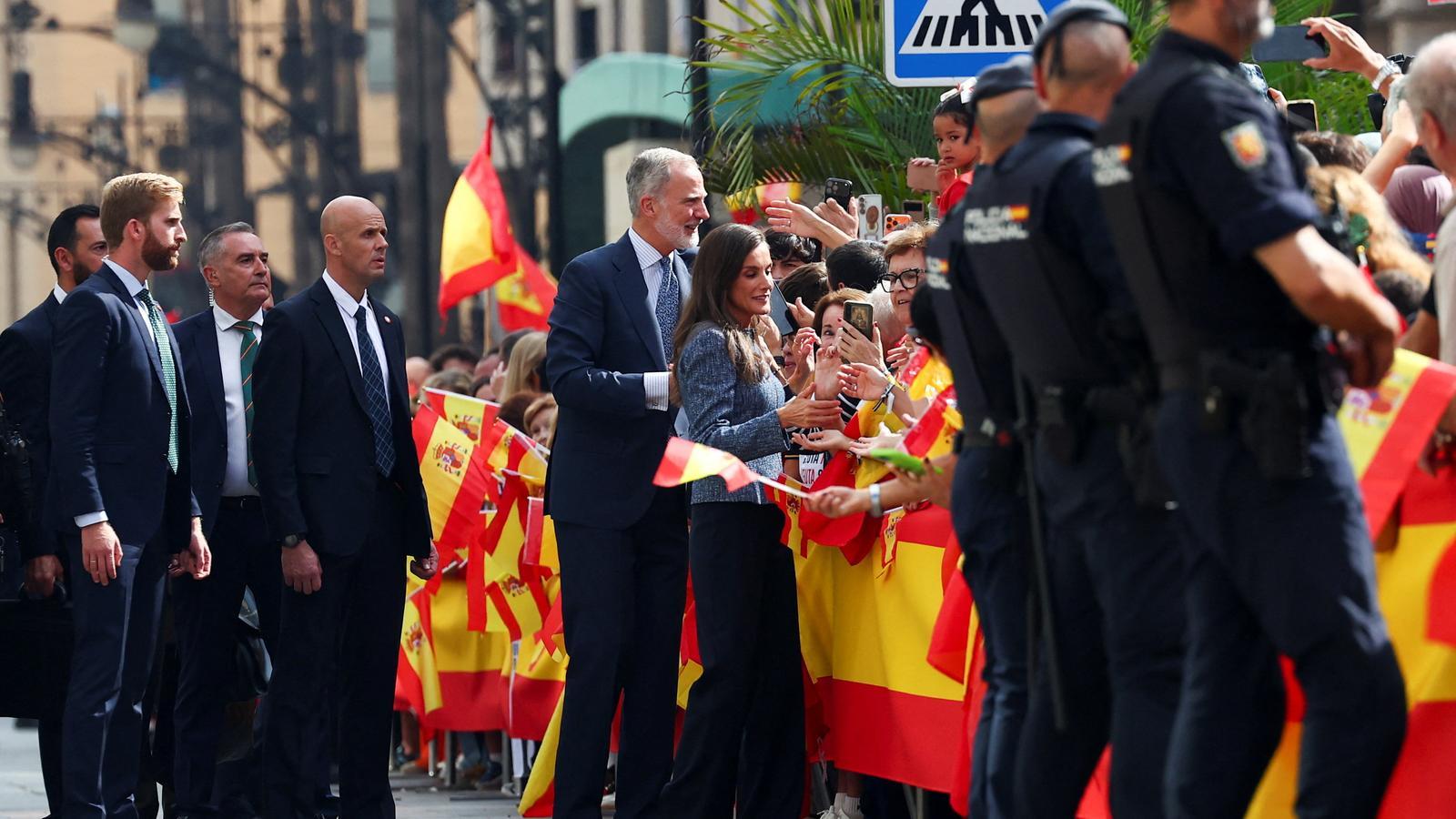
MadridThere were a few weeks, during the height of the Ceuta crisis, when the main question was: why aren't the monarchs visiting the autonomous city after the massive influx of immigrants on July 30th? The day finally arrived this Tuesday, just the day after Hispanic Day, when Felipe VI and Letizia stepped into the autonomous city for the first time and claimed its Spanish identity. "Ceuta is Spain and Europe," the monarch defended in a speech delivered at the end of a day in which he had a crowd bath. It is a delicate trip regarding the diplomatic balances of the Spanish state with Morocco, but the king was clear in his rejection of this summer's "violation of the border." "The sovereignty and territorial integrity of our country are not negotiable: they are indisputable," he remarked.
Still with several thousand immigrants in the autonomous city, Felipe VI argued that, "as a rule of principle," all those "who entered irregularly" into Ceuta "must return to their place of origin, as soon as possible and through legally established channels." He also stated that while they are in Spanish territory, they must be "required to have scrupulous respect for the norms of civic coexistence," although he also recalled that they must be treated "always with dignity and humanity, and with all the guarantees provided" by law. The monarchs also remembered the hundred immigrants who died at sea trying to enter Ceuta with a visit to the Muslim cemetery of the autonomous city. In a prior act, the president of Ceuta, Juan Jesús Vivas, had conveyed to the monarchs that the autonomous city is a "pressure cooker that, at any moment, can explode" and had thanked them for a visit that can "generate confidence where it is most needed," in the "most difficult" moment in the recent history of Ceuta.
The monarchs have been received with enthusiasm at the events in which they have participated, and Vivas has symbolically handed them the keys to the city. This is the second time in democracy that the Spanish monarchy has set foot there, since until now only King Juan Carlos I and Sofia had visited Ceuta in 2007, exactly 19 years ago, which sparked a diplomatic crisis with Morocco due to its territorial claims over the autonomous city –the ambassador at the time was withdrawn for a few days–. In fact, this will be the first time that the King and Queen will spend the night in Ceuta, something that has not happened before in democracy. Felipe VI has warned Morocco that it is necessary to maintain a bilateral relationship "based and sustained always on mutual trust and respect." "Making it possible requires good faith from both sides," he insisted.

The visit of the king and queen was also present at the press conference following this Tuesday's council of ministers. Right at the beginning, the executive's spokesperson, Elma Saiz, referred to it. "It is a historic trip to two Spanish cities that is framed within normality," she said, in addition to noting that there has also been a "turning point with the eviction of the beaches of El Trampolín and El Guano" in the autonomous city. The Spanish government continues with the triage process for immigrants who are still in Spanish territory and this Tuesday has given figures on the more than 7,000 temporary places that are enabled in Ceuta.
On the other hand, taking advantage of the occasion, the Minister of Finance, Arcadi España, has also announced a direct subsidy of 45.3 million euros to guarantee the financial sustainability of the autonomous government and Ceuta is exempted from creating a financial stability plan if the extraordinary expenses resulting from the crisis could lead to a failure to meet the debt and deficit reduction objectives dictated by Brussels. The Spanish president has not accompanied the king and queen on their visit to Ceuta and Melilla. Even so, the Minister of Territorial Policy, Ángel Víctor Torres, did attend the council of ministers, and Saiz herself will be there on Wednesday. The leader of the PP, Alberto Núñez Feijóo, has criticized Sánchez's absence on X.
The objective of the visit by the Spanish monarchy is to express support for the citizens of Ceuta, who have been living in an exceptional situation for more than two months. At the time, Felipe VI described the events as an "unacceptable violation" of a European and Spanish border and, in the framework of Emmanuel Macron's visit, the King asked the European Union to also take responsibility for the situation. He has done so again this Tuesday before the Ceuta civil society and has recalled that any threat to Ceuta is one "to the EU as a whole".
However, the big question is whether this visit will provoke a new crisis with Morocco, taking the precedents into account. Recently, the Moroccan King Mohammed VI referred for the first time to the crisis of July 30th without mentioning the visit of the monarchs. He asserted that in Spain there have been "irresponsible statements" regarding the migration problem and warned that he would not accept "pressures or blackmail". Throughout this Tuesday, however, the Alawite regime has opted for silence, and it remains to be seen whether the coalition government, formed after the elections in the month of September, will speak out or not after listening to Felipe VI.
Moroccan warships
For its part, the Spanish government had to address a controversy this Tuesday brought forward by the newspaper El País: that, around the same dates as the entry of immigrants into Ceuta, an incursion by a Moroccan warship occurred in Spanish waters. "It was an isolated incident that was resolved with total normality. They were days of high tension that were resolved with collaboration," summarized Elma Saiz. Sánchez also confirmed the same facts at the Royal Palace this Monday, adding that the Spanish government sent a frigate to stop the incursions. The head of the executive did not explain the reasons for this movement by Morocco, but he remarked at all times that bilateral relations with Morocco are "very important" and he once again committed to good neighborliness. Moncloa is now also awaiting the reaction that the Alaouite regime may have following the "historic" visit, in the words of the Spanish government, of the Spanish monarchy to Ceuta and Melilla.
