Surveys point to a historic defeat in Andalusia... but the PSOE is confident of a "comeback"
Various surveys indicate that Juanma Moreno Bonilla is close to an absolute majority and could govern without Vox

-
CAT -
CAST
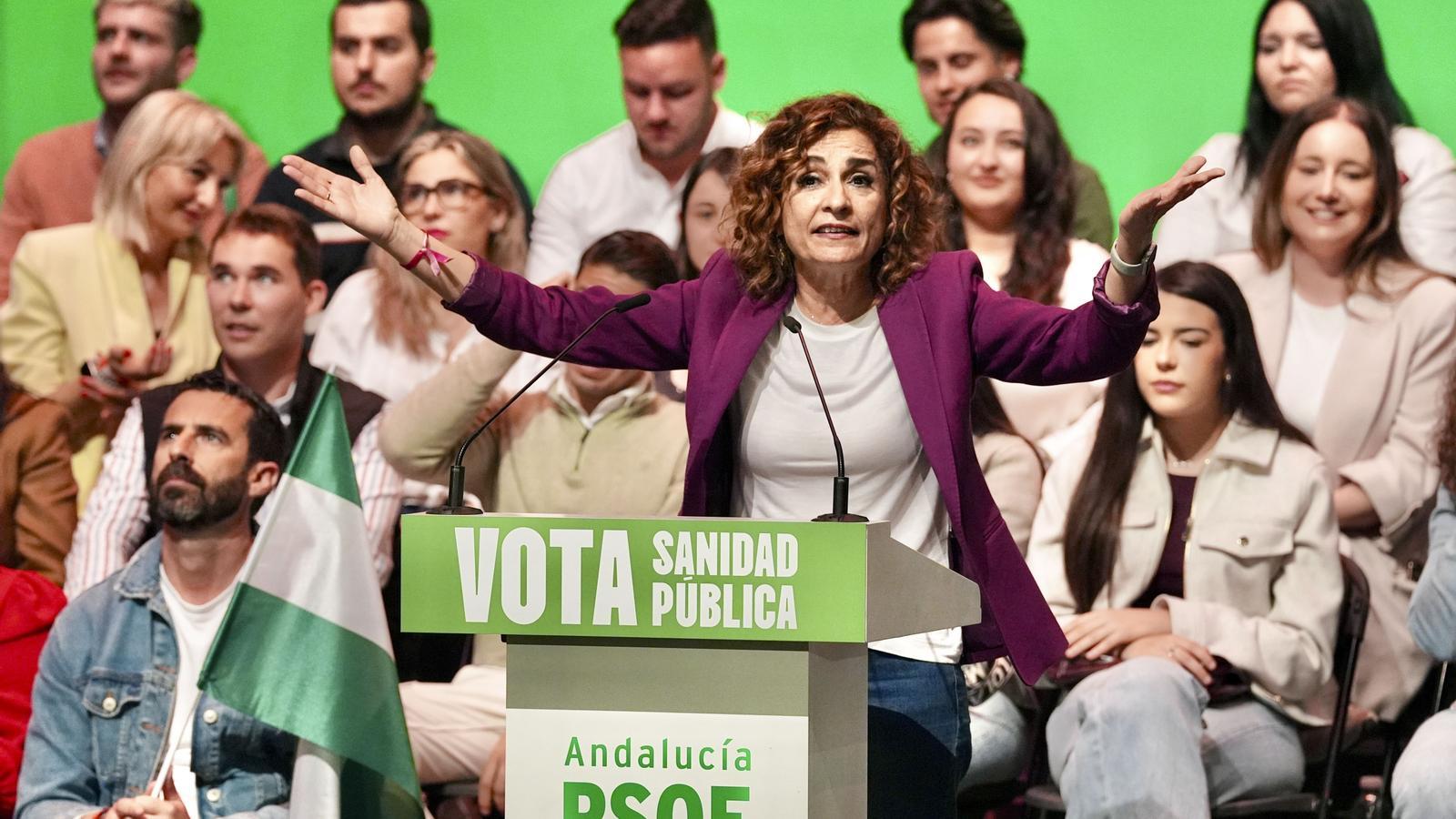
Madrid"We trust in the comeback." In this way, the PSOE spokesperson, Montse Mínguez, responded this Monday to all the published polls that point to a historic defeat for the socialists in the Andalusian elections on May 17. "Let's not get demoralized, quite the opposite," she added, and assured that there are "many people worried about public services" who will trust María Jesús Montero to change the model that the PP has established in the last two legislatures. "We will fight until the end, the vote is on May 17 and that is the poll that counts," she stated.
This Monday is the last day that polls can be published, and all national newspapers carry their forecasts. None of them give them a higher expected result than in the previous elections, in which the PSOE already fell to a historic low of 30 deputies. And not only that: most also indicate that Juanma Moreno Bonilla is close to an absolute majority, almost doubling their results, and that he could govern without the far-right Vox. A dream for Moreno Bonilla, but also for Alberto Núñez Feijóo.
The poll from El País and Cadena SER gives an absolute majority for the PP with 56 seats as the "most probable" option (the threshold is 55), although it would be two seats less than in the last elections in 2022. Vox would only increase from 14 to 15, while the PSOE would still fall to 28 seats, two less than the 30 parliamentarians that Juan Espada obtained in the previous elections. Por Andalucía, led by Antonio Maíllo, the unitary front of IU, Sumar and Podemos, would gain one seat, up to 6 deputies, and Adelante Andalucía, the most sovereigntist party, would increase by two parliamentarians, going from two to four. It is important to put these results into context: since the Transition, Andalusia had been the traditional stronghold of the PSOE, both for the voters it contributed to win Spanish elections and to govern the autonomous community, where they held power uninterruptedly from the beginning of democracy until 2019, when Moreno Bonilla displaced them with a pact with Cs and Vox. Three years later, the PP candidate already obtained an absolute majority. All this after the ERE de Andalucía corruption scandal, which left "scorched earth" (in the words of a veteran politician) in a territorial party structure that is no longer what it used to be.
The forecast from El País and SER, made by Institut 4dB, is very similar to that of GAD3 carried out by elAbc, as well as that of La Razón,, made by NC Report. The one who is slightly more optimistic for María Jesús Montero is El Mundo, which gives her 30 seats, although it also gives the PP a rebound to 58 seats thanks to Vox's stagnation.
These polls show the same trend that the CIS already
pointed out for Andalusia. In this case, Moreno Bonilla would also obtain just an absolute majority due to Vox's decline, and the PSOE could gain a seat but would still be very far from its main competitor.

The difficulty of mobilizing the voter
The PSOE's problem in these elections is twofold. Beyond the downward trend in the last regional elections —with the exception of Castilla y León—, the case of Andalusia has its particularities. To begin with, the difficulty of mobilizing left-wing voters for an election in which the opportunity for a change of government is not visible, as no poll predicts that the left could unite to form a coalition and unseat the PP. Therefore, in this sense, it is more difficult to mobilize left-wing voters. But another problem is added for the PSOE: they have detected that there are socialist voters who are leaning towards Moreno Bonilla to prevent him from having to make a deal with Vox to govern. That is to say, the PSOE in Andalusia has an electoral border with the PP because there is a part of the left-wing electorate that prefers to reinforce Moreno Bonilla —from the more moderate wing of the party— so that he has an absolute majority and thus prevent the far right from taking power in the Junta. Not to mention, former Spanish president Felipe González agreed to share a stage with the PP candidate during the pre-campaign.
To combat this dilemma and try to recover, from the PSOE they insist on three messages: mobilization of the left, "coherence" and concentration of the vote. First, they encourage the electorate to go out and vote and cling to the data: they recall that in the Spanish elections of 2023 there were half a million more voters for Pedro Sánchez than those who opted for Espada in 2022. Therefore, they argue, there is room for improvement. Second, they ask voters to be "coherent" if they are left-wing and not to opt for the PP even if the polls say what they say. And, third, that they concentrate their vote on Montero and not opt for other left-wing options such as Endavant Andalusia or Per Andalusia. "The second week of the campaign always goes well for us," optimistically point out from the PSOE, while other leaders cling to the idea that there may be hidden votes and the result may be better than the polls suggest. On Sunday, everyone on Ferraz street will hold their breath.
