The National Court will investigate the entry of migrants into Ceuta as an attempt to attack the State
María Tardón maintains that there was a "clear and undoubted management favoring the process" from Morocco
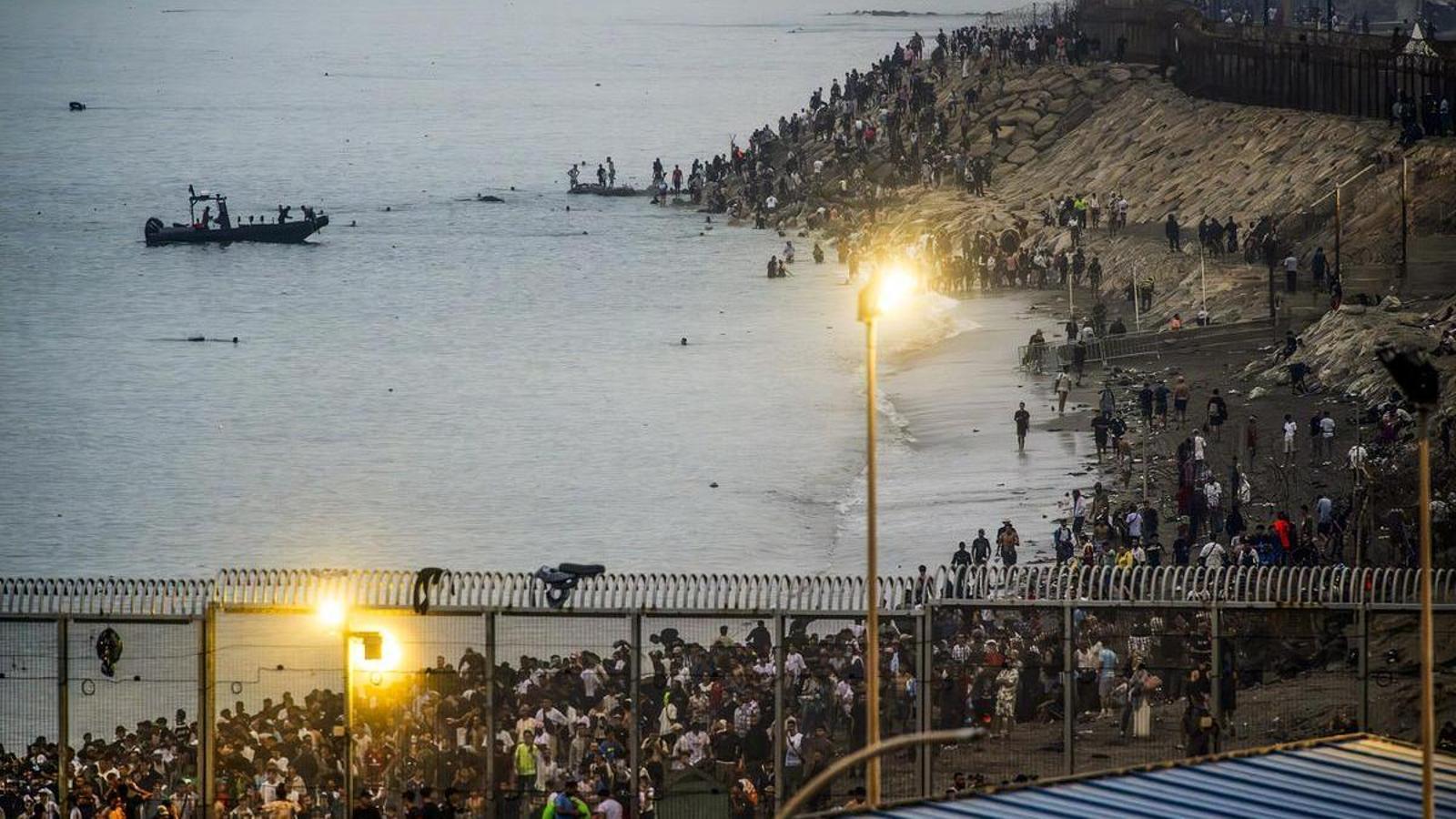

MadridThe National Court has decided to open a criminal case to investigate the massive entry of migrants into Ceuta at the end of July. After the endorsement of the Public Prosecutor's Office, Judge María Tardón considers that the events could constitute crimes that compromise the peace or independence of the State, against the rights of foreign citizens in connection with a crime of reckless homicide for the 83 corpses that were found in Spanish waters and of criminal organization. "We are facing criminal conduct allegedly committed abroad that has seriously attacked the territorial integrity of Spain," she maintains. "It is deduced that the crime has an intent to attack the State," adds the judge, who recalls that Pedro Sánchez presented the events as a "violation of Spain's territorial integrity." And she justifies that a "massive migratory flow" is "one of the characteristic methods" of hybrid warfare with the "purpose of altering the life and rights of Spanish citizens.
The court order, of 26 pages, also speaks about the great question that still lingers, which has become the epicenter of the political squabble and which has left the PSOE isolated from its partners: the role of Morocco. For the judge, "a clear and undoubted management favoring the process" from the territory of the Alawite country has been evidenced thanks to the "confirmed and graphically contrasted behavior" of the Moroccan security forces. Adopting the arguments of the Public Prosecutor's Office textually, she alleges that there was not only "passivity" on the part of the agents, who did not make "any serious attempt to try to reduce, disperse or move away the mass of people" from the border, but that they carried out an "active guidance" by giving "indications" to the migrants to help them "overcome the obstacles.
The importance of mobile phones
The judge dedicates four and a half pages to creating a chronology of the events. She explains that it all began with a "sustained and growing situation of increased entries" into Ceuta in the days prior. Until the crisis erupted on July 30th. There were "waves of different intensity and profile" that caused a "collapse of the response capabilities" of the Spanish border control system and a "massive violation of the territorial sovereignty" of Spain. The arrival of so many people meant that the courtyard between the restricted beach area and the free movement zone, where migrants were initially held, reached a state of "saturation" that made it necessary to open it. "The agents had to choose between momentarily ensuring the tightness of the border or defending human life", argued Pedro Sánchez last week.
After this door was opened, entry became "more accessible" and the message that the border had been opened spread. The court order collects some of them. "Night of assault, the last one to leave turn out the light" or "Brothers, come down, the customs has opened". "The police are wearing their normal clothes, all the cities of Morocco are here", said another. Subsequently, advice on how to avoid expulsion also spread. "You have to enter Ceuta and hide until the Spaniards calm down", for example. Or "when you step into Ceuta, say that you cannot return to Morocco due to political problems".
