Sánchez remains alone defending Morocco but admits that it is necessary to investigate its role
Feijóo believes that the Spanish president acts under blackmail from Rabat and warns that he will pay for it in the courts and at the polls

-
CAT -
CAST
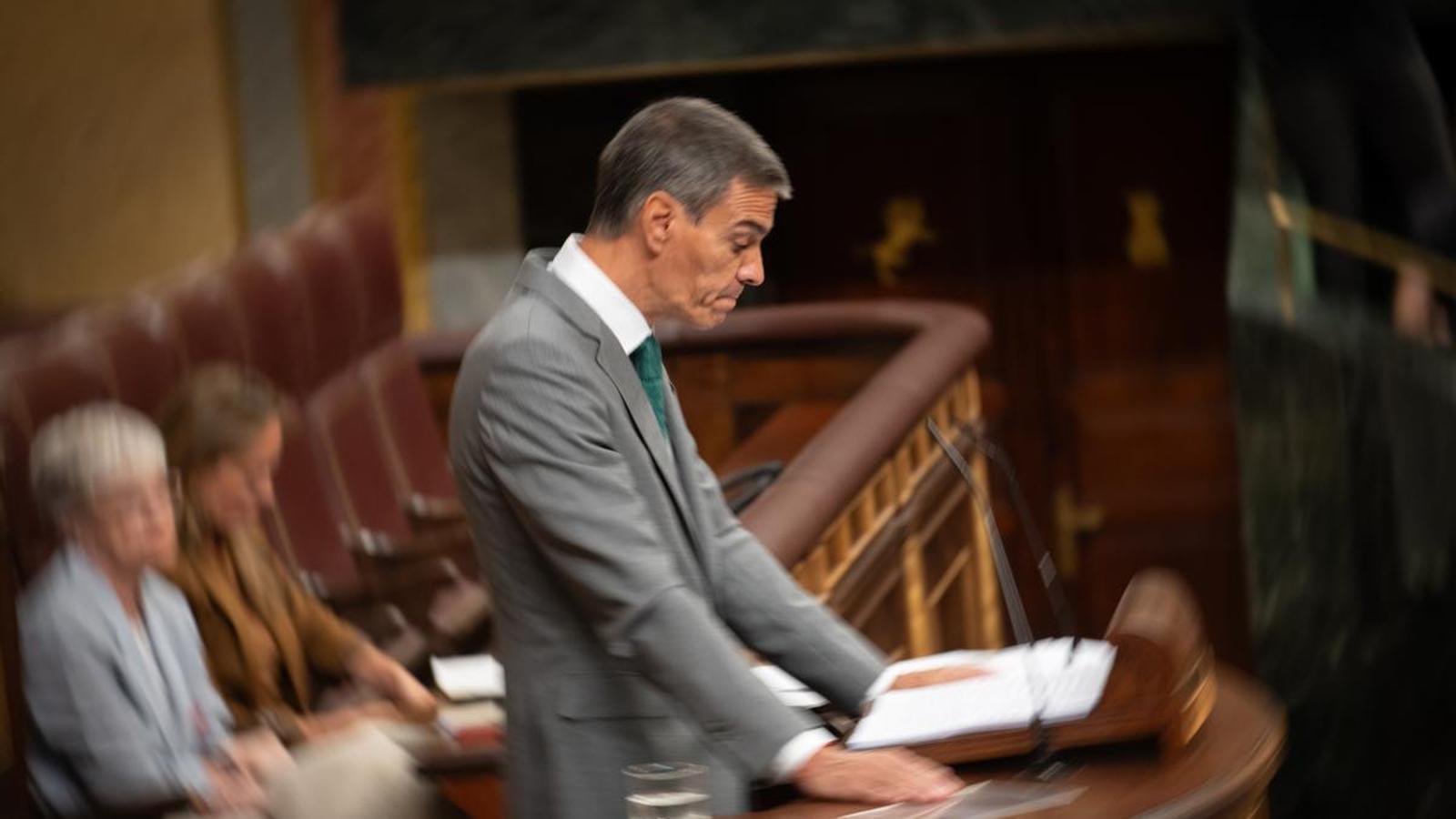
MadridPedro Sánchez faced one of the most difficult appearances of his presidency. He had to account for the management in Ceuta, immersed in a humanitarian and social crisis due to the massive entry of migrants on July 30 and 31. But not only that: it was a complicated day because just this Wednesday a police report emerged that pointed to Morocco and put the president's narrative against the ropes. Sánchez has nuanced his speech by slightly hardening his tone towards the Alawite regime. He has maintained that there is "no solid evidence" to suggest that Morocco "planned and executed" the massive entry of migrants, but he has admitted that the Moroccan gendarmerie was passive at the border.
“It will have to be determined whether there was inability or inaction, it is something that must be clarified,” he assured, thus committing to investigate and act with "forcefulness" if there is evidence that it is behind it. A mention that the Spanish government had not made until now, but which has not been enough to convince either partners or the opposition. The Alawite regime has also informed the Moncloa that it is investigating what happened. "Why are you afraid? What does Morocco know about you?", the leader of the PP, Alberto Núñez Feijóo, snapped at him, who believes that the executive's position is too benevolent with the neighboring country.
The Spanish president has distinguished three moments regarding Morocco's role: he said that Moroccan officials acted normally before the critical point; then he spoke of a second moment in which he acknowledged that "during the ten central hours of July 30th, the Moroccan gendarmerie allowed passage at the border"; and a third moment in which the same body "effectively controlled the border by carrying out hundreds of arrests, preventing thousands of illegal crossings, and decisively facilitating returns".
The Spanish president, therefore, has maintained the main thesis of the Moncloa: that without Moroccan collaboration it would have been "impossible" to immediately return the majority of migrants, but he did speak for the first time about the fact that security agents let people through. At the same time, he insisted that the amplification of fake news on social media generated the crisis and that it was amplified by pro-Russian, pro-Israeli, and far-right international accounts, clarifying, thus, that he has no proof that these states are behind it.
He revealed, in any case, a relevant fact: that on August 21st he summoned the Moroccan ambassador to Spain, following the claims of sovereignty over Ceuta and Melilla by Moroccan ministers. "Ceuta and Melilla are Spanish and will be until the end of time," Sánchez wanted to make clear, although he did not mention that the person who finally attended the meeting was the charge d'affaires because the ambassador was not there.
Without prior "exceptional" warnings
Sánchez's speech was interrupted by the noise from the right-wing benches, who were laughing or shouting indignantly. The government has maintained that it did not have any "exceptional" prior warnings that would have alerted them to the entry of more than 70,000 people. "None of them foresaw either the scale or the probability of what finally happened," he stressed.
In any case, to dispel doubts, he has committed to publishing a dossier with all the reports made by all intelligence and security agencies. "We have nothing to hide," he stated, which will take place, according to Moncloa sources, next Tuesday after the Council of Ministers. The announcement was received with applause by all ministers except for the Minister of Defense, Margarita Robles, on whom the CNI depends. Later, sources from the ministry clarified that they have no objection, but that certain things may collide with other foreign intelligence services.
Sánchez has not spared a dart at police and courts, after evidencing that the Minister of the Interior was unaware of the National Police report pointing to the Moroccan regime. In parallel, the Minister of the Interior, Fernando Grande-Marlaska, has sent a letter to the General Council of the Judiciary expressing his "concern" regarding the request by the National Court magistrate that the police officers should not inform their superiors, but the president, Isabel Perelló, replied that it fell within the judge's powers.
Without allies
Sánchez has found himself more alone than ever in the Congress of Deputies. There has been no other group beyond the PSOE that has considered the explanations sufficient. All the rest, including the partners of Sumar, have lamented that the Spanish government does not clearly point to the Alawite regime. "The crisis was organized by Morocco, in coordination with the United States and Israel. Defending another hypothesis is not credible," said Sumar deputy Enrique Santiago. And from the other extreme, the PP and Vox have been harsher: "What document or evidence was on your phone for you to behave this way?", Feijóo asked him, alluding to a hypothetical Pegasus intervention on Sánchez's mobile, in addition to warning him that he will pay for it in the courts and at the polls. "Your master is Mohamed VI," Santiago Abascal retorted in turn.
Junts, Esquerra, Bildu, and the PNB have also emphasized that the government does not point to the Alawite country: "You, without evidence, have exonerated Morocco. But you have blamed Israel, the United States, and Russia. It interests you more," said Maribel Vaquero (PNB).
Are they worried, however, in the PSOE about this solitude? Sources from the Moncloa minimize the attitude of the partners, since they consider that today precisely was the day to mark their position. The harshness, they believe, will fade away soon. However, they do acknowledge "fear" in the face of the verbal escalation of the right and the far-right –Abascal has said that Sánchez has the empathy of a "serial killer"–. "What do they want? That war be declared on Morocco?", the same sources point out, reminding Feijóo that "responsibility and prudence" are necessary.

The reply to the PP and Vox
Be that as it may, Sánchez wanted to defend the actions of the Spanish police at the border. "They had to choose between defending the border and human life, and they chose the second option". "They did the right thing", he stressed. For this reason, he was harsh in his reply to the PP and Vox. "Would you have ordered the National Police to shoot at the civilian population? Would you have preferred to kill thousands of young people to avoid managing their reception?", he asked. And in the same vein, he argued that before returning migrants, as the PP and Vox demand, it is necessary to respect the law and carry out individualized files.
Finally, there was also room for promises. After the package of 309 million euros to help Ceuta, Sánchez has committed to mobilizing 100 million more, for the King's visit to the city to take place in the "coming weeks", and for a greater presence of Ceuta and Melilla in the EU. At Moncloa, they consider that they have weathered the day, but they acknowledge that this crisis may be long.
