BarcelonaThe judicial timelines had intended for the final session of the trial against the national police officers who blinded the eye of the activist Roger Español to be held on October 1st, nine years after the day of the referendum in which the pro-independence activist was mutilated. This Thursday, however, there was a final plot twist: the session was suspended because Inspector Ángel Diego Vaquera Alonso –number 73861– alleged having suffered "a health problem" that "forced him to move to a hospital center where he is undergoing tests," according to his defense. The judge suspended the trial until one in the afternoon and demanded "proof" from the defense. The magistrate, moreover, declared his intention to resume the session this same Thursday, even if it were in the afternoon, "if the official were able to." He did, however, reject the private prosecution's request to issue a search and arrest warrant and immediately detain the inspector, for whom they are requesting 13 years in prison.
This Thursday's session began more than half an hour late compared to the scheduled time and without Español's prosecution knowing why. The delay was caused precisely by the inspector's no-show, but the activist's lawyers were unaware of it, something the judge himself reprimanded the State Attorney's Office for, which is in the eye of the storm of criticism. Lawyer Benet Salellas was blunt: "No one communicated this circumstance to us; in terms of procedural courtesy, it is unacceptable," he began by saying. And he made a direct request: "Faced with the non-appearance of an accused for whom we are requesting 13 years in prison, we must request an immediate search and arrest warrant, we must request a detention warrant because this would be a case of non-appearance," he asserted, demanding, furthermore, to "bring him in by force."
The judge was understanding of their words, which, de facto, ended up pointing to the State Attorney's Office for not having communicated anything to the prosecution: "He understands and shares them, the court delayed it because it knew the circumstance," he let slip. In any case, he pointed out that "there is no reason to doubt the information that has been conveyed to him regarding the health problems" of the inspector, although he warned that he requires "documentary evidence to assess the circumstance of the impossibility of attending the plenary session". This medical evidence should be delivered before one o'clock. Then the court "will agree on whether to hold the session today at some point in the afternoon" or if it is postponed, while waiting to analyze everything. However, the magistrate refused to adopt "any measure" of search and arrest because "there is no reason," he said, to distrust it for now, given that "the desire to testify" of the accused has been conveyed to him.
Controversial statement
It should be remembered that this Thursday the accused national police officers were scheduled to testify, and for this reason, the State Attorney's Office argued, despite having no documentary proof of hospital admission, that the "sudden medical cause" has caused an absence that "would make the resumption of the trial unfeasible." Among the accused are the inspector in question, who is the head of the unit, the sub-inspector, another sub-inspector from the area, and the riot gunner who fired at Roger Español.
In this Wednesday's session, the expert testimony from the Mossos also clarified that the riot gunner is the one who fired at Español. For the first time, it was established, without any of the parties questioning it. The Mossos confirmed that this riot gunner used the weapon in the direction of the area where Roger was up to three times. The Omega armament experts explained that the way of firing could cause the rebound to bounce high and reach such delicate areas as the head.
It is true, however, that the Mossos stated that the Spanish police officer did not aim directly at Roger Español, but for Irídia and the activist's defense, this circumstance and the rebound effect of the projectile do not prevent the acknowledgment of the cruelty in the action that October 1st, during which his eye was emptied at a very short distance from the weapon. This is the only case of police violence perpetrated during the referendum that is being tried without the amnesty having been applied to the agents due to the gravity of the facts. 97% of the police officers have received the grace of the penal oblivion law of the 'Procés'.
Pro-independence support for Roger Español
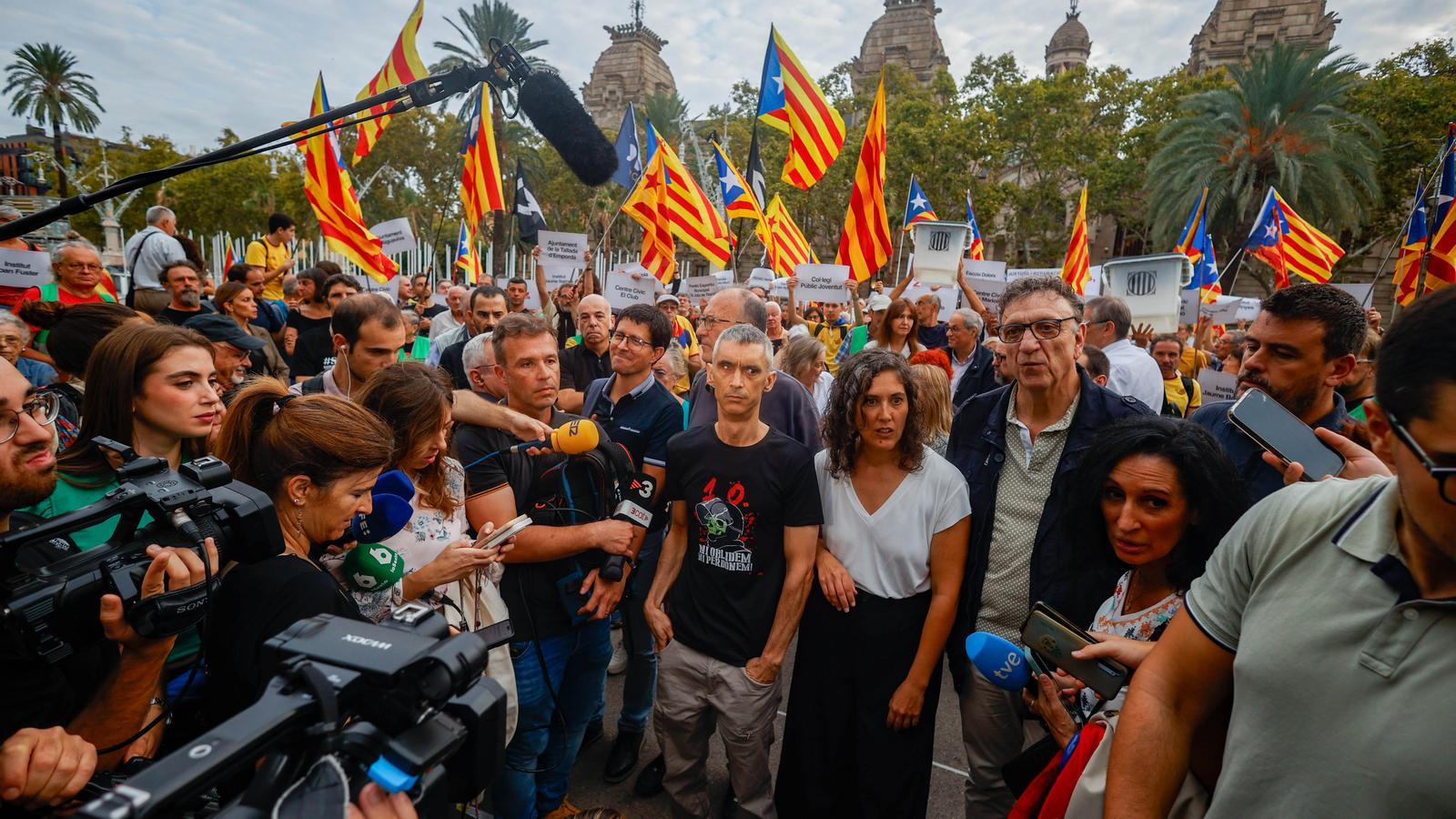
Before the start of the session, which took unexpected turns, there was a pro-independence rally in support of Roger Español with Òmnium, the ANC, Irídia, Junts, and the CUP. In a media appearance, Español emphasized that he intends for the four accused police officers to be convicted and, therefore, for the "police brutality" of the State to be condemned as well. At the same time, he vindicated the 1-O referendum and called for rubber bullets to be banned, as did Carles Guillot, another person who was maimed and a founder of Stop Bales de Goma. Meanwhile, the lawyer and director of Irídia, Anaïs Franquesa, assured that all "expert evidence" has been collected to achieve a guilty verdict.
In parallel, the presidents of Òmnium and the ANC, Xavier Antich and Josep Vila, defended that the independence struggle "continues" and gave their support to the activist, as did the secretary general of Junts, Jordi Turull, who said that "it is regrettable" that justice has not yet been served "nine years later".