Michel André: "Communicating with other species will be a greater advance than the internet"
Professor of bioacoustics
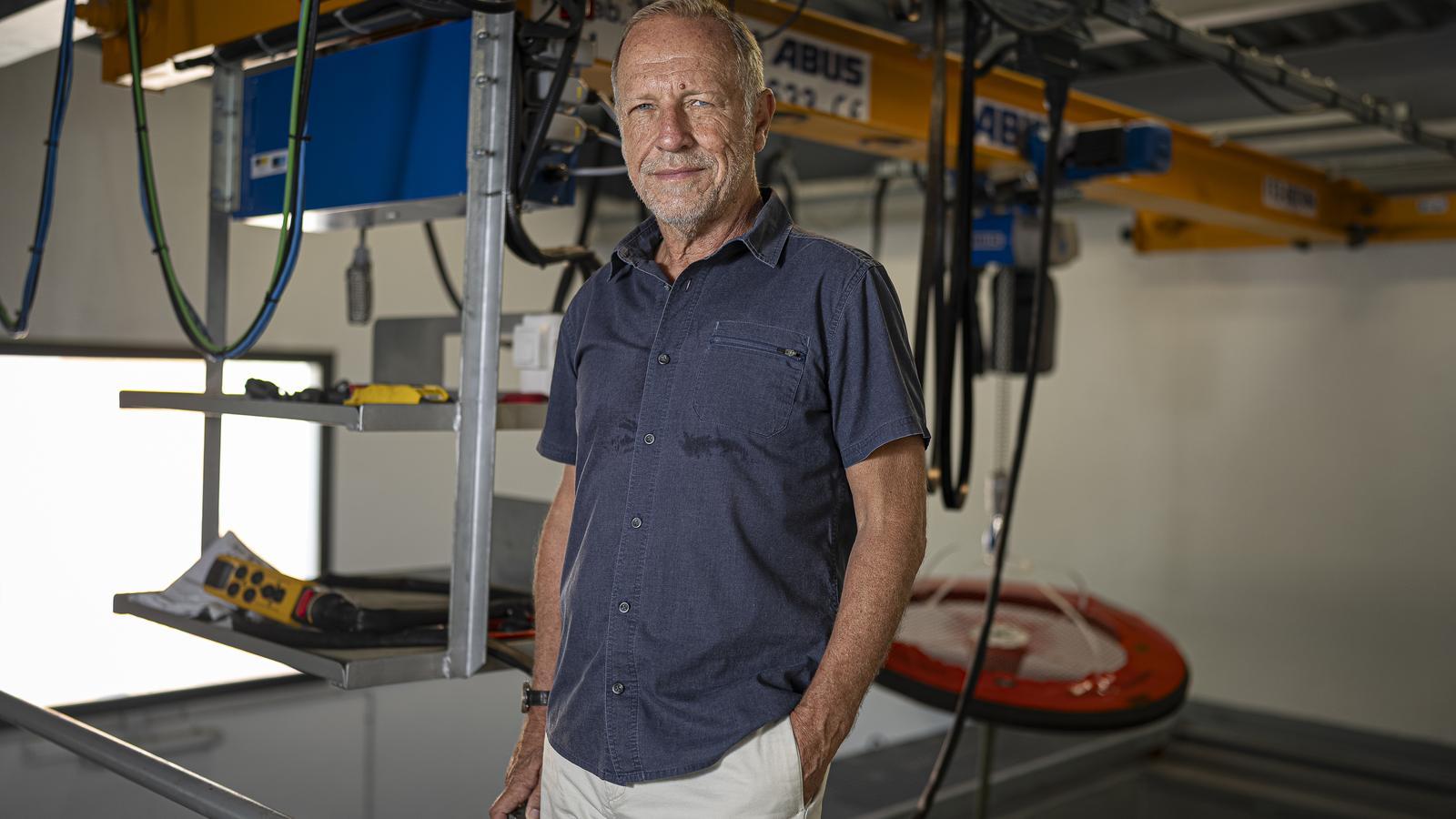

-
CAT -
CAST

He does not put his face on WhatsApp but the sky reflected in the Amazon because he believes that communication always goes beyond the person you have in front of you. “We are inside a whole and this photograph represents it”, says Michel André (Toulouse, 1963), professor of bioacoustics at the UPC and director of the LAB, the only research center dedicated specifically to the study of noise pollution in the ocean. His network of aquatic microphones collects, in real time, the cry for help of marine fauna.
When did you hear the call of the cetaceans?
— When I was eleven or twelve years old, one day I told my parents that I no longer wanted to be a veterinarian as I had been saying, but rather to learn how dolphins communicated. But there are no specific studies on this, so I built my curriculum based on engineering, sociology, physics... and the specific study of these fascinating animals.
Fifty years later, have you understood what the dolphins are telling us?
— We often look for similarities with human language, but this does not seem like a profitable path to me. Sound is an evident support for their communication, but the content is not what carries the bulk of the information, but rather the combination of several factors. It is a very complex system and if we approach it from a human prism it will take us many years before we find a way to understand each other.
What do we know that they say to each other?
— Apart from the obvious vital information related to food, group distribution, or courtship, we know that they are capable of using their acoustic emissions to scan our bodies. They do not need to ask how you are: they can see it with their sound. Just as we do in clinics with a CT scan.
Are we close to cracking this mystery?
— We are getting closer, because the computing power that AI gives us was unthinkable until today. We have had sensors all over the world for many years, but we could not process the database with the necessary power. I look forward to seeing the results!
Among all the cetaceans, their weakness is the sperm whales. Why?
— It is a superlative species. They migrate from pole to pole, can descend to the opaque abyss of 3,000 meters deep and go without breathing for an hour. And they are the ones that have the most complex phonation apparatus of all cetacean species. At the same time, the signal that comes out of this incredibly complex apparatus is the simplest of all: a click. [Taps with fingers] Click, click. But with just one of these clicks it can identify a 25-centimeter squid three kilometers away, in absolute darkness.
You will forgive my utilitarian view, but what could be the point of talking to cetaceans?
— Understanding communication with other species will be a greater breakthrough than the internet or AI. For the first time, we will have access to information that we do not know about the capacity to survive on this planet. All these species, particularly cetaceans, are still here after three million years: they have seen it all and have adapted. We, on the other hand, have only been here for about 150,000 years, in our current form. And, in this short time, we have understood nothing about our relationship with nature.
Seen like this, it is fascinating.
— But we will have to take into account, then, that we will no longer be the only ones who can govern the planet. We will have to seat these species at the table –not on top of it as until now, but around it–, so that together we know what future we want to give to the planet.
Is the idea of speaking with other species a provocation?
— No: in fact we are the only species that communicates solely among itself. People say that we disconnected from nature a century and a half ago, in the industrial era. I believe it was 150,000 years ago, when we began to articulate our language... and stopped listening.
He is a world expert in marine noise pollution. How did he get there?
— At the beginning of the 90s, in Las Palmas, sperm whales and fast ferries would collide from time to time. In one of these collisions, one of the passengers died, so the company commissioned me to lead the investigation into whether it was a one-off accident or a risk likely to be repeated. That was when I began to design ways to sense underwater to start listening to the acoustic dimension of the ocean. The conclusion was terrible: noise is polluting the sea in a deadly way.
How does sound kill?
— In many ways. It can mask the information you need to live. This is the most obvious risk, but the smallest one, because there is another one much more immediate: the blast wave of certain sounds bursts the internal structures of the organism and death is instantaneous. And there is also what we call acoustic trauma: the fatigue that is suffered if this source is not stopped and that transforms into a permanent pathology.
How do we deal with it?
— All industries produce noise. Now, some sources of this noise are of no interest in themselves. For example, the noise of a ship or when the seabed is drilled to plant wind farms. Can we do anything to avoid it? With oil it is more complicated, because the noise is precisely what allows us to detect where it is from tens of kilometers away. Here we will have to look for technological alternatives.
And what about ordinary citizens who don't own an oil company?
— Becoming aware. The issue is not whether a fish or a whale dies. It is that if the sea dies, we all die. And it is urgent: if we do not act, we will not even have time to understand what these species are telling us. I am talking about a short time, a few years. Noise is destroying the sea much more than plastic, but we have ignored it because it is invisible.
If you were to meet that eleven-year-old boy who wanted to talk to dolphins now, what would you say to him?
— I would tell him: you have to listen beyond the dolphins. If you want to understand a species, listen to its entire environment.
Did that boy lose his fascination as cetaceans became work and daily routine?
— I have been lucky enough to be in contact with many of the 90 species of cetaceans and it is something that never fades. The first encounter is just as impactful as the last one, forty years later. There is something inexplicable when we are in their presence, a communication that, without a doubt, is real.
