The Mossos say that the shotgunner did not aim directly at Roger Español
The experts explain that the agent had his field of vision "partially" blocked and that he did not look in the direction of the barrel
-
CAT -
CAST
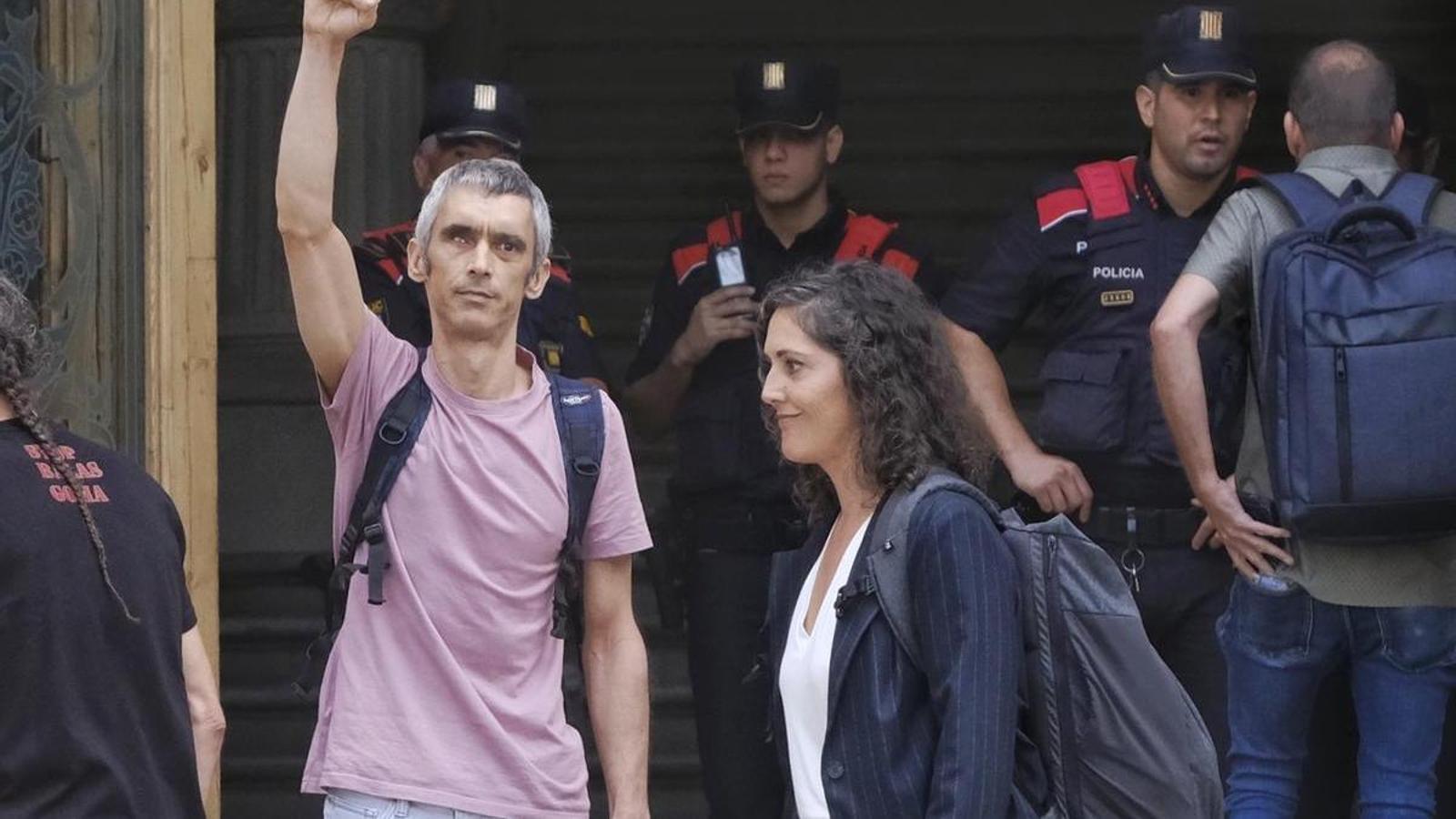
BarcelonaThe final stretch of the trial of four police officers for blinding Roger Español in one eye during the 1-O has begun with one goal: to clarify as many details as possible about how the shot was fired by the National Police riot officer who now sits in the dock with three commanders. This Wednesday, specialists from the Photography and Audiovisual Unit of the Mossos d'Esquadra's Scientific Police explained their conclusions to the court after viewing all the footage of the day. The officers explained that a frame from the images shows that the shooter did not aim directly at Español, but rather fired towards the ground. The images also show a "black spot," the bullet, which bounces off the ground before striking Roger Español in the face.
The same officers explained that at the moment of firing, the officer had his field of vision "partially" blocked. Additionally, another expert proposed by the prosecution stated that at the moment of firing, the shooter "is not looking in the direction of the barrel, he is not aiming well." This person is a member of the British non-profit organization Omega Research Foundation, dedicated to investigating and denouncing the use of military, police, and security equipment. He also highlighted that the shooter fired between two officers, which he interprets as the officer "having confidence in his aim."
Another element that was examined is the distance from which the officer fired. The general rule is that rubber bullet shotguns should be fired at a distance of at least 25 meters, and exceptionally at a distance of 15 meters. According to the Mossos' experts, the shooter fired when he was 14.12 meters away from Español, who fell to the ground instantly.
Following these expert testimonies, the trial will continue this Thursday, October 1st, on the ninth anniversary of the events being judged. It will be the final day of the trial and the moment when the four defendants will give their version of events, as they face sentences of up to 13 years in prison. Afterward, it will be time for closing arguments, in which the prosecution and the defense will present their cases to request a conviction or an acquittal.
"Verbal harassment"
In this Wednesday's round of expert evidence, members of the Civil Guard and the National Police also testified, considering the police action around the Ramon Llull School to be "appropriate," and believing that the officers' integrity was "at risk" due to a "multitude of violent acts" and the "verbal harassment" of the protesters. In fact, this alleged danger to the officers is one of the main points of the defense's arguments, and for this purpose, they requested that images be projected in the courtroom of protesters blocking the path of the police vans that were taking away the ballot boxes from the school.
In contrast, in Thursday's reports, the prosecution will focus on justifying the officer's intentionality, as they believe he fired with the intention of causing harm and punishing. "A reprisal," just as Español defined it when he testified at the beginning of the trial.

