The president of the TC defends that the ruling on the amnesty be "clear and precise" so that the Supreme Court applies it
Cándido Conde-Pumpido responds to Pablo Llarena's exhortation and makes it clear that the Constitutional Court will communicate its first verdict to the high court "immediately"

-
CAT -
CAST
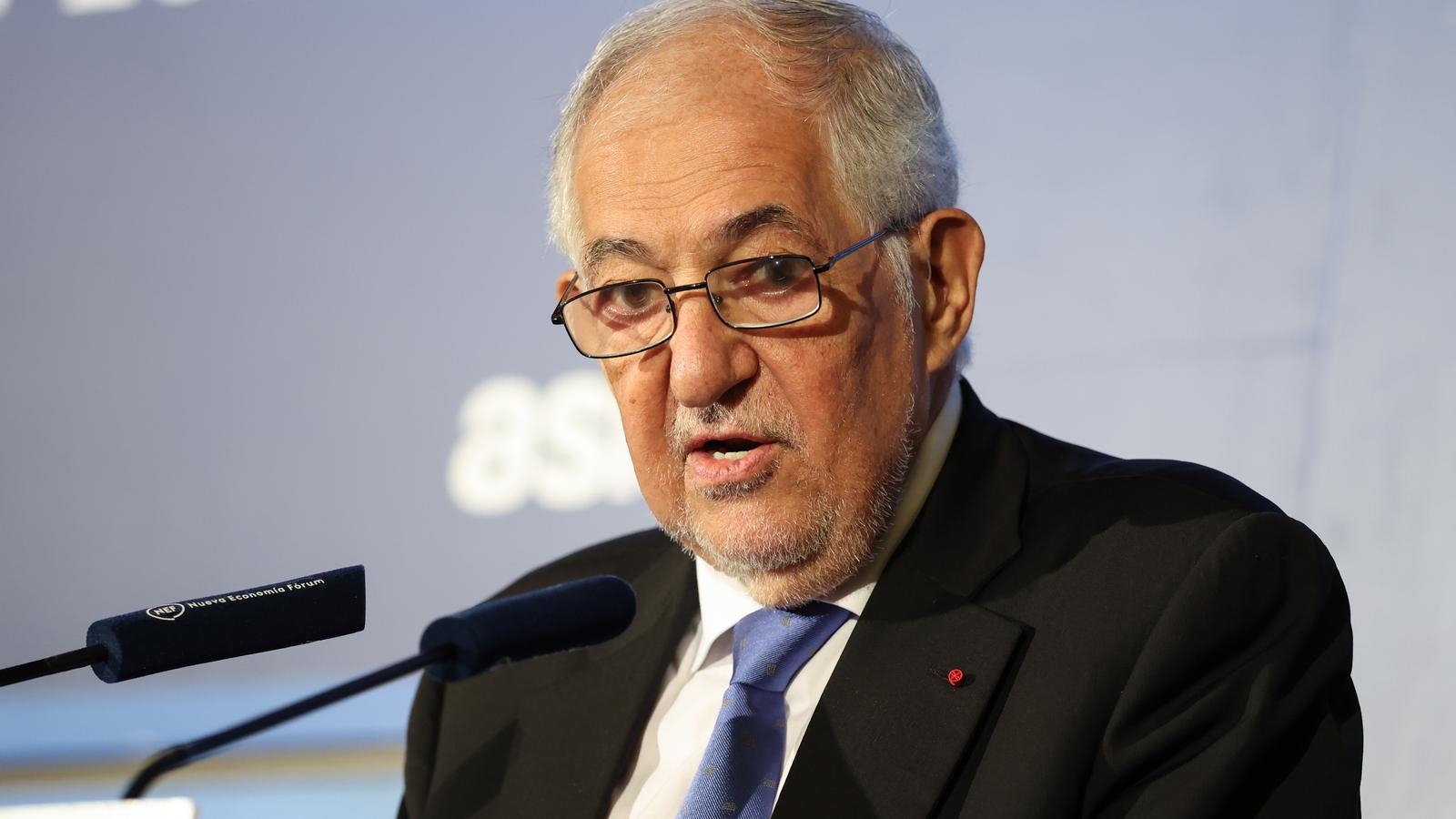
MadridWith the permission of the Ceuta crisis and the demands for the right to housing, the Constitutional Court is once again on the front page of political news. Next week it will approve the ruling that contradicts the Supreme Court's criteria regarding the amnesty law and will impose on the high court that it apply the pardon to the embezzlement attributed to the October 1st referendum. The proposal drafted by the president of the Constitutional Court, Cándido Conde-Pumpido, regarding Dolors Bassa's appeal directly orders the high court to backtrack and "declare amnestied" the crime of embezzlement in a "preferential and urgent" manner. Why was it so explicit? "From what I have read, at times the Supreme Court itself has stated that it would take into consideration the Constitutional Court's doctrine provided that the Constitutional Court had established a clear and precise doctrine. Therefore, we want to establish a clear and precise doctrine," argued Cándido Conde-Pumpido at a breakfast organized by Nueva Economía Fórum.
In this sense, he argued that the recovery of the violated fundamental rights – in the case of the leaders of the 'Procés', these will be the rights to effective judicial protection, to access public functions and positions, and to criminal legality – requires "pointing out" to the Supreme Court with "complete clarity" what the "content" of its decision is. This justification is not accidental. Twenty days ago, Pablo Llarena opened up to lifting the arrest warrant for Carles Puigdemont after the first pronouncement of the Constitutional Court. Sources with access to the Supreme Court consulted by ARA alleged that it would be necessary for the Constitutional Court's verdict to be very clear, contain a conclusion "extrapolable" to the leader of Junts, and have "constitutional expressions with repercussions and relevance" in his case. The first ruling will also allow for an end to the disqualification of Oriol Junqueras, Raül Romeva, and Jordi Turull.
Likewise, Cándido Conde-Pumpido has made it clear that the Constitutional Court will "immediately" communicate the ruling to the parties and to the Supreme Court, which will be in charge of "taking the appropriate decision" and making a move. Pablo Llarena could act ex officio on his own initiative or at the request of, for example, Gonzalo Boye, Puigdemont's lawyer. That said, Conde-Pumpido has avoided committing himself on the deadlines: "I am no one to say how long it will take the Supreme Court, it is their competence." And he has recalled that the TC's doctrine is "binding" for "all judges and courts" of the Spanish state. "When the Constitutional Court establishes a doctrine, it must be implemented," he said.
In the background, Josep Maria Jové and Lluís Salvadó are waiting for the Court of Justice of the European Union to rule on the preliminary question presented by the High Court of Justice of Catalonia regarding the amnesty. The TC's pronouncement could unblock a matter that has been frozen for more than two years.

Cándido Conde-Pumpido has defended the June 2025 ruling that upheld the constitutionality of the amnesty law. He was being listened to by the vice-president of the institution and rapporteur of that historic pronouncement, Inmaculada Montalbán. “We understand that we only fulfilled our obligation,” he defended. And he took the opportunity to make a “call” to the PP and the PSOE to reach an agreement to renew the Constitutional Court in the Senate, a pact that has been pending since December of last year. Four new magistrates must be appointed and, in fact, he is one of those whose mandate has expired. Once the body has been renewed, he will leave the TC and retire: “My intention is to withdraw into private life. I have no project to continue in any other body nor has anyone proposed it to me,” he said. However, the agreement seems distant and nothing suggests that it will arrive before the general elections.
The “rules of logic and common sense”
The words of Cándido Conde-Pumpido come three days after his draft ruling became known, to which ARA had access, and five days before the plenary session that must approve the sentence. The text, which will be approved next Tuesday, October 6, argues that pardoning embezzlement is “the only conclusion reconcilable” with the “rules of logic and common sense” and with an interpretation of the amnesty that “attends to its spirit and purpose” and its “own genesis”. It alleges that the “interpretation sponsored” by the Supreme Court is “clearly expansive” and is “opposed” to the “purpose and spirit” of the law. The draft speaks of an “internal contradiction” in the reasoning of Manuel Marchena, whom it accuses of making an “irrational” argument.
Also on the table will be the second draft ruling prepared by the conservative José María Macías. Its original wording shared the Supreme Court's criteria, but the progressive majority made him change it. High-ranking sources from the Constitutional Court argue that Cándido Conde-Pumpido decided to bring his text on the same day to “not waste any more time” and because his draft reflects more “faithfully” and in a more “convinced” manner the majority sentiment of the court.

