The first step for the State budgets fails: PP, Vox and Junts reject the path of stability in Congress
The Spanish government will move forward with the process to try to approve them anyway
-
CAT -
CAST
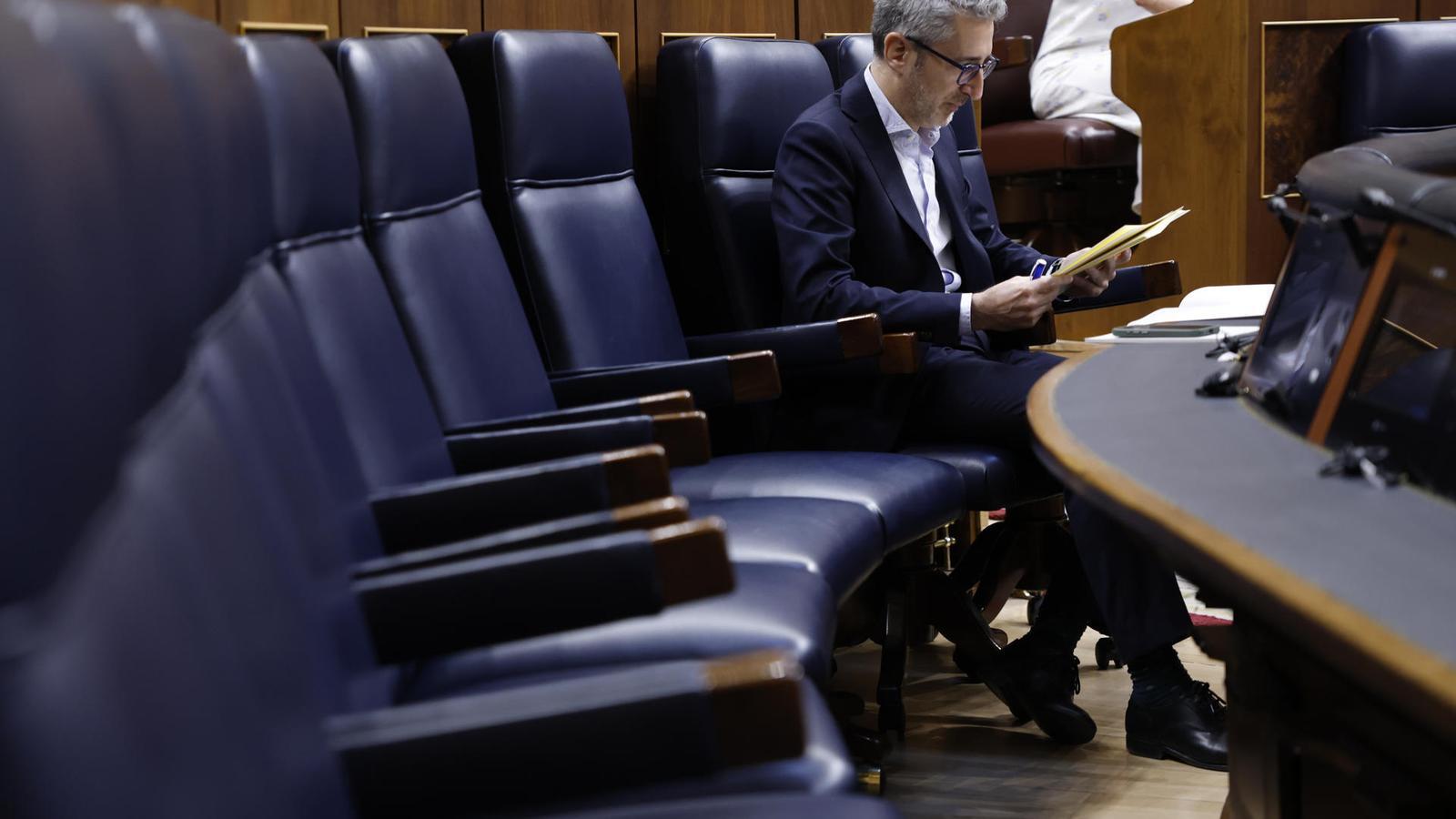
MadridA week after the Spanish government activated the mechanism to present State budgets for 2027, Congress has dealt a first blow to Pedro Sánchez's initiative. The PP, Vox, and Junts have rejected the stability route, one of the mandatory steps to bring the accounts to the Spanish chamber this autumn. However, despite this first parliamentary failure, the Spanish executive can still move forward with the process. And it will do so in the face of a defeat in Congress that at Moncloa they had already accepted and which will not alter their plans. "Some will try to present this vote as a victory or defeat for the government, but they are mistaken. The real question is whether the autonomous communities will have more resources," argued the Minister of Finance, Arcadi España, during the debate in the lower house.

What was voted on in the extraordinary plenary session this Tuesday afternoon are new stability objectives (deficit and debt), which give the autonomies more fiscal margin than they currently have – the Treasury estimates it at an additional 5,849 million euros. Sources from the Spanish government insist that PP, Vox, and Junts say "no" to "an improvement for the autonomies" and warn that they will be the main ones affected because "they will not be able to access borrowing capacity." Next week, in a new extraordinary plenary session, there will be a second and final attempt to approve the stability path. If it definitively lapses, as is foreseeable, the Spanish government will be forced to set the objectives of the previous budgetary year.
Spain's arguments have not convinced Junts, which maintains that the proposal "is once again a scam for Catalonia" and argues that the deficit authorized for the autonomous communities should be raised to 0.6% – the Spanish government's proposal is for it to be 0.1%. The Junts deputy Josep Maria Cruset has also criticized that activating this first step for the State budgets is a "marketing operation." According to Cruset, Sánchez's executive is "acting" because "everyone knows that they will not have budgets," as it does not have a parliamentary majority to push them through. "Stop deceiving people," the Junts deputy demanded.
In this regard, the PP deputy José Vicente Marí took advantage of the debate in the hemicycle to call for elections and stated that the "no" to the stability path is a vote against "the very existence of this incapable government." This was reinforced in the corridors of Congress by the spokesperson for the Popular Party in the lower house, Ester Muñoz, who described this first step for the presentation of budgets as a "smokescreen" and a "propaganda campaign." The PP considers that, after an entire legislature without public accounts, Sánchez's attempt to push some through almost on the eve of the next Spanish elections, with a weaker parliamentary majority than ever and amidst a earthquake due to judicial cases involving his circle, simply responds to the desire to seek an "excuse" to call the elections.
On the other side of the parliamentary spectrum, Podem – which abstained – has had a similar reading. In the opinion of the purple deputy Javier Sánchez Serna, the presentation of the stability path is "the starting gun for the PSOE's electoral campaign". The purple party has criticized that the Spanish government's announcements "continue to not reach the people". Other allies of the investiture who have guaranteed their "yes ", such as ERC, have warned Sánchez that they support it "without any triumphalism or satisfaction". "We do it angrily because it does not solve the underlying problem," said the deputy spokesperson for the Republicans, Teresa Jordà, who has lamented that "Catalonia continues to be underfunded".
