Treasury opens to negotiate a differentiated deficit target with the autonomous communities
Inform the counselors that initially it will be 0.1% for the autonomies, while it will allow them to spend 4% more resources

-
CAT -
CAST
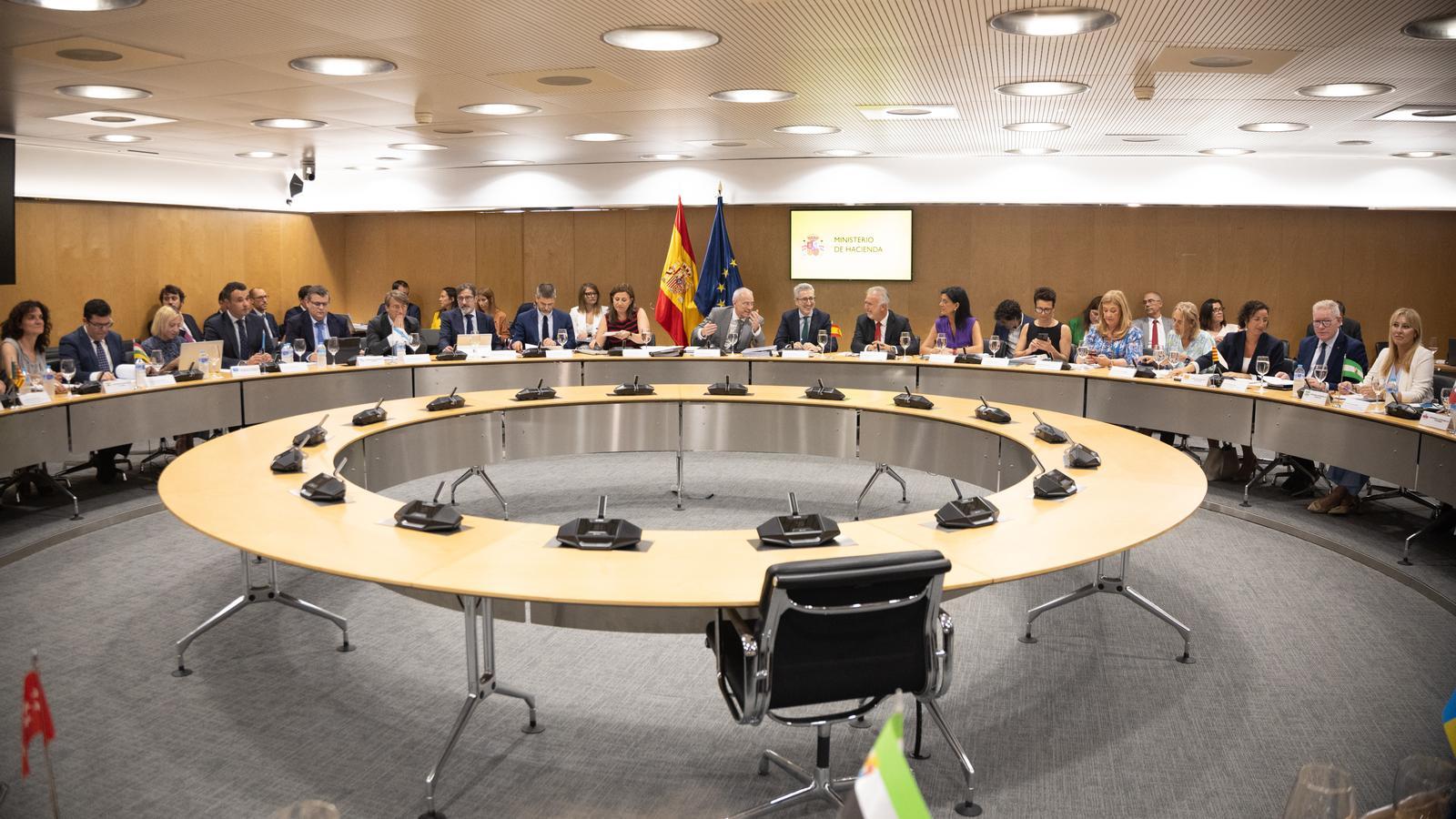
MadridLa Moncloa is determined to present the budgets for 2027 despite not having support in the Congress of Deputies. And, for this reason, it has already begun to take the necessary steps to bring the accounts to the Spanish chamber this autumn. The Minister of Finance, Arcadi España, met yesterday with all the Finance Ministers of the autonomous communities and conveyed to them the spending limits foreseen by the State government for regional and municipal governments throughout next year. They will have the possibility to spend up to 4% more, and this new spending rule will apply to all administrations, although it maintains the deficit margin for autonomous administrations at 0.1% of Spanish gross domestic product (GDP, the indicator that measures the size of an economy).
In relation to this, Minister Arcadi España announced a novelty: he opened himself up to “debating and establishing different deficit objectives, taking into account the differentiated situation of each one.” That is, that it is not a linear issue. In a press conference, he argued that this is not a new measure and that it was already done in 2013 during the PP government in the State. His argument is that now not all autonomous communities start from the same situation and that, therefore, it would be fair for them not to have to comply with the same deficit objective.
“It is a reflection that must be put on the table. It is an exercise in solidarity between the communities that need it and those that do not need it,” said the minister, who pointed out that there are autonomies that have closed 2025 with a surplus (like Asturias, with +0.51%); while others have done so with a large deficit, like the Valencian Country (-1.54%) and Murcia (-1.56%). It would therefore be for the communities to allow each other the possibility of incurring more deficit. If there were an agreement, a Council of Fiscal and Financial Policy would have to be convened again. That is, from the outset, the announced 0.1% is set in stone.
Alícia Romero, in statements to the media, received the ministry's proposal with satisfaction, but avoided specifying what target would be appropriate for Catalonia, which closed 2025 with a deficit of 0.54% of GDP. In fact, this is one of the issues that the president of Esquerra, Oriol Junqueras, demanded in a press conference yesterday, arguing that if the European Union differentiates deficit targets by territory, the Spanish state can also do so. And, according to sources consulted by ARA, it is one of the issues that the Republicans have been working on with the Treasury in recent days.
The rest of the autonomous communities did not receive it the same way. "We are a unitary state, there cannot be second-class and first-class citizens," said the head of Extremadura, Elena Manzano, while the harshest was the Andalusian, Carolina España: "To favor separatism is a purchase of votes with public money, it is a form of corruption."
The Spanish government asks to make use of the data communicated to the autonomous communities, the majority of which – governed by the PP – have opposed the stability path. The Treasury points out that the income that the general State administration will transmit to the governments of the communities will rise up to 8% due to the increase in collection (counting the settlements of the financing system and the advance payments).
"The communities will receive the largest amount of resources in their history," remarked España at a press conference, who accused the autonomies of not spending the money where it should be: "Are they using this money to make tax cuts?" she asked herself, while ministry sources ask to include in the debate not only the income of the communities, but also the expenses, since they accuse the PP communities of lowering taxes and then blaming the Spanish government for the state of public services.
A vote doomed to failure: Junts opposes it
Moncloa's intention is to approve the spending ceiling and also the budgetary stability objectives today in a cabinet meeting to bring them to a vote in Congress this July, once it has already passed through the Council of Financial Policy. With what perspective? Of failure.
Junts has already said it would vote against it because "it does not provide the economic resources corresponding to the Generalitat and Catalan municipalities". "If the Spanish government makes the same proposals as in previous years, it will obtain the same result and they will not be able to count on our vote. The PSOE persists in its error," assure sources from Junts.
"These fictitious budgets are a smokescreen to cover up the serious problems that plague the Sánchez government," they add. Junts had previously said that if there was no more room for the autonomies, their position would remain no, as they already did last year. did last year.From the group led by Miriam Nogueras, they point out that more deficit margin should be left to the autonomous communities and municipalities, which are obliged to have a deficit of 0: sources from Junts criticize that the general administration of the State keeps the largest spending margin –1.6% of the total of 1.8% set by Brussels, as 0.2% goes to Social Security– even though it does not cover most of the welfare state services.
The Ministry of Finance warns of the consequences of the announced failure of the vote on deficit targets. It emphasizes that, translated into figures, 0.1% implies being able to spend 5,849 million euros more without having to balance the budget. If this is not approved in the Spanish chamber, they warn, the communities will have to comply with a deficit of 0. A threat that, for now, does not change Junts' position.
What, then, is the fate of the deficit targets? Once they are rejected in Congress, presumably in an extraordinary plenary session on July 14, the Spanish government will bring them back for a second vote, presumably in another extraordinary plenary session on July 23. Two essential steps to continue with the preparation of the budgets. Subsequently, it would be the turn to approve them in the cabinet and initiate the processing in the Spanish chamber. Publicly, Minister España limited himself to saying that they will continue negotiating with all parliamentary groups.
The PP doesn't believe it
In Génova, they do not believe the Spanish government's attempt to move forward with a budget. "We will not participate in this discursive pantomime," said spokesperson Borja Sémper, who considered it all a "trick" by the Spanish government despite knowing that these are "unexecutable" accounts because it lacks the support of its partners. According to the Popular Party, these accounts will only serve for Sánchez to have an excuse to call elections once Congress rejects them. On the other hand, Esquerra Unida trusts that Pedro Sánchez will roll up his sleeves so that the future general budgets receive the green light. However, at Moncloa, they know that the future of the budgets – if there is no 180-degree turn – is written.
